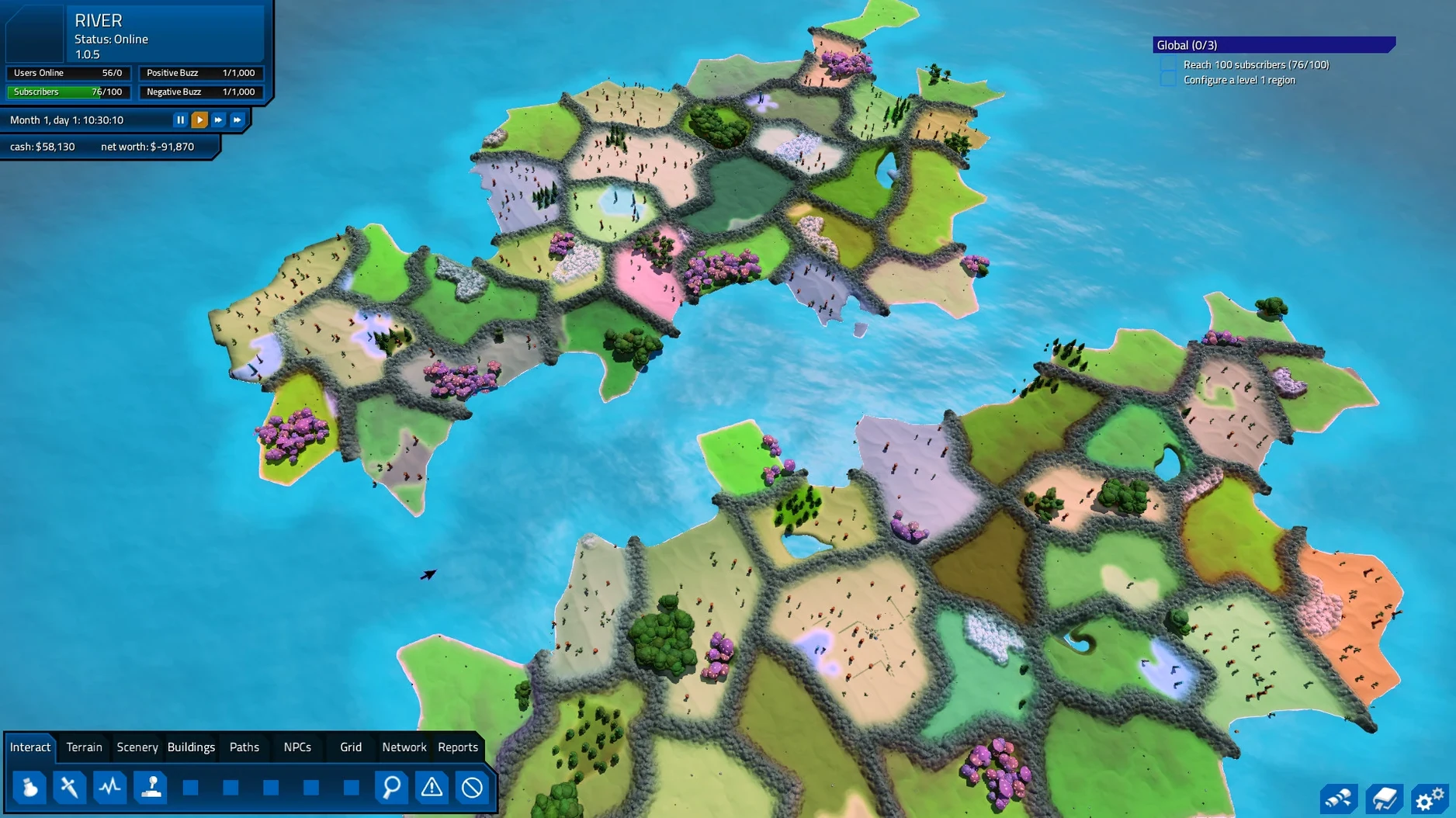
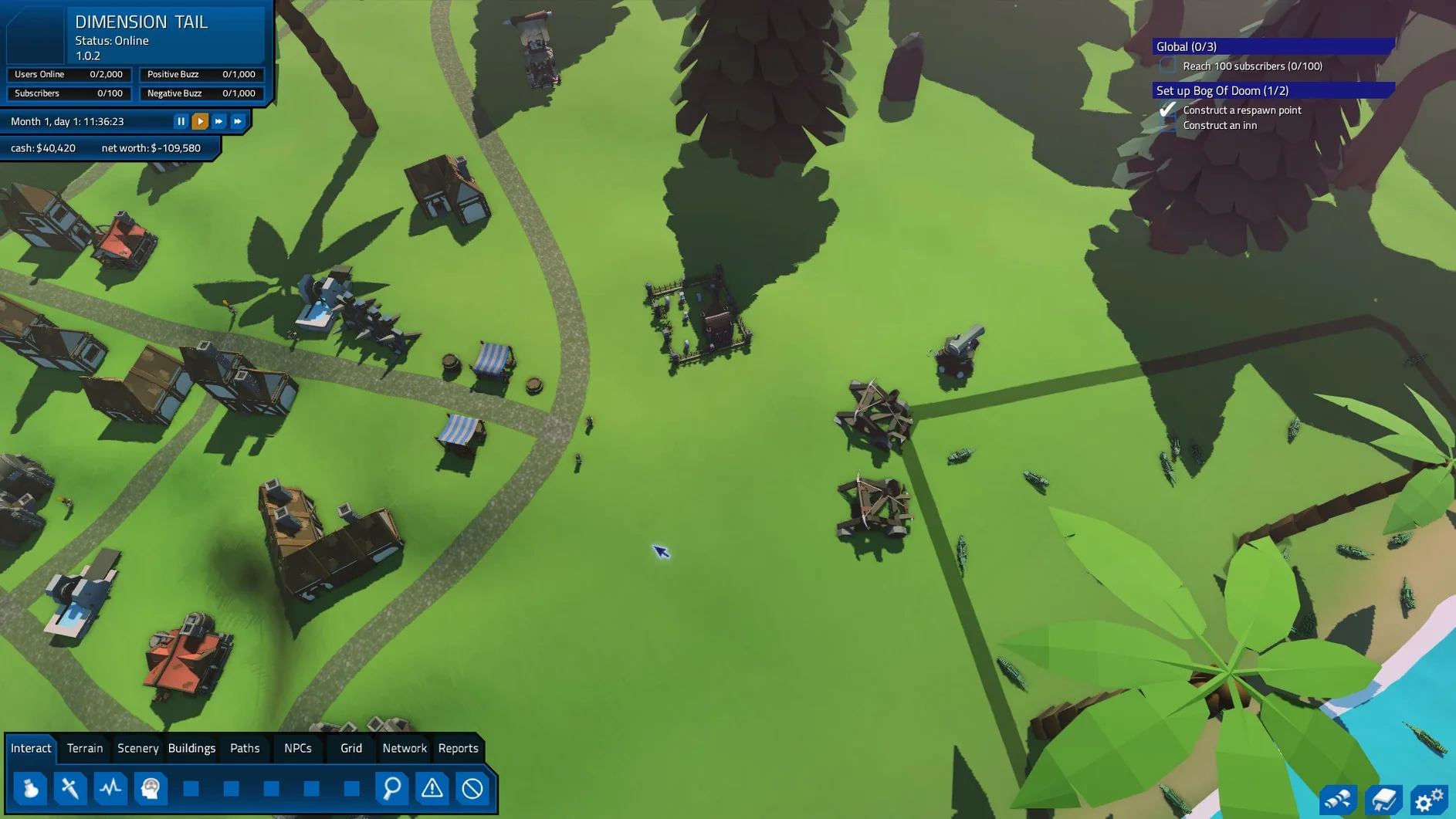
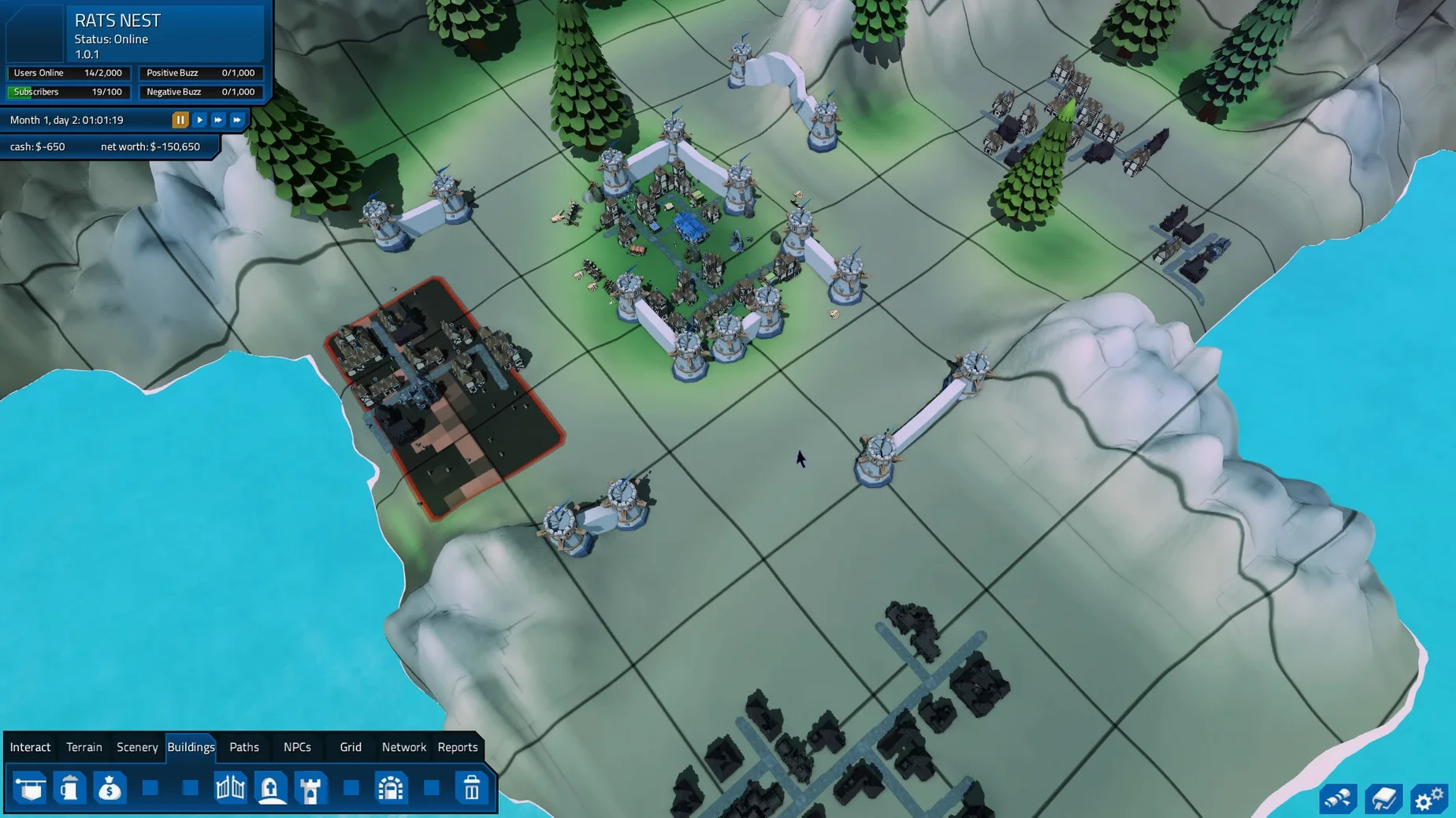
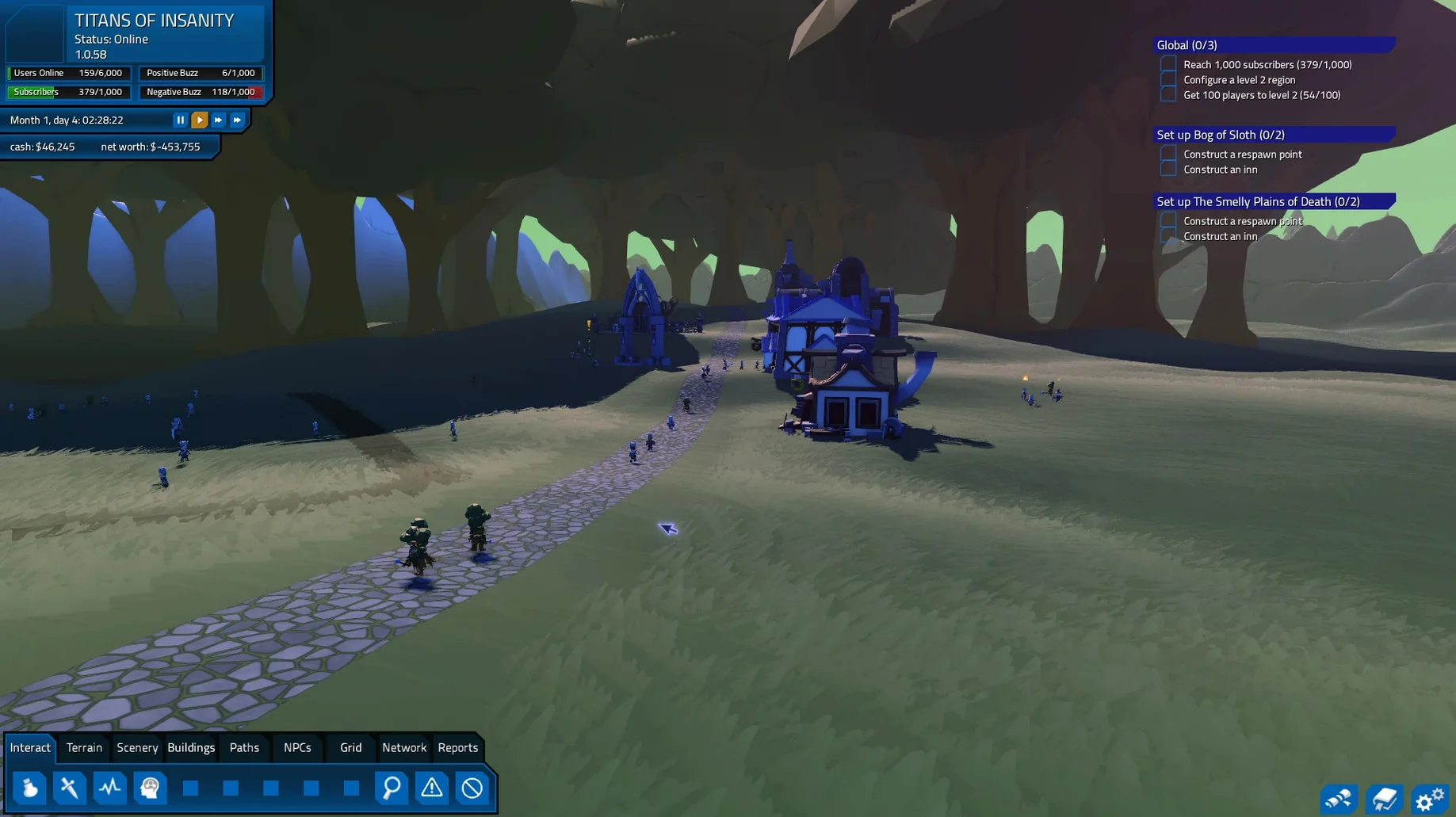
MMORPG Tycoon 2 is for the player who has spent more time thinking about zone flow and quest chains than actually grinding for loot. It hands you the tools of a game director rather than a character sheet, letting you sculpt terrain, place scenery, and populate a continent with monsters, towns, and NPCs before you ever open the gates to your imaginary subscriber base. If you find spreadsheets soothing and get a quiet thrill from watching crowd behaviour emerge from rules you set, there is a lot here to lose an evening to.
The loop is gentle but absorbing. You carve out starting areas, balance monster difficulty so new arrivals are not instantly flattened, and thread together quests that guide players naturally toward higher-level regions. The simulated adventurers have their own rhythms — some will explore, some will cheat, and a few will be awful to each other in chat, at which point the moderation tools become a strangely satisfying part of the workflow. It is less about winning than about tuning a system until it hums.
Players who need a clear victory condition or a tight narrative arc may drift away. There is no end boss, no final upgrade that rolls credits. The game is a sandbox of interlocking systems, and its rewards are the small dramas that unfold when your world design clicks and a zone you built from scratch suddenly teems with life. It suits a mood of unhurried tinkering, the kind where you notice a pathing problem at midnight and fix it because you want to, not because a quest marker told you to.
Alongside other management sims on the Mac
Where something like Parkitect asks you to obsess over coaster throughput and litter-bin placement, MMORPG Tycoon 2 shifts the focus toward behavioural systems. You are not managing physical infrastructure so much as social and mechanical balance — the equivalent of tuning drop rates and patrol paths rather than plumbing. That makes it feel closer to a god game with a spreadsheet heart, though it lacks the narrative scaffolding of a RimWorld or the visual polish of a Two Point title. The trade-off is a design space that can surprise you; an evening spent tweaking monster aggro radii might accidentally create a choke point that becomes the subscriber base's favourite grinding spot.
OpenTTD scratches a similar logistical itch on the Mac, but it deals in cargo and timetables, not player classes and quest chains. MMORPG Tycoon 2 gives you a more character-driven sandbox, even if those characters are only simulated. The social layer — cheaters, stuck adventurers, the quiet hum of an economy you barely realise you have tuned — is what sets it apart from pure transport or city builders.
Performance and daily feel
On an Apple Silicon machine the simulation stays responsive well into the mid-game, with frame pacing that holds steady even as subscriber counts climb. The terrain editor and building placement feel immediate, with no perceptible lag when dragging scenery across a region. On Intel hardware the experience is similar, though fan noise kicks in sooner once the pathfinding calculations stack up — still entirely playable, just warmer.
Memory use sits modestly for a simulation of this scope, hovering in the low hundreds of megabytes during normal play. I have left it running while switching between a DAW session and a writing sprint, and returning to the open world never triggers the beachball. Crashes were rare in this build, and the recent fixes to dungeon destruction and region-editing travel planning mean the late game, when zones are dense and overlapping, no longer feels fragile. Stability has been a quiet strength, which matters in a game where you might spend four hours sculpting a quest chain that only half your simulated players will ever find.
- macOS (tested on macOS Tahoe with a Mac mini 2024 M4)
- Apple Silicon and Intel 64-bit systems