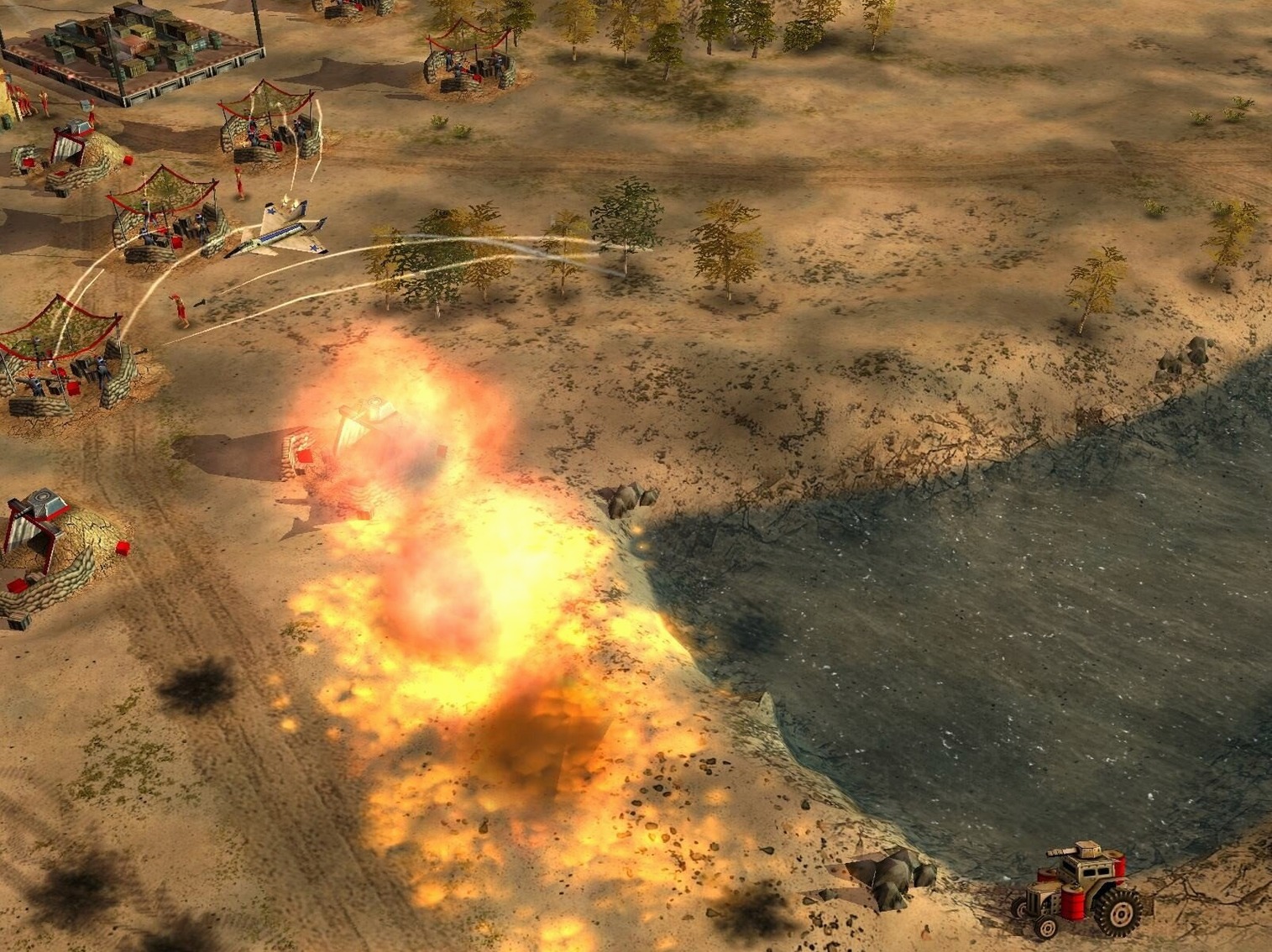
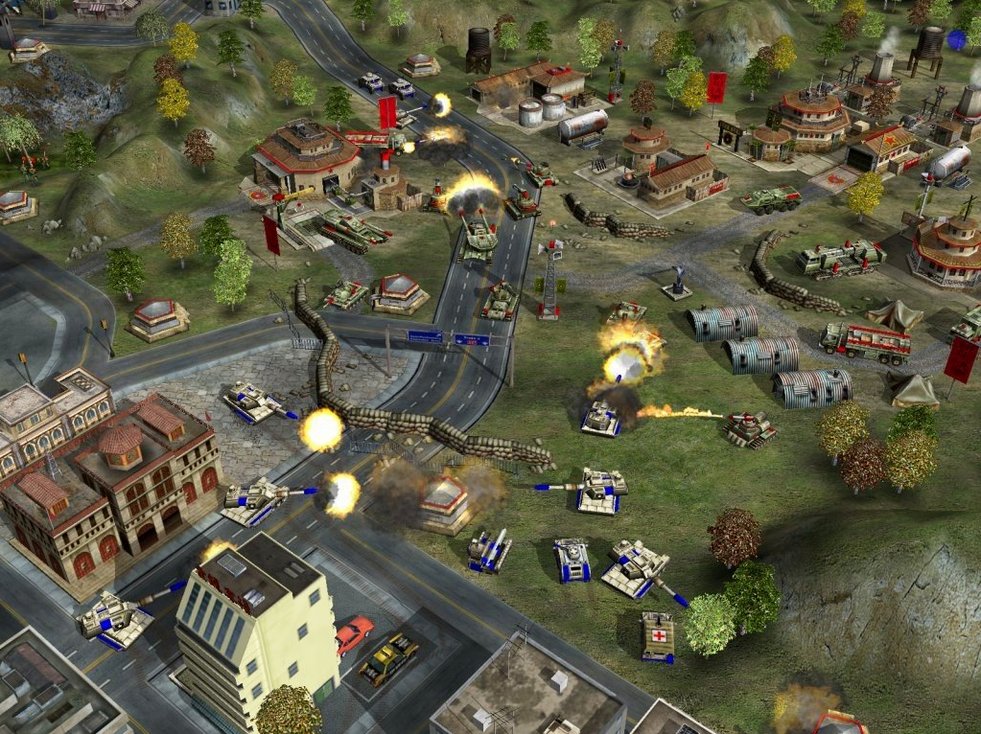
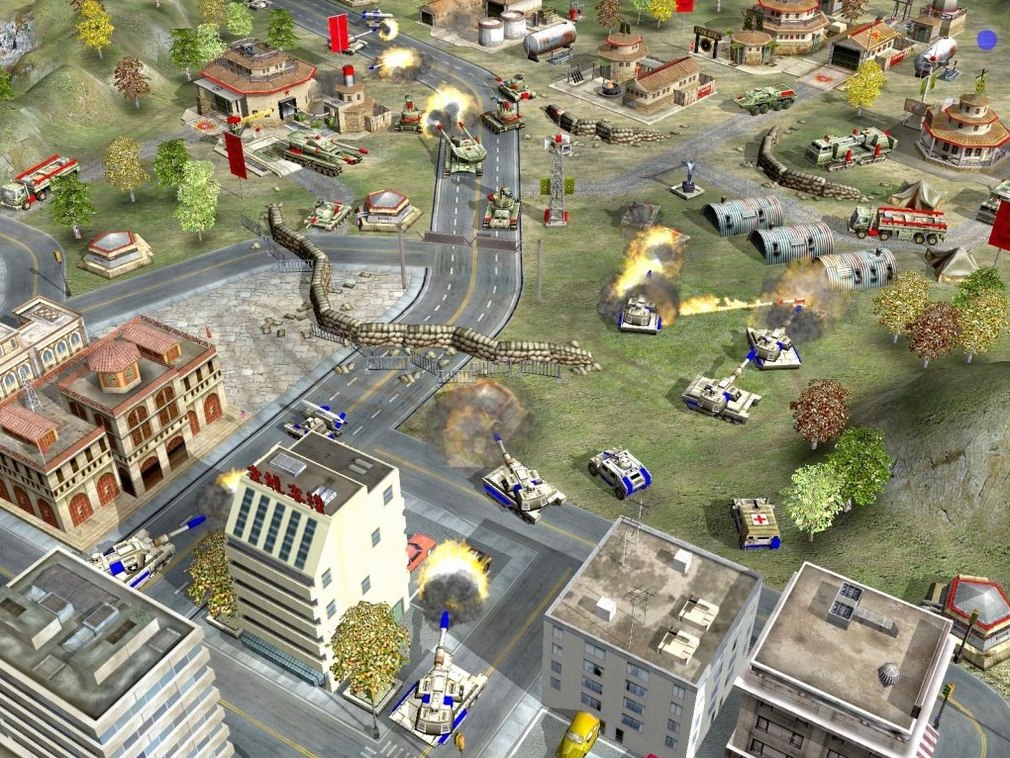
Laser turrets humming to life while a fuel-air bomb splits the screen—Zero Hour starts where the original ended and hands the war over to individual personalities instead of a generic superweapon timer.
Generals system — the Super Strike ability is gone; each faction now picks a named general with a unique doctrine. The Air Force General deploys King Raptors and stealth Comanches but fields no tanks. The Toxin General coats the map in anthrax and armours tractors. Every match unfolds differently because the commander shapes the tech tree before the first structure is placed.
Economy — supply docks and oil derricks keep the loop simple. Build a dozer, drop a supply centre, protect the chinook runs. Cash arrives in steady ticks, so the pressure comes from spending it wisely, not from managing complex production chains.
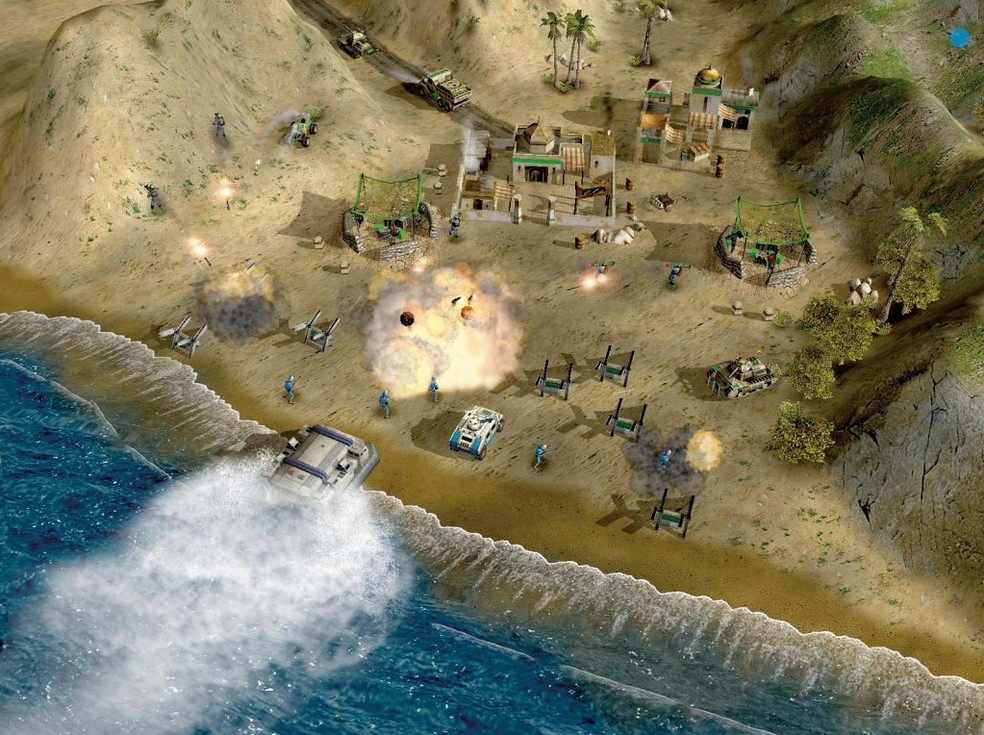
Missions — some scenarios hand you a full base; others drop a handful of infantry behind enemy lines and ask you to survive long enough to capture something that turns the tide. The Gulf War aesthetic pushes through sandstorms and satellite uplinks, while the new units—sentry drones, battle buses, microwave tanks—make each faction feel physically different under the mouse.
How the Wineskin build holds up
The 1.04 package runs through Wineskin, which means a brief wait on first launch while the wrapper initializes. After that, skirmish loads clock in under twelve seconds on the M1 Air it was tested on—faster than many native strategy ports from the same period. The translation layer introduces a tiny input lag, maybe two frames, but Generals has always been a game of positional decisions rather than twitch reflexes, so you adjust without thinking about it.
Memory use sits around 600 MB during a full eight-player skirmish with all particle effects active. The fan on an M1 Air stays silent through the first hour, then barely audible once the unit count crosses three hundred. That quiet operation changes the experience more than you would expect—you hear the soundtrack properly, the radio chatter and the distant thud of artillery, without a cooling whine underneath.
Stability is the nicer surprise. The original Windows release had a reputation for desyncs in multiplayer and occasional crashes when too many GLA demolition charges triggered at once. The Wineskin wrapper seems to iron out the worst of that. A four-hour session cycling through all three factions, loading saves and alt-tabbing to notes, did not produce a single crash. Quick-loading feels instantaneous, and the cursor never locked up after a resolution change. If you play single-player, the technical friction is close to zero.
One quirk worth knowing: the wrapper defaults to a fixed resolution that matches the MacBook Air display well, but external monitors sometimes need a trip to the in-game options. Set it once and it sticks.
What the Zero Hour expansion actually changed
The jump from vanilla Generals to Zero Hour is not a map pack. It rewires how you think about the opening two minutes. Replacing the Super Strike with named generals means you choose a weakness before you place a dozer. The Air Force General cannot build a tank—not a light one, not a heavy one, nothing with treads. If the map has choke points that armour would hold, you hold them with helicopters and hope the opponent did not bring quad cannons. That kind of trade-off did not exist in the base game.
The new units fill gaps that used to require awkward workarounds. China gets the battle bus, a transport that turns into a fortified bunker when you garrison it with tank hunters. GLA adds the combat bike, fast enough to scout but fragile enough that you feel every loss. The USA fields sentry drones that reveal stealth units—a direct answer to GLA tunnels that used to be invisible death traps. These are not cosmetic additions; they change the counter-pick dance that starts the moment you see the loading screen faction icons.
Mission design shifted too. The original campaign moved from base-building to base-building. Zero Hour includes infiltration missions where you control a squad and nothing else—no dozers, no supply docks, just the units you have and whatever you can capture. It brings the pacing closer to a real-time tactics game for those stretches, and the shift makes the full-base missions feel larger by contrast.
Players who treat skirmishes like story generators
The Mac user who gets the most out of Zero Hour is the player who treats an RTS like a short story generator. You are not optimizing a build order to shave three seconds off a tank rush; you are watching a toxin tractor dissolve an infantry column while a scud storm comes in sideways and the screen shakes. The simplified economy means you reach the dramatic moments faster. If you play games to feel a narrative emerge from systems, this version delivers that in twenty-minute bursts.
Strategy archivists get a lot from it too. The game sits at a pivot point—after the resource complexity of StarCraft but before the cover-and-squad mechanics that would dominate the next decade. Playing it now, you can trace how RTS design shed economic micromanagement in favour of unit interaction, and Zero Hour is the clearest expression of that shift. The generals system previews hero-centric design without ever giving you a single overpowered unit to babysit.
Players who want a competitive ladder will feel the absence. The Wineskin build focuses on single-player and LAN, not ranked matchmaking. If you need a leaderboard and a meta to chase, this is the wrong package. Likewise, anyone who dislikes early-2000s pathfinding should know that units still take odd routes around cliffs and occasionally bunch up at bridges. The charm is in the chaos, not the precision.
Where new players stumble
The most common beginner mistake is treating dozers as an afterthought. In Zero Hour, a single dozer builds everything, and losing it early to a sneak attack means you sit idle while the opponent's base doubles in size. Build a second dozer before your first power plant finishes, and park it somewhere your main force can reach in ten seconds. It feels wasteful until the first technical rolls through your supply line.
Another trap is ignoring the generals' passive abilities. The Laser General's point-defence turrets shoot down incoming rockets automatically—new players often build redundant anti-air because they do not notice the lasers are already doing the work. The Toxin General heals units in contaminated ground, which sounds like flavour text until you park a battle bus on a poisoned patch between fights and watch its health tick back up. Read the general description before you place your first structure; it is not background lore, it is the rulebook.
Overbuilding supply centres is a quieter mistake. The economy ticks per second, not per structure, so a fourth supply dock adds nothing except a bigger target for artillery. Two centres protected by overlapping defences will fund a full army. Spend the extra cash on units that can take the next oil derrick instead.
Finally, using the command and conquer generals torrent or a c&c generals torrent that bundles mismatched Wineskin versions can introduce weird audio bugs—missing voice lines, doubled-up music tracks, briefing screens that skip. The command and conquer generals zero hour download torrent that matches the tested 1.04 build avoids those headaches. A clean generals torrent with the proper wrapper is the difference between spending an evening in skirmishes and spending it troubleshooting ini files.
Version 1.04 delivers the full standalone expansion, bringing fresh missions and scripted events that extend the original campaign. All three factions receive new units and buildings—sentry drones, battle buses, and microwave tanks among them—while the old Super Strike mechanic makes way for a roster of distinct generals, each with their own doctrine and limitations.
- Architecture: Intel (x86, 64-bit)
- Tested on macOS Monterey
- Tested on MacBook Air (M1, 2020)
Questions from the booth
It is a standalone expansion, so you can play it without the original Command & Conquer: Generals installed.
Each player picks a named general instead of a generic faction, which replaces the old Super Strike with unique units and tactical restrictions that force different build orders.
No, several missions drop you into the field with a small force and no base, asking you to capture objectives with what you have.