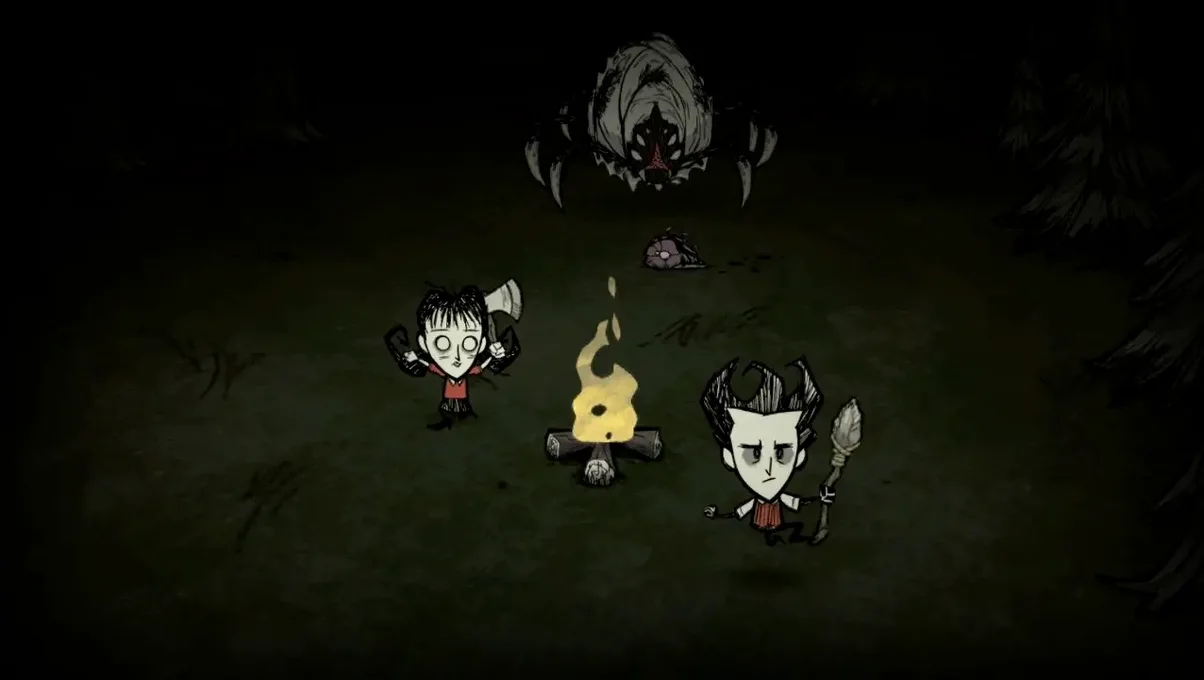
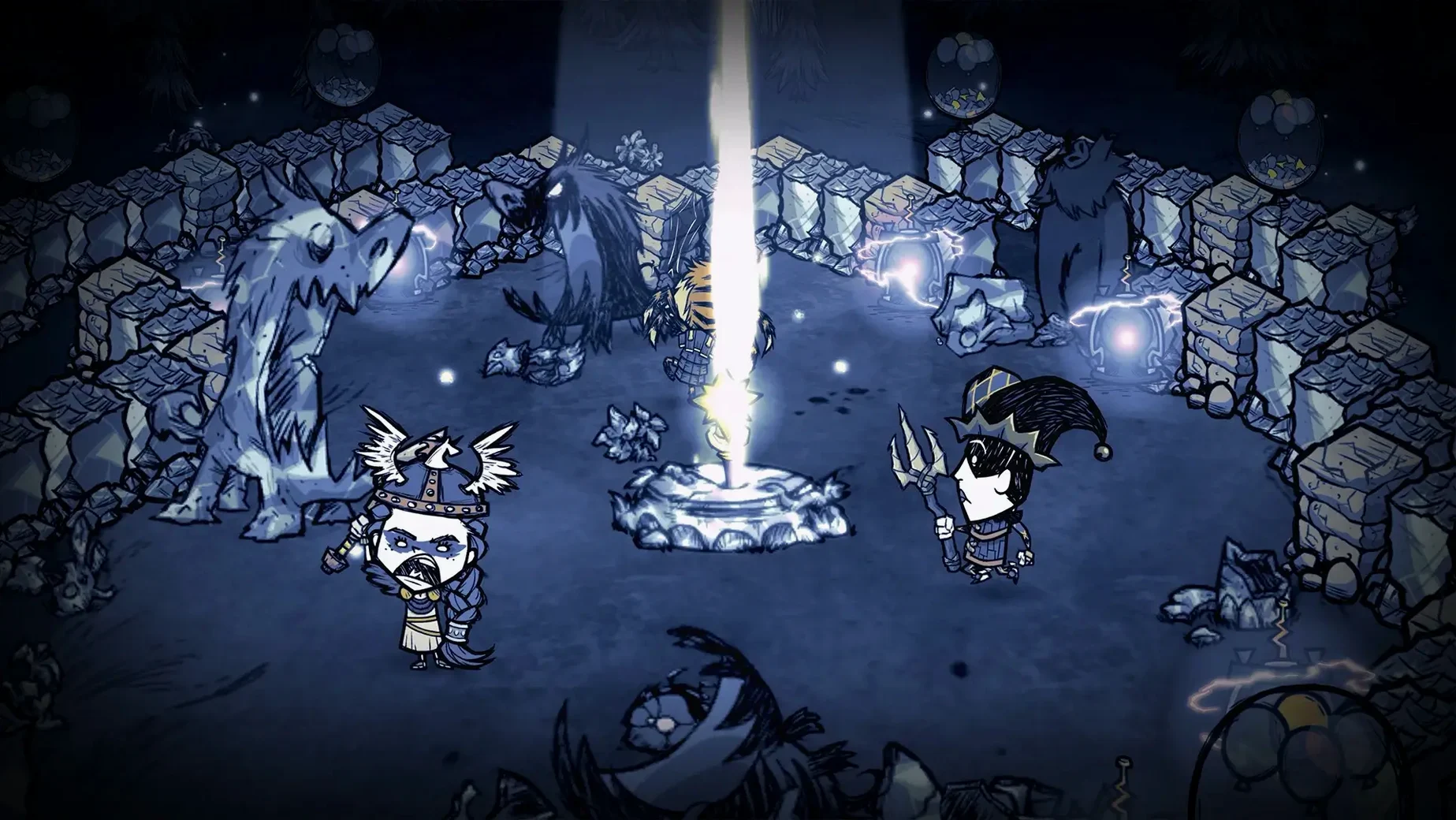
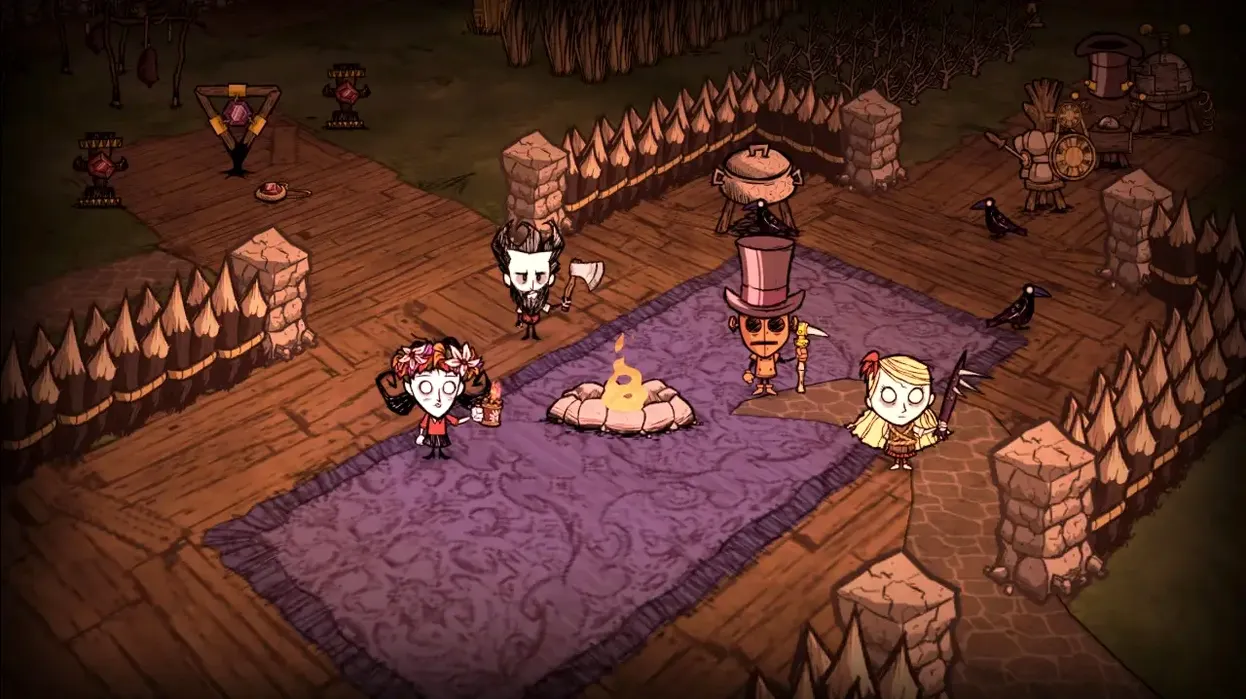
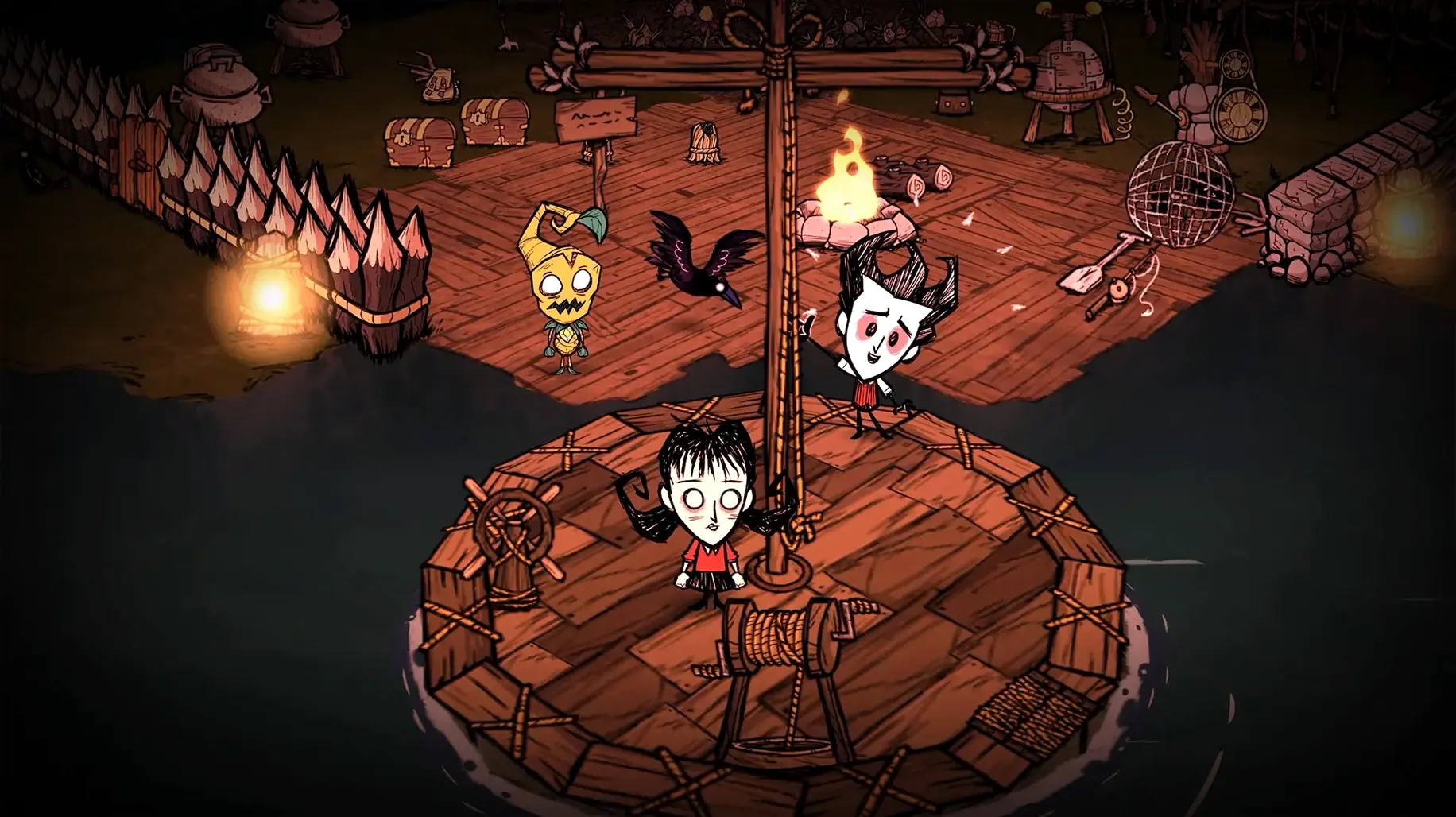
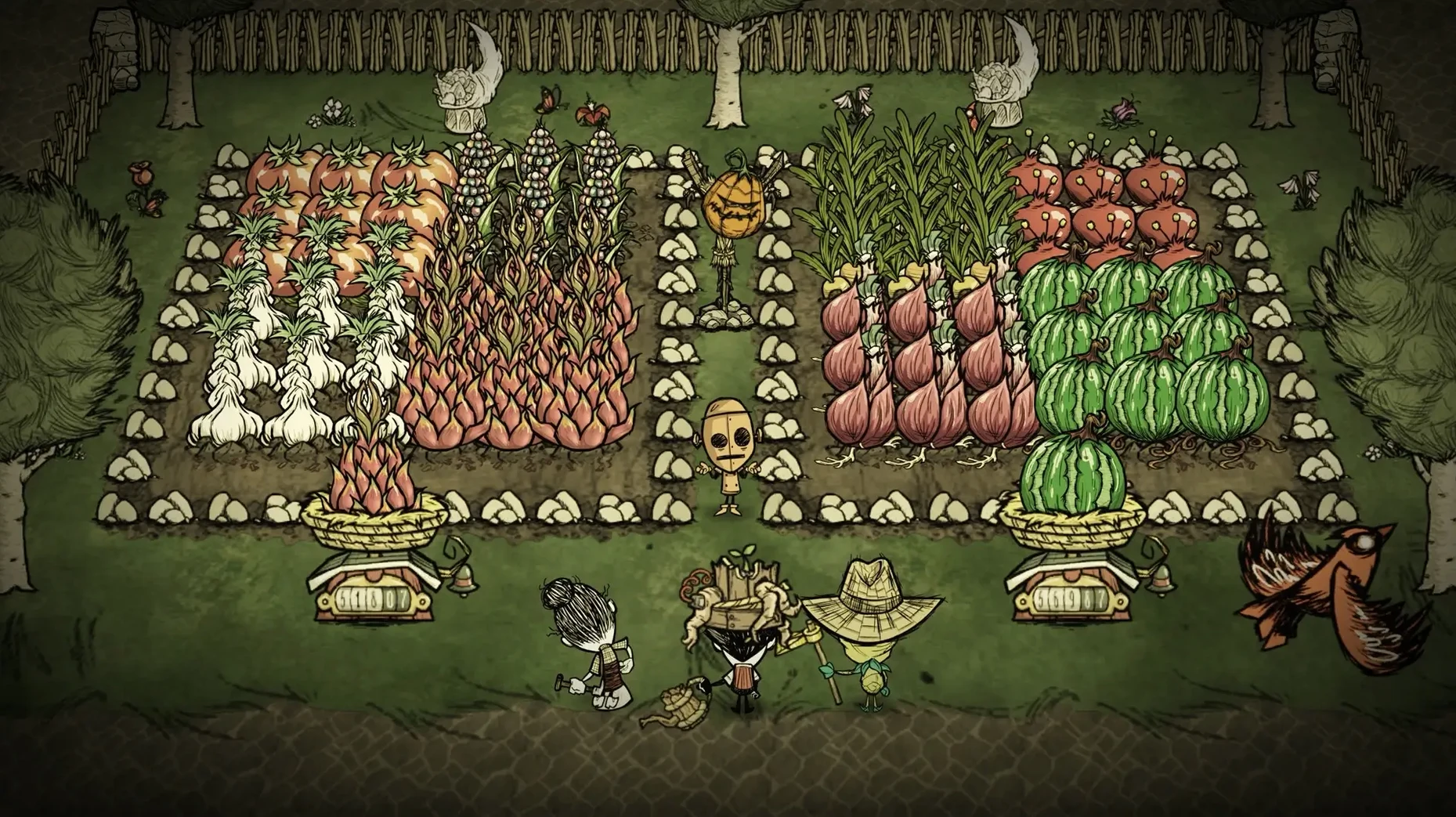
Your friend picks a spot by the savanna for its rabbit holes and beefalo herds; you head into the marsh, drawn by the promise of reeds and a touch of danger. Before the first night falls, you are both scrambling to pool enough grass and twigs for a fire that will keep the darkness at bay.
Shared wilderness — A procedurally generated map that every player inhabits together, from the mosaic of rocky biomes to the wormhole-linked swamps. Resources, threats and the turning of the seasons affect everyone at once.
Cooperative survival — The core loop is about dividing labour: one person farms and cooks while another scouts for clockwork monsters or descends into the caves. Death is not the end for a group that knows how to revive a fallen teammate with a telltale heart.
Standalone expansion — This is the full multiplayer experience built from the world of Don’t Starve, not a mode bolted onto the solo game. It runs natively on both Apple Silicon and Intel Macs, with its own set of characters, seasonal giants and an endless night that arrives if nobody prepares.
One copy per player, even on the same couch
Most people want to know whether a friend needs the same setup, or whether one copy on a Mac is enough. The short answer: everyone joining a world runs their own copy of Don’t Starve Together. It is a standalone multiplayer game, so it does not piggyback on the original Don’t Starve, and it does not require activation to get into a session. If you are both on Macs, things are simple; a mixed group with Windows or Linux players works too, because the game matches across platforms through the same server system.
Another common question is whether the world persists between sessions. It does, as long as the host keeps the same save slot. The seasons roll on, structures stay where you left them, and a hound attack that ruined your evening will still be waiting in the world’s memory when you return. That persistence is part of why some groups end up with a long-running camp that feels less like a match and more like a shared place.
People also ask about performance on older Macs. The art style hides a fair amount of simulation — item decay, creature pathing, weather, fire spread — but the game has been running on modest hardware since its original release. On Apple Silicon it is comfortable, and on older Intel machines the biggest strain tends to come from dense player-built camps rather than the wilderness itself.
A full evening: from spawn to first winter
A good first session covers more ground than people expect. Start by agreeing on a meeting point as soon as you spawn, usually near the nearest road or a distinctive biome edge. One player gathers grass, twigs and flint while the other scouts the perimeter and marks interesting spots. By the end of the first day, you want a science machine, a couple of crock pots and a fire pit — nothing grand, just enough to survive the night with a plan forming.
On day two, split the work properly. The player who enjoys combat baits a clockwork rook into a forest to harvest wood in bulk; the other digs up berry bushes and saplings to replant near camp. Come evening, the cook turns monster meat and three berries into meatballs while the builder crafts a lightning rod and a few chests. The rhythm builds from there: hound waves interrupt the routine, seasons shift the food sources, and winter pushes everyone toward thermal stones and beefalo hats well before the first snow arrives.
Runs native on Apple Silicon, no Rosetta needed
The game behaves like a good citizen of macOS for the most part. It supports both Apple Silicon and Intel 64-bit Macs, so Rosetta is not part of the equation on newer machines. The interface comes in English and Simplified Chinese, which covers a lot of co-op pairs who might otherwise rely on a patch. The soundtrack is wordless, so the language setting stays out of the way during play.
It also plays well with other Mac habits. If you keep voice chat in a separate app, the game does not fight for the microphone. If you record clips for a group highlight reel, the windowed mode and shortcut-based capture tools get along fine. A few players run the game alongside a note-taking app or a drawn map on a second display, which suits the slow-burn planning style the game encourages.
There is a version of this experience people hunt for under phrases like don't starve torrent or don't starve mac download, expecting a stripped-down solo build. What those searches usually want is exactly what the standalone multiplayer expansion already provides: a complete, self-contained Don’t Starve world that runs on a Mac without needing the original game installed. The co-op layer is not an afterthought; it is the whole structure, and it holds up even when only two people share the map.
- Runs natively on both Apple Silicon and Intel Macs.