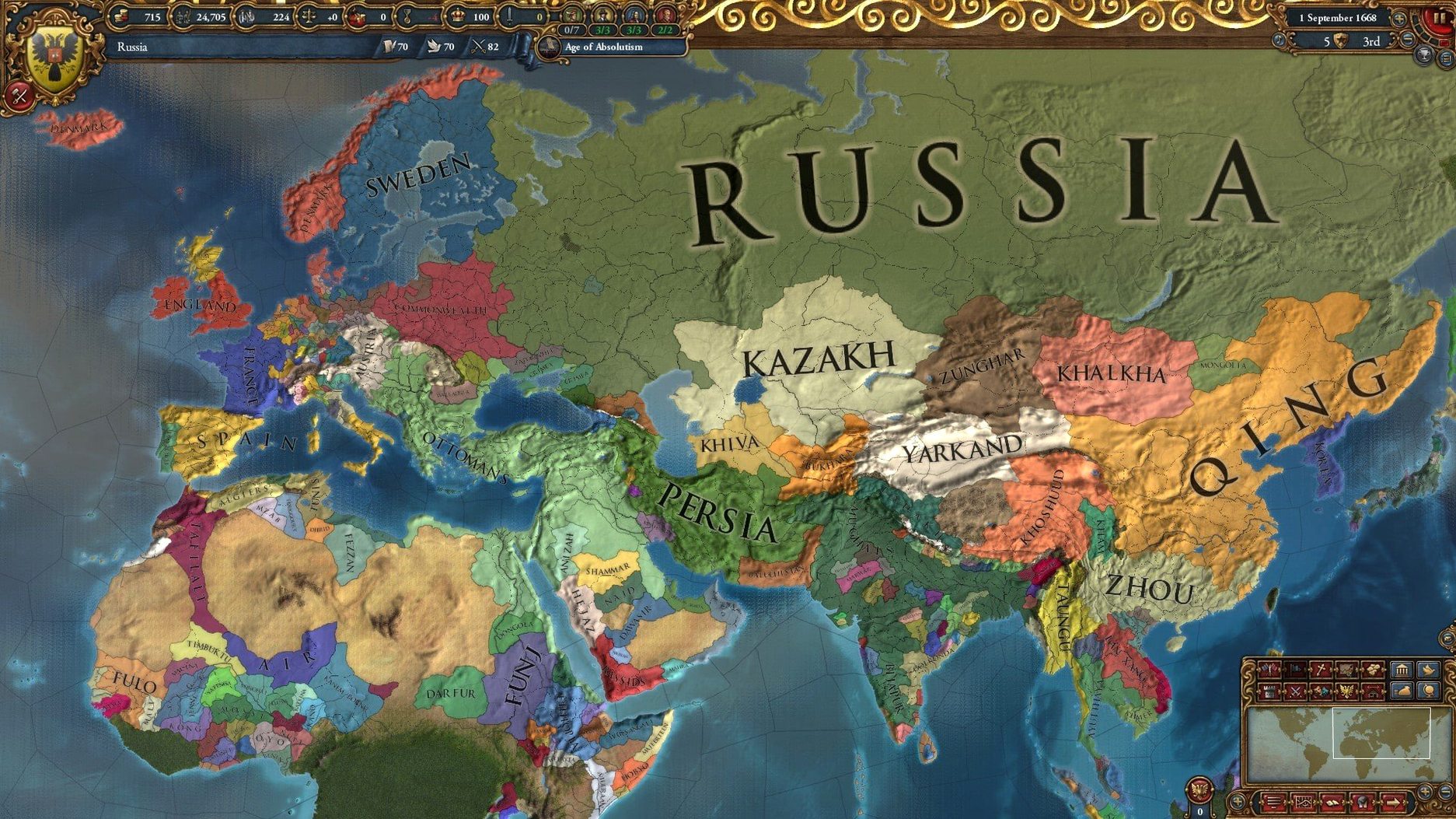
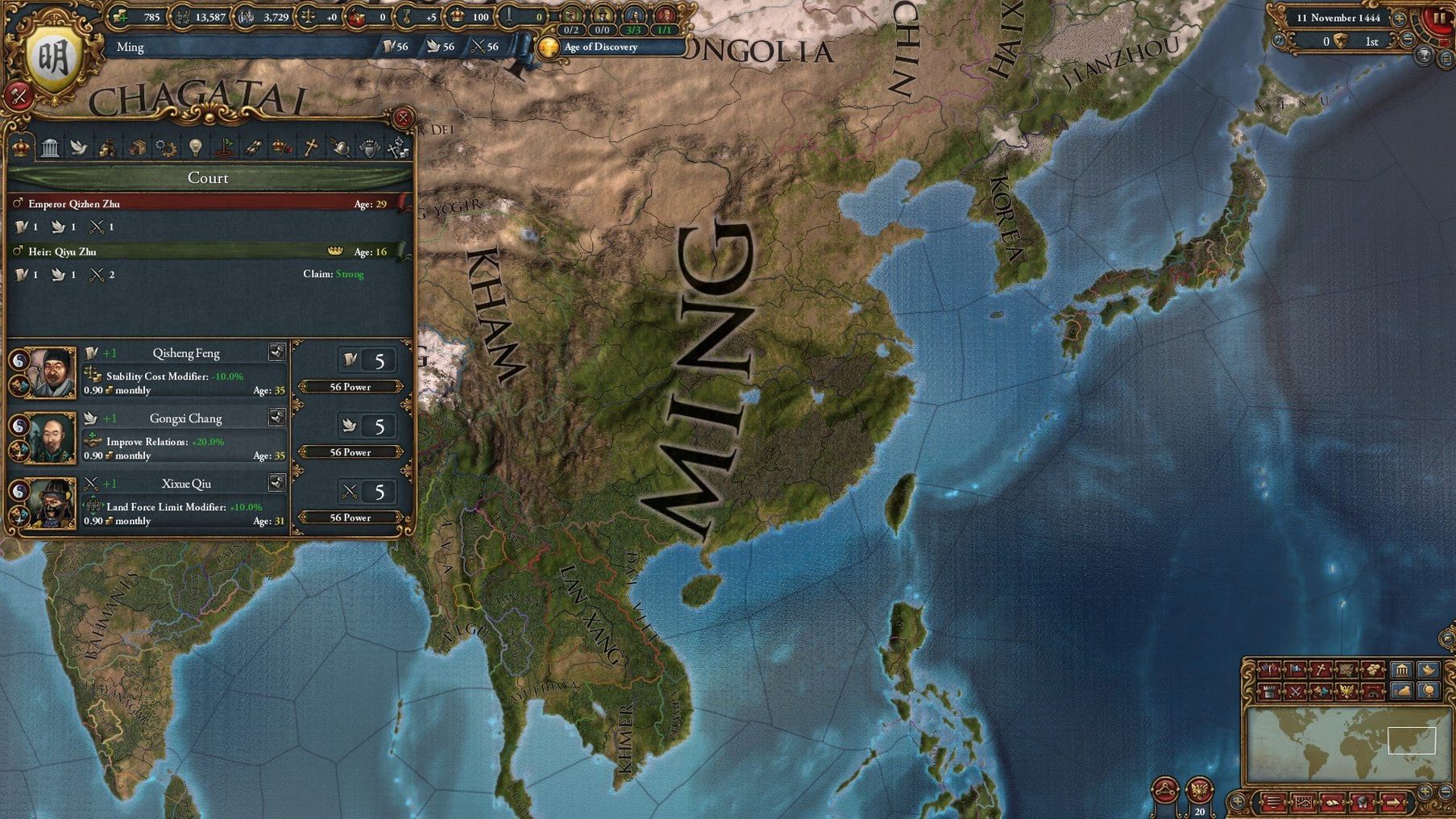
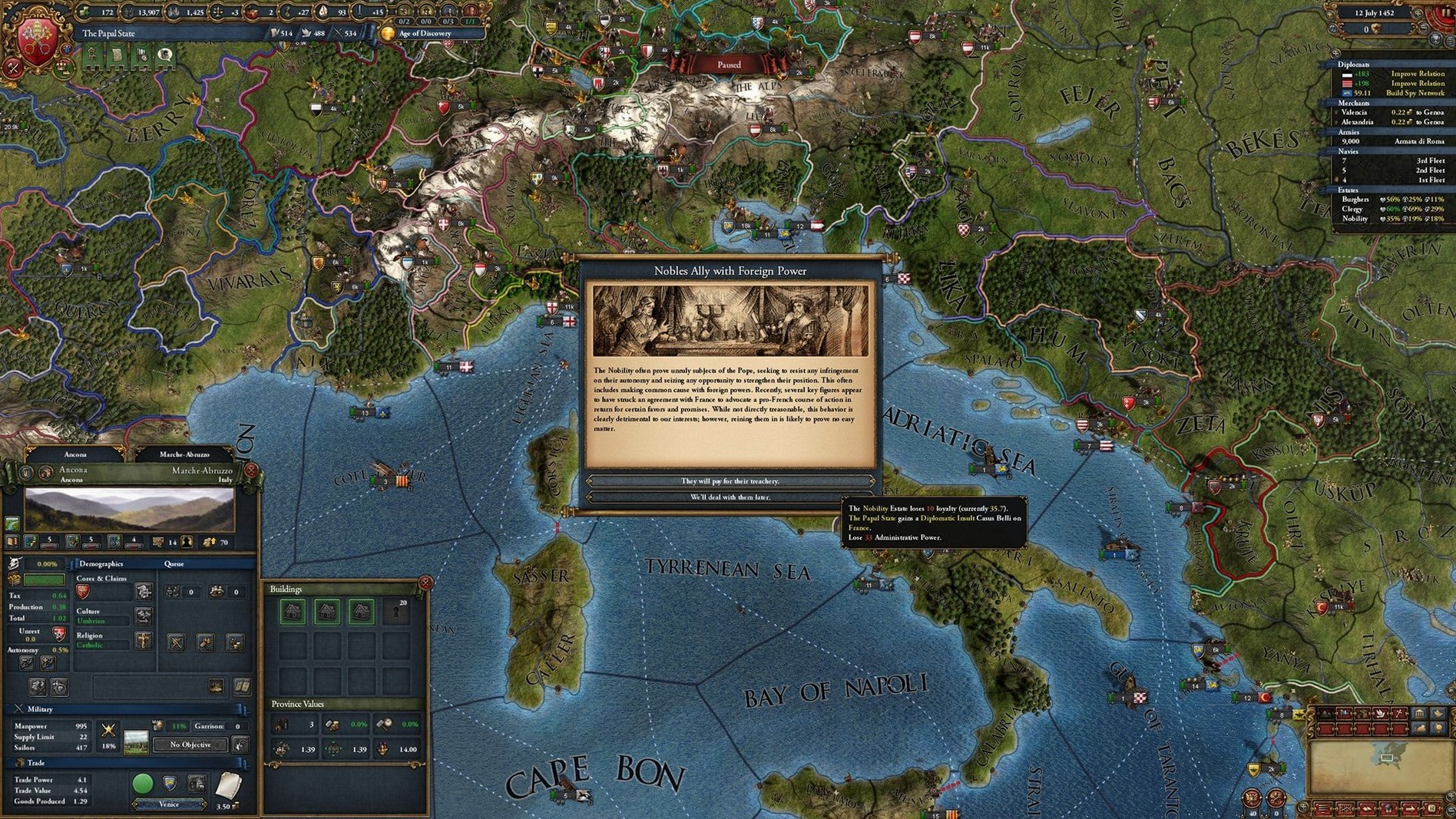
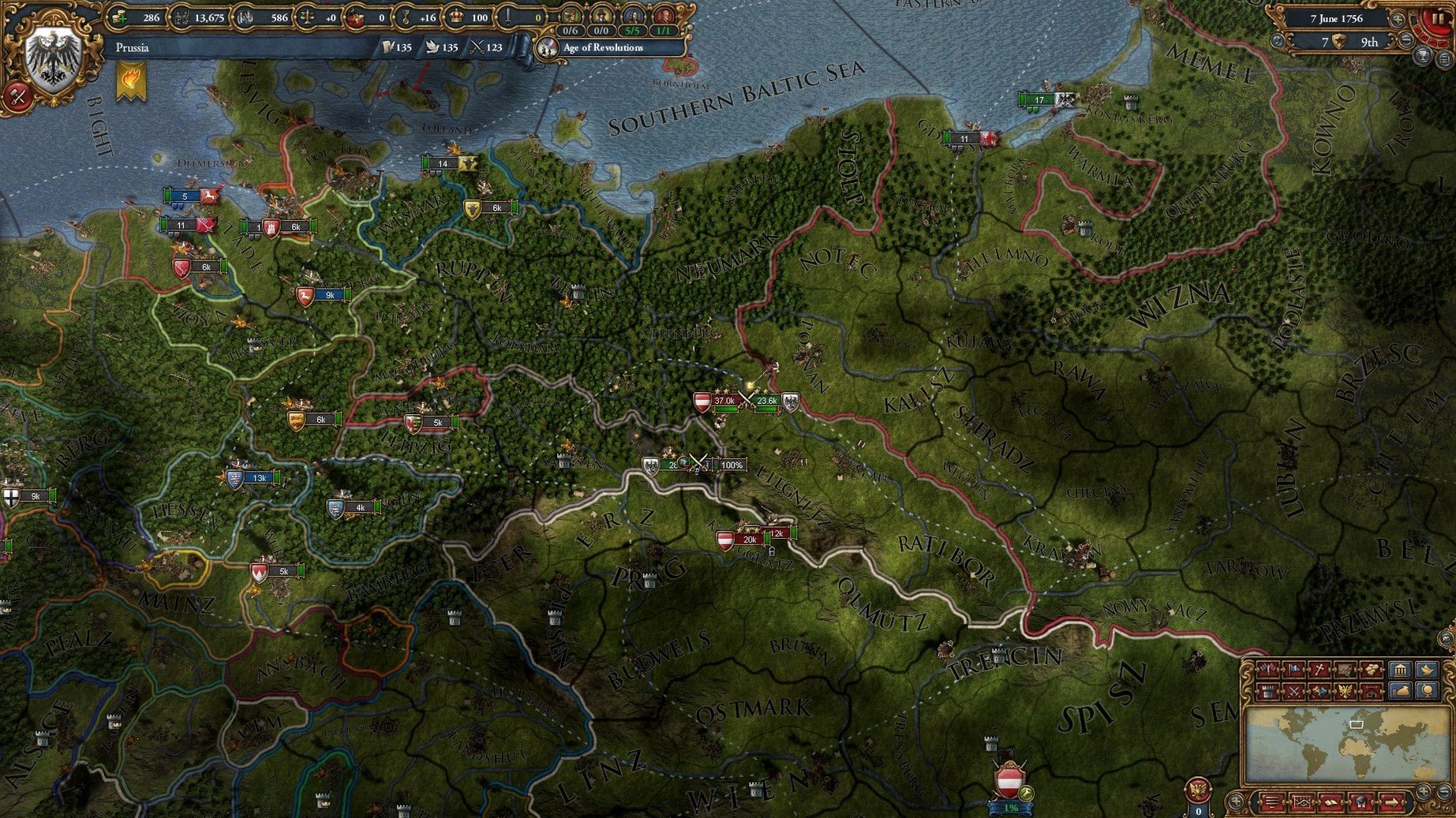
Most strategy titles give you a few decades and a narrow set of win conditions. That works if you want a tight, score-attack experience. It falls apart when you want to steer a nation through centuries of diplomacy, trade, religion and war, with no script telling you what counts as victory. Europa Universalis IV opens the map in 1444 and lets you decide what success means — whether that is a quiet trade empire in the Baltic or a sprawling colonial power stretching from the Ivory Coast to the Moluccas.
A millennium of marriage, schism and your own ambitions
- Players who enjoy setting their own goals across a full historical sweep — the campaign runs from the late Middle Ages through the age of revolutions.
- Anyone drawn to the texture of history: royal marriages, religious upheavals, shifting alliances and the slow burn of institutional change.
- Tinkerers who like seeing how a small diplomatic decision in 1480 reshapes the map by 1720.
- Those who read tooltips as part of the fun — the interface layers information densely, and learning it is part of the satisfaction.
One vengeful alliance can unravel forty hours of empire
- This is not a conquest-paced game. Wars are costly, and a single badly timed coalition can undo decades of careful expansion.
- The learning curve is steep. Expect to lose your first few campaigns while you absorb trade nodes, aggressive expansion and estate management.
- It runs on Intel Macs; there is no native Apple Silicon build, so newer machines rely on Rosetta 2.
- The music is excellent, but the soundscape is otherwise quiet — long play sessions suit a podcast or an album in the background.
My deep‑focus Mac drawer mates: EU4, Scrivener, Resolve
I keep Europa Universalis IV in the same mental drawer as Scrivener and DaVinci Resolve — it is a long‑session application that rewards patience and punishes distraction. On macOS it coexists well with apps that use modest background resources. I often leave Notes or a simple text editor open on a second desktop for jotting down trade node chains I want to revisit, or the name of a general I cannot afford to lose in the next war. The game plays nicely with systemwide keyboard shortcuts, and Mission Control lets me flick between the map and a browser without the engine stuttering. If you use Focus modes, set one that silences notifications but leaves audio uninterrupted; the soundtrack deserves an unbroken hour.
Ten minutes of staring at a Florentine trade map in silence
Late evening, a pot of jasmine tea. I launch the eu4 file and the map resolves on Florence, 1444. First ten minutes: I do almost nothing. I read the mission tree slowly, toggle the trade map mode, check who rivals whom in northern Italy. Then I unpause. A diplomat leaves for Ferrara; an alliance offer arrives from Milan. By 1452 I have swallowed Lucca whole, and the Papal States are eyeing my borders with unconcealed hostility. I spend the next hour avoiding a war I cannot win — marrying into Savoy, improving relations with Austria, building a single extra regiment to make myself look less appetizing. Around 1510 the Protestant Reformation cracks Germany open, and my careful Catholic alliances wobble. That is when the session turns. I abandon the original plan and pivot toward the Balkans, where Ottoman attention is elsewhere. By midnight the tea is cold and I have a foothold in Ragusa, a tense truce with Venice, and a notebook page full of scribbled lessons for the next campaign. The game never tells you that this is a story. It simply hands you the systems and waits.
Hide inside a big power bloc while the systems click
Start with a nation that sits inside a larger political network rather than on its edge. The Ottomans, France and Castile are classic recommendations for good reason — you see multiple systems overlap without being immediately crushed for a small mistake. Spend the first evening with the ledger and the trade map mode before worrying about expansion. The interface rewards hovering: every number and icon has a tooltip, and many contain nested information that explains why a value is what it is. Keep the wiki nearby, not as a walkthrough but as a decoder when a mechanic feels opaque. And resist the urge to restart every time a war goes badly. Some of the best campaigns start with a defeat that forces you into a part of the map you never planned to explore.
- Architecture: Intel (x86 64-bit)
- Apple Silicon Macs run the game via Rosetta 2
- Current build: 1.37.5.2 fix
Questions from the booth
The campaign runs from 1444 to 1821, taking you from the late Middle Ages through the Napoleonic era.
Yes — every nation available on the 1444 start date is playable, from major European powers to small states in Asia, Africa and the Americas.
The game includes Russian, English, German, Spanish and French.