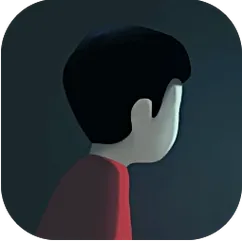
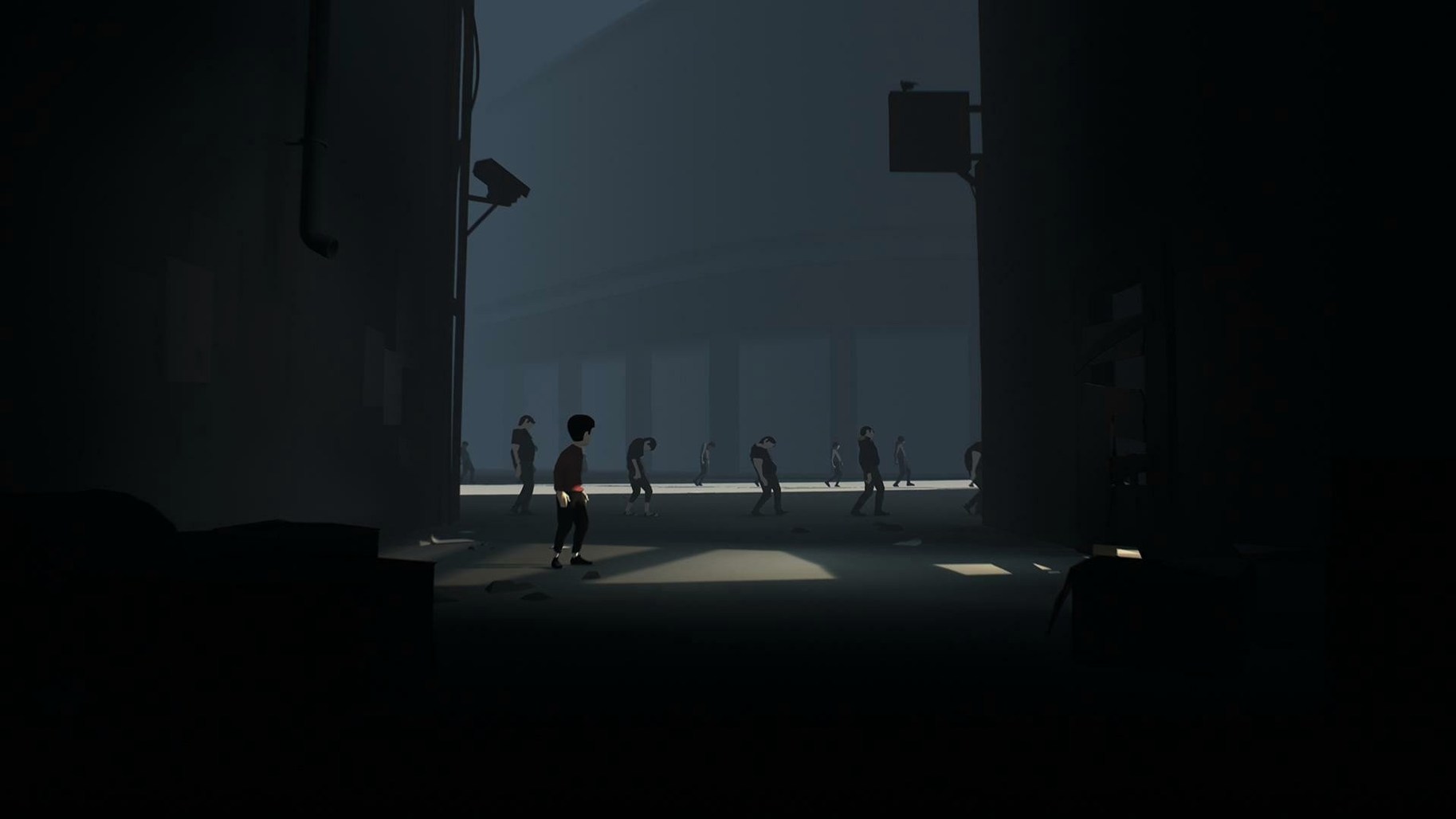
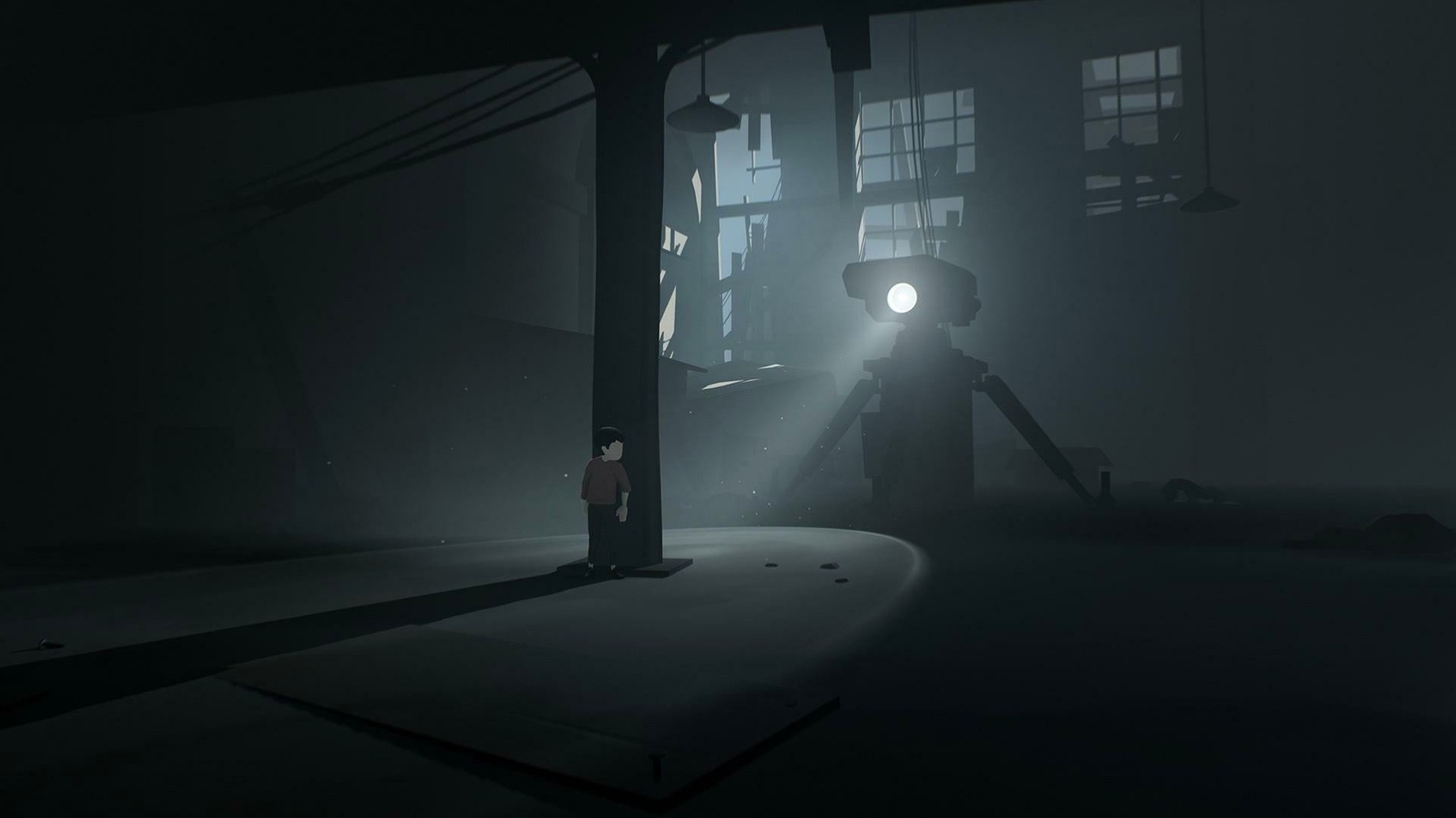
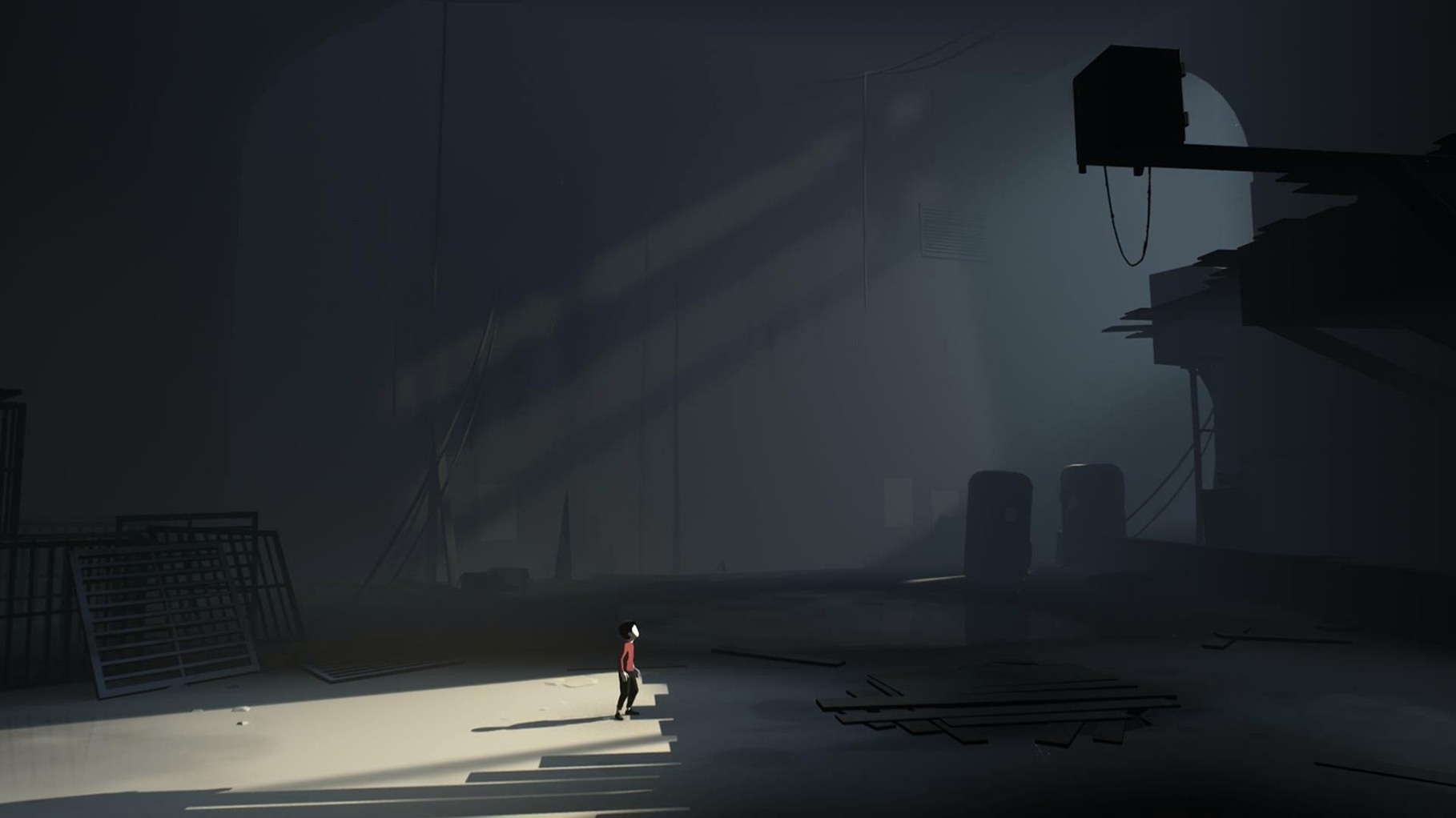
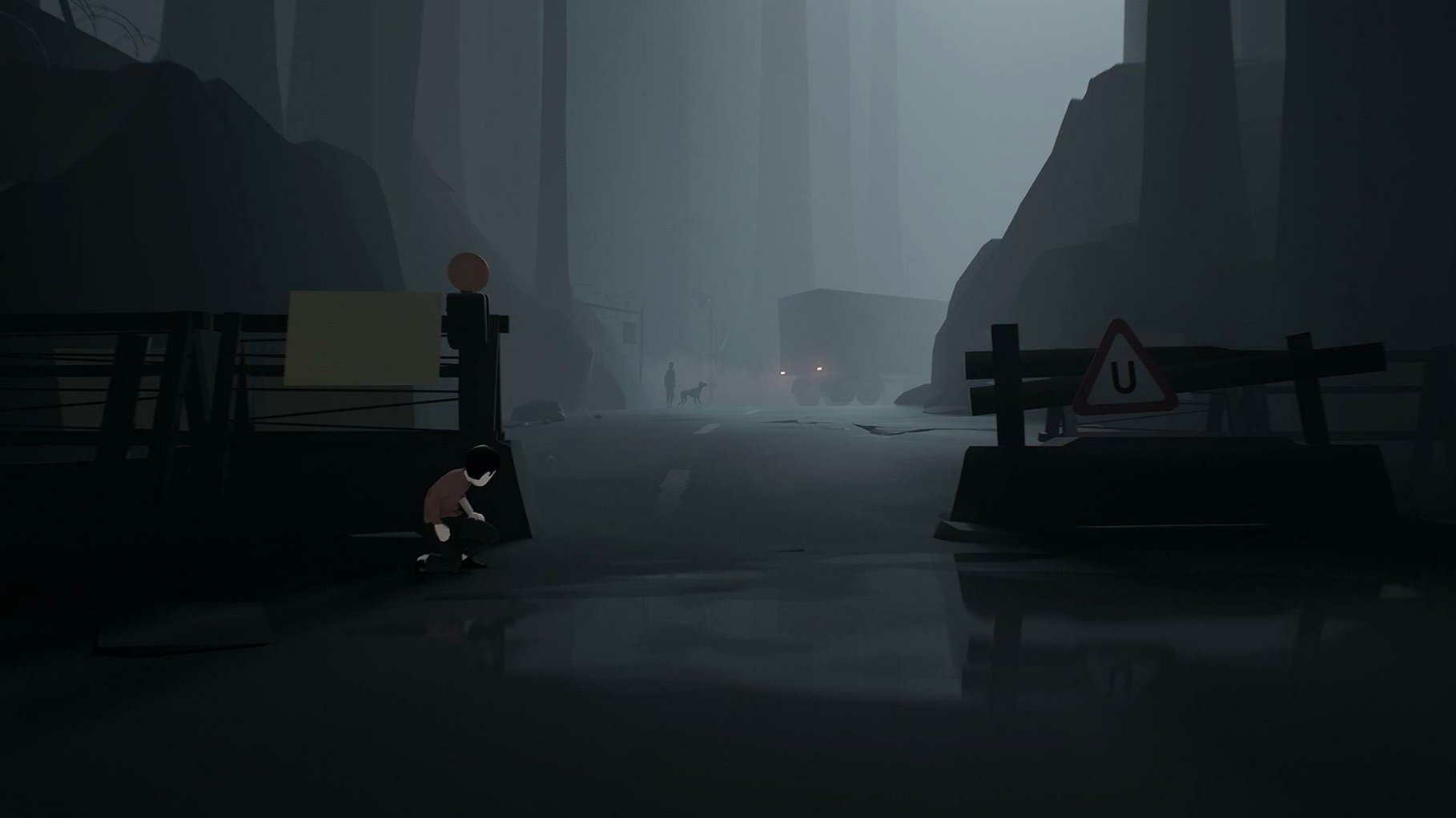
A boy slides down a scree slope into a monochrome forest, and from that moment you are running. Not because anyone explained why—no one speaks in this world—but because the armed men and snarling dogs closing in leave no other choice. That is the minute-to-minute rhythm of INSIDE.
The shape of a breathless hour
- Run and hide. You sprint through undergrowth, vault low walls, and crouch behind cover while flashlight beams sweep past. The boy is fragile: one shot, one grab, and he crumples.
- Solve with weight and motion. A dead pig, a loose crate, a pulley hanging over dark water—objects become keys. You drag, shove, and climb. Puzzles are physical, never abstract; the solution is usually something you can touch.
- Swim and drown. Later stretches flood the screen. You hold your breath through submerged corridors, surface gasping in air pockets, and learn to steer a strange submersible through ruins lit only by its headlamp.
- Absorb and control. A shockwave hits and suddenly you are not just a boy anymore. You steer a writhing mass of limbs through offices and laboratories, crashing through doors that once stopped you. The world’s horror becomes, briefly, your leverage.
- Watch and wonder. Between hazards you slow down. A silent parade of mindless workers trudging by. A diorama of the forest you just crossed. No dialogue, no text—just the unblinking stare of something that was never meant to be understood.
Playdead’s follow-up to Limbo carries the same wordless dread but trades the spiderwebs for industrial decay. The game was tested on macOS Tahoe running on a Mac mini 2024 M4, and on that hardware the grey skies and grain elevators feel unnervingly close. The story stays open—you leave with an image, not an answer.
Whether the boy survives depends on you
Whether the boy survives depends on you, but people still want to know a few things before committing to the descent. The most common question is about length. INSIDE runs roughly three to four hours on a first playthrough—short enough to finish in a single evening, long enough that every setpiece lingers. A second question circles around the horror: this is not a jump-scare gallery. The dread is environmental, the kind that settles in your stomach when you notice a row of blank-faced figures standing motionless behind glass. It disturbs rather than shocks.
Another frequent hesitation involves the puzzles. If you bounced off Limbo's more trial-and-error traps, know that INSIDE leans further into physical logic. You rarely die because a hidden spike caught you mid-jump; you die because you mistimed a sprint past a searchlight or misjudged the arc of a swinging chain. The checkpointing is generous, usually dropping you seconds before the mistake. People also ask about the ending—here, the only honest answer is that it arrives without explanation, and you will either find that maddening or magnificent. There is no middle ground.
The missteps that cost you progress
Beginners make a handful of predictable mistakes, and most of them stem from impatience. The first is treating every dark stretch as a chase. Large portions of the game reward stillness: standing in shadow while a guard passes, letting a truck rumble overhead, watching the rhythm of a piston before committing to the gap. The boy runs fast, but sprinting into a room you have not read is the quickest route to a snapped neck.
Another common error is overlooking the vertical. Playdead tucks ledges, ladders, and climbable chains into the background in ways that do not glow or pulse to announce themselves. If a room feels like a dead end, look up. The third mistake is subtler: assuming you are always alone. In the later sections, what you control and what you are controlled by start to blur, and players who barrel forward without absorbing what just happened to the boy's body will miss the thread entirely. The game rewards attention, not reflexes—stop and listen to the soundtrack, because it is the only voice you will get.
- macOS: unspecified version
- Architecture: Intel
- Interface languages: Russian
Questions from the booth
No. The game contains no dialogue and provides no backstory on screen; the narrative is told entirely through its environments, animations, and the events you trigger.
INSIDE was created by Playdead, an independent game developer and publisher based in Copenhagen, Denmark, the same studio behind Limbo.