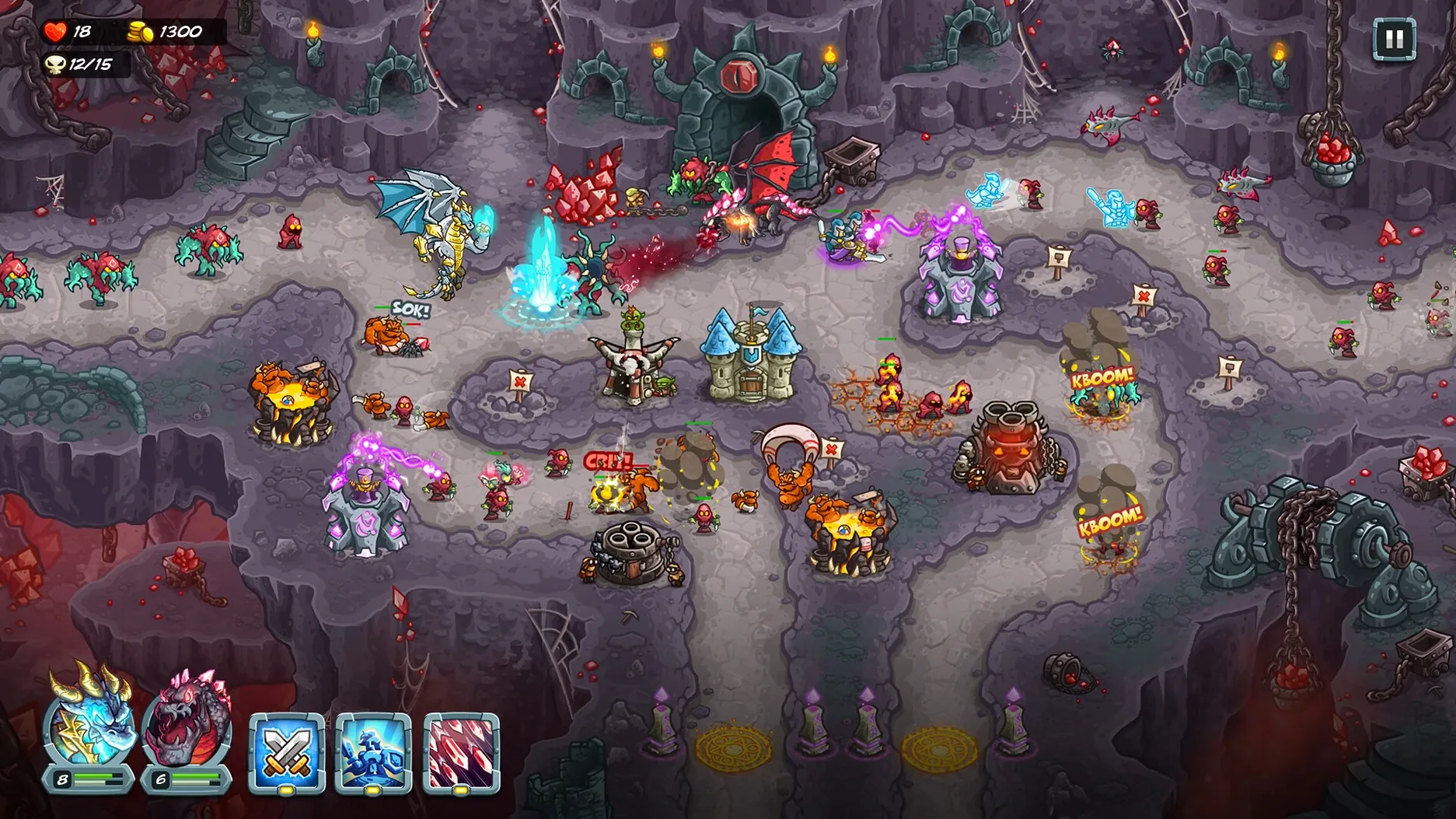
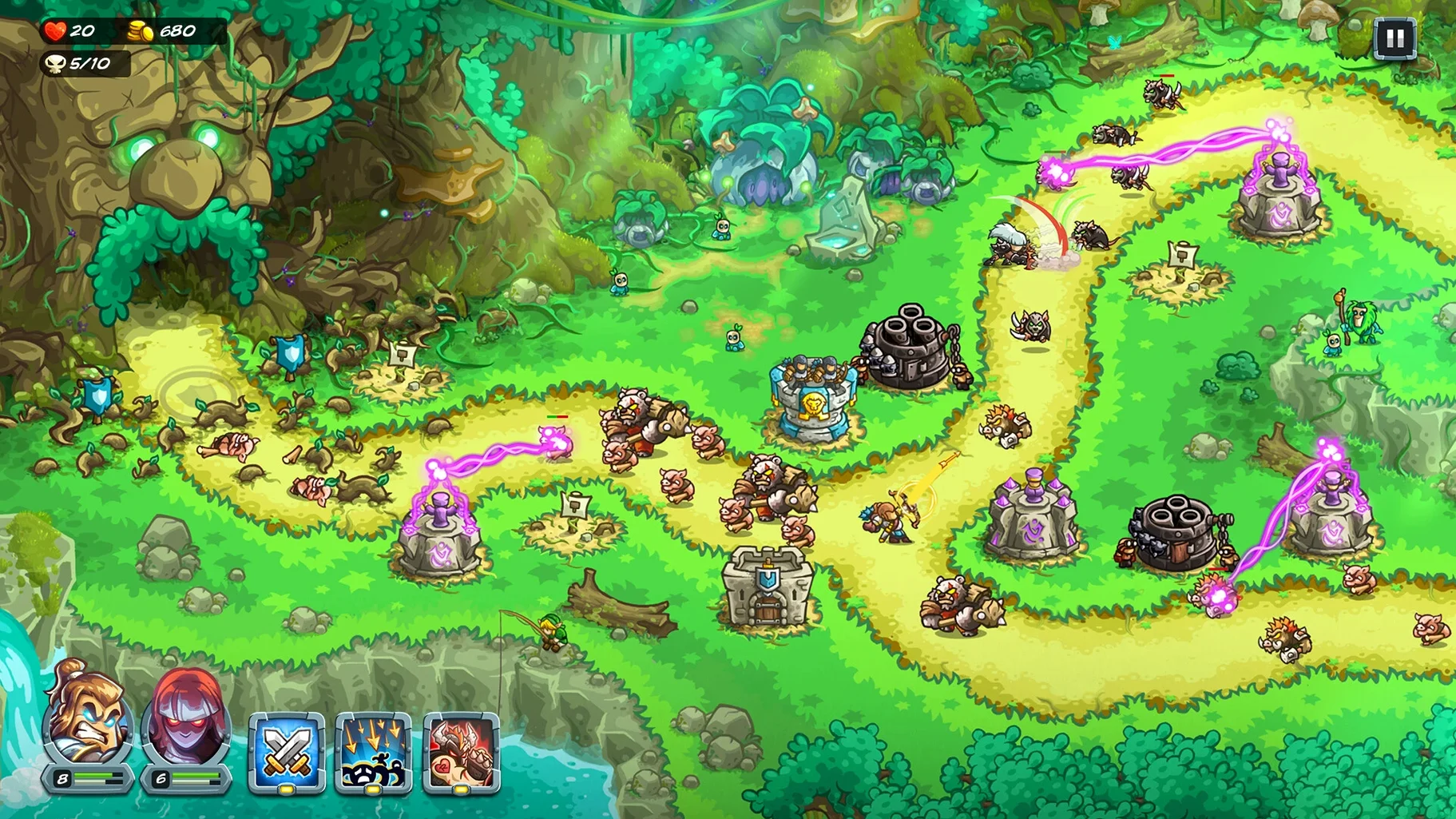
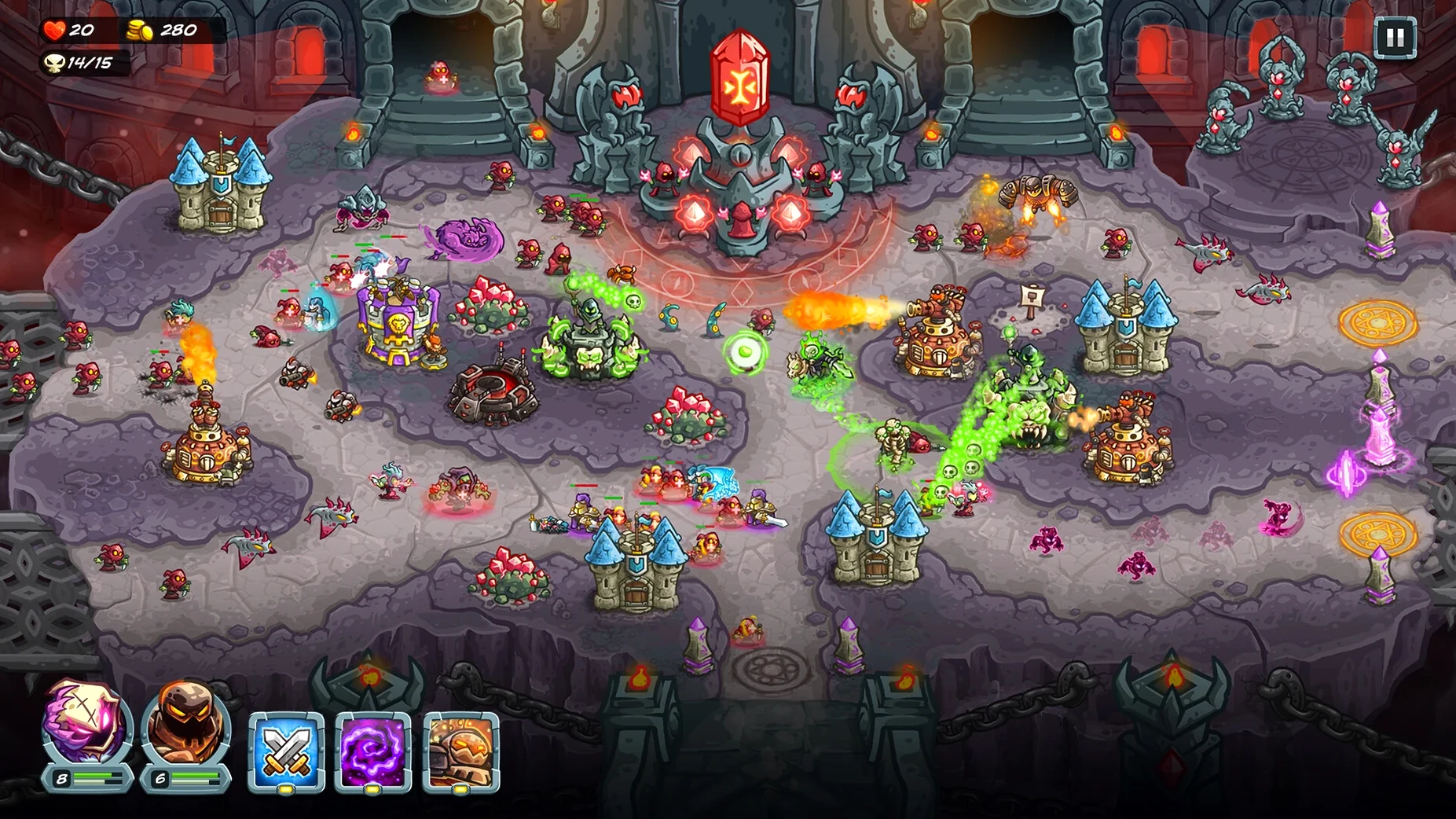
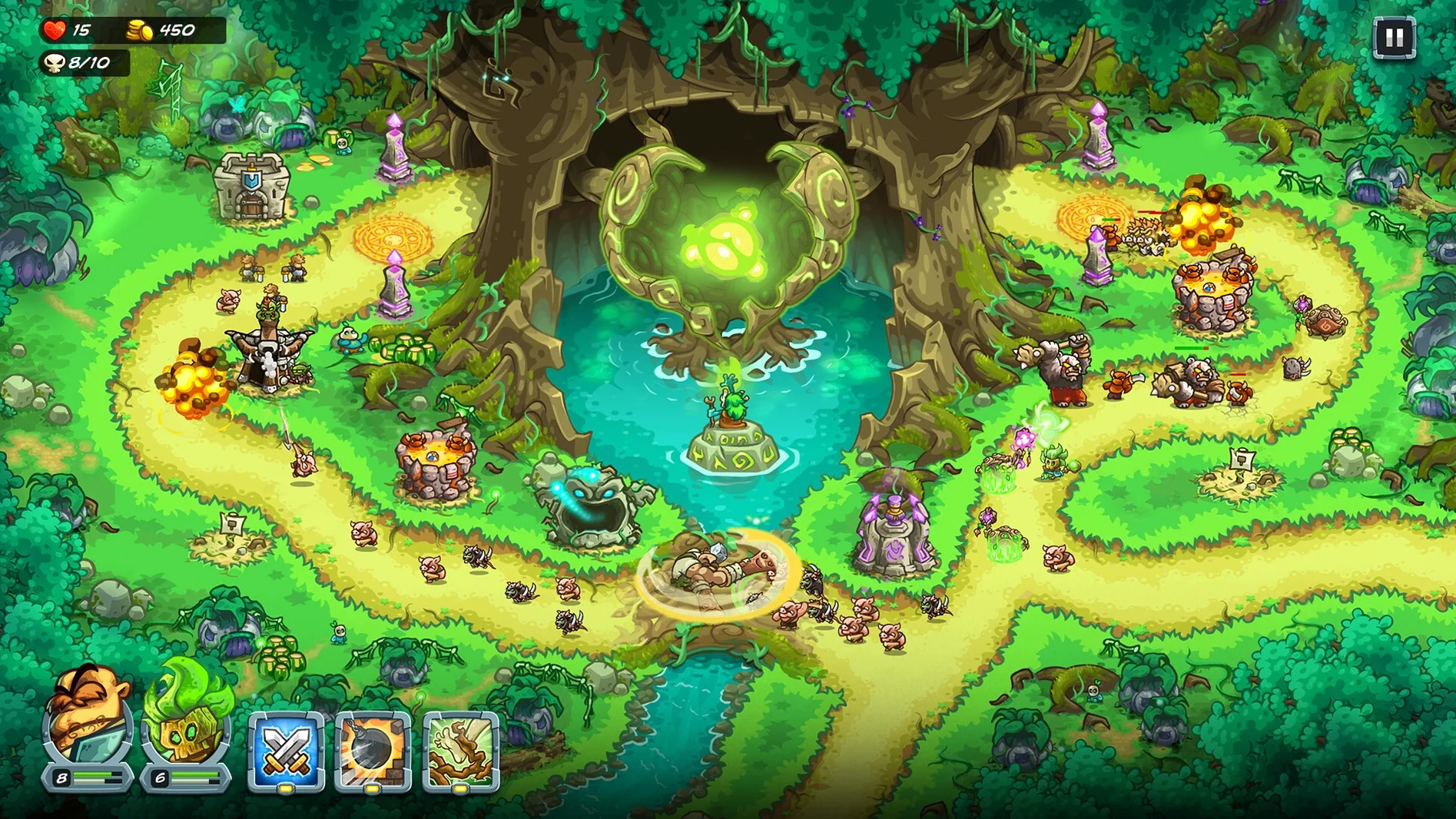
Anyone who has spent an evening nudging automation lanes in a DAW will recognize the mindset Kingdom Rush 5: Alliance TD asks for: you lay down a structure, then you ride the faders while it plays back. The difference is that the mix is coming at you in real time, and the faders are paladins, demon archers, and a trebuchet with a grudge.
What does a single stage actually feel like?
You trace a winding path on the map, drop tower foundations along the chokepoints, and wait. The first goblins lope into range and your archers begin their quiet work. The rhythm holds for maybe thirty seconds—then a siegebreaker lumbers through the treeline and the calm snaps. You spend the next few minutes dragging heroes to the breach, upgrading a barracks on the fly, and burning a reinforcement cooldown because the left flank just evaporated.
How do heroes change the loop?
Heroes are not passive buffs; you are steering them through the fray moment to moment. One might hold a bridge with a shield wall while another circles behind an ogre mage to interrupt a heal. Their abilities recharge on timers you learn to feel, and swapping two heroes between stages remixes the entire defensive shape you planned.
What makes the campaign keep its grip across 16 stages?
Each landscape introduces a new behaviour the enemies exploit. One region teaches you to watch the canopy for dropping ambushers; another forces you to split your tower budget between two lanes that never pause. The achievements—over 50 of them—nudge you toward reckless experiments on stages you thought you had already solved.
What does the enemy roster throw at you?
More than 32 enemy types means the game never lets a single tower arrangement work for long. Armoured front-liners absorb projectiles while healers slip behind; flying swarms punish any board that skimped on anti-air. The later waves layer three of these threats at once, and you learn to read the spawn icons like weather warnings.
One of the quietest snags people hit in the first few stages is treating every tower slot like it needs to be filled immediately. The instinct to plunk down a full row of level‑1 archers before the first wave finishes is strong, but it spreads your gold too thin to upgrade anything meaningfully. A tighter setup—two or three well‑placed towers fed early upgrades—handles the opening waves more cleanly and leaves you with a reserve for the first hero ability unlock, which often arrives right when the armoured bruisers start appearing. Letting a few early creeps leak through to save for that timing is almost always the smarter play.
Another recurring headache is hero micro positioning on stages with narrow bridges and teleporter pads. The pathfinding will occasionally route a hero the long way around a cliff while a crowd of fliers drifts straight toward your exit. Tapping the hero portrait twice snaps them to the rally point faster than dragging, and placing that rally point on the far side of a teleporter pre‑positions them for the next spawn announcement. It is the kind of small habit that transforms a chaotic third wave into something you can actually read.
Rotate heroes early to catch enemy-cancelling rhythms
Spend your earliest sessions rotating through the full hero roster in the first three campaign stages, even if a pair already feels comfortable. Each hero’s ability descriptions are useful, but how an ability interrupts a specific enemy rhythm—like cancelling a shaman’s heal chant or stunning a siegebreaker mid‑swing—only becomes muscle memory through repetition against live waves. The achievements tied to individual hero deployments steer you toward combinations you might otherwise ignore, and they double as a gentle tutorial for the later game modes where those synergies become essential.
In the pause menu you will find a detailed enemy compendium that updates as you encounter new types. Checking it between stages reveals armour values, special traits, and movement speeds that the in‑wave chaos obscures. A quick glance at the next region’s roster before placing your first tower often means the difference between a one‑star clear and a flawless run on the first attempt.
Mac performance holds up as a clean native build
The question that surfaces most often is whether the Mac version feels like a port or a native build. It runs on both Apple Silicon and Intel hardware, supports OpenGL 3.0‑compliant graphics, and the interface scaling holds up cleanly on a range of display densities. The game does not phone home for activation, and the download lands as a straightforward disk image you drag to Applications. No launcher, no background service—just the app, ready from Launchpad.
Another common uncertainty is whether the difficulty curve assumes you have played the earlier Kingdom Rush titles. The campaign introduces its mechanics gradually enough that newcomers can find their footing in the first four stages, while the optional challenges and three distinct game modes give veterans something to chew on immediately. The alliance mechanic itself—fielding two heroes with overlapping ability windows—is new to this instalment, so everyone learns that rhythm from scratch.
People also ask about the storage and RAM footprint. The game occupies roughly 1 GB of disk space and stays comfortably within a 4 GB RAM ceiling during play, which leaves headroom for a browser or music app in the background. On a 2024 Mac mini with an M4 chip running macOS Tahoe, the framerate locks smooth even when the screen fills with particle effects and a full wave of fliers.
- macOS 11.0 or later
- Apple M1 or Intel Core M processor
- 4 GB RAM
- 1 GB available storage
- OpenGL 3.0 compliant graphics with 1.0 GB video RAM
Questions from the booth
Yes, the game supports both ARM and x86 64-bit architectures and requires macOS 11.0 or later with an Apple M1 or Intel Core M processor, 4 GB of RAM, and 1 GB of available storage.