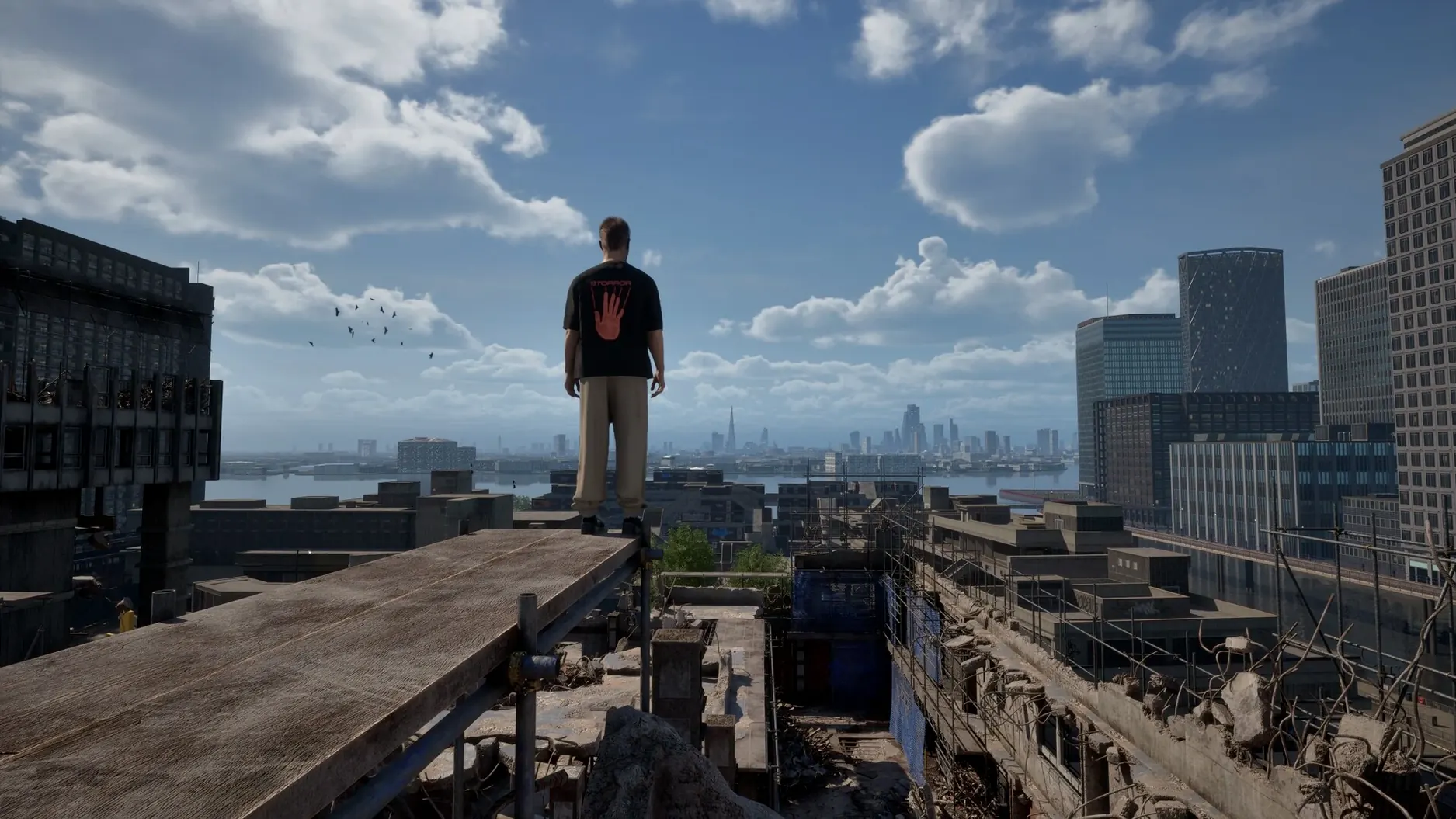
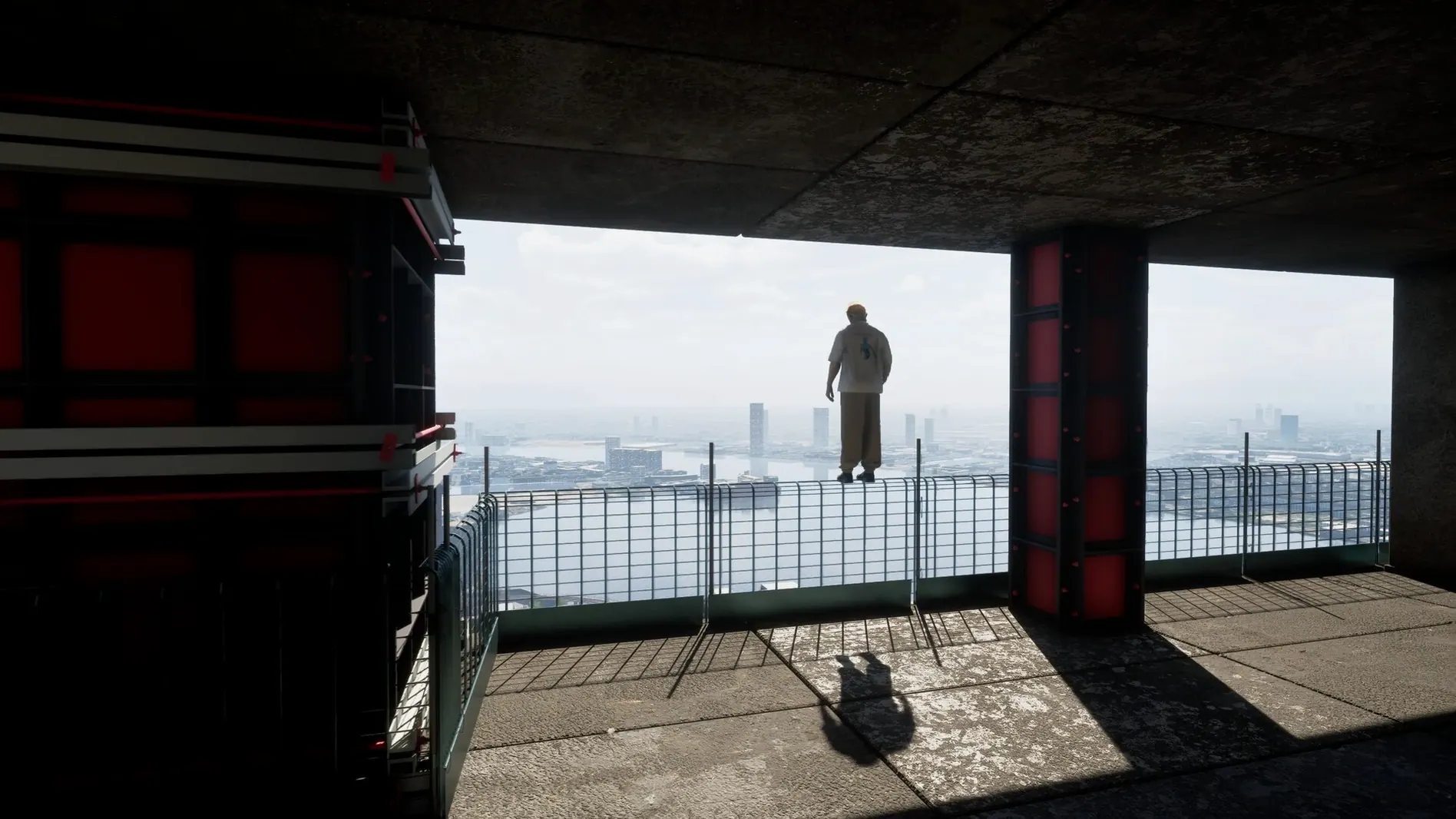
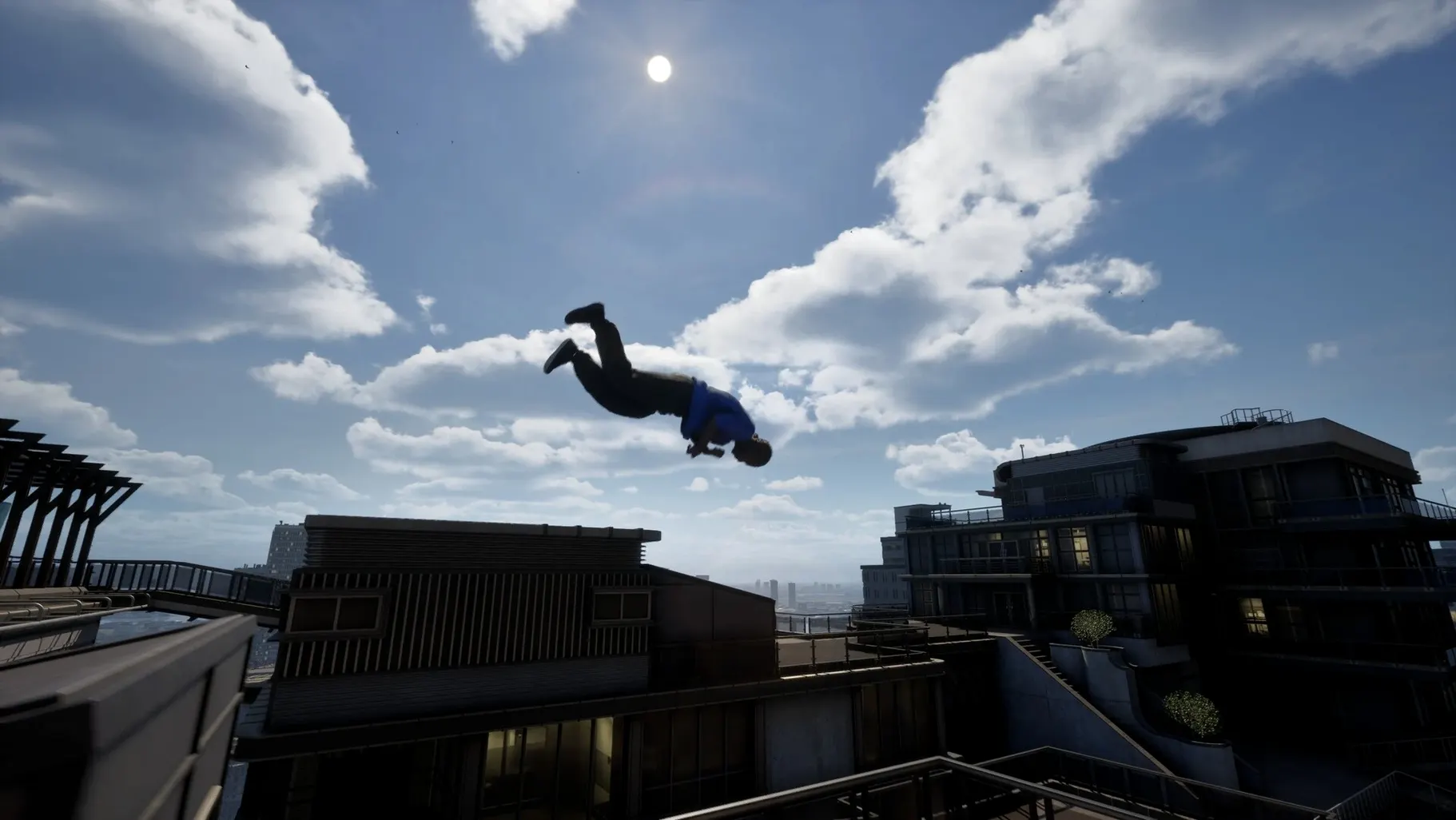
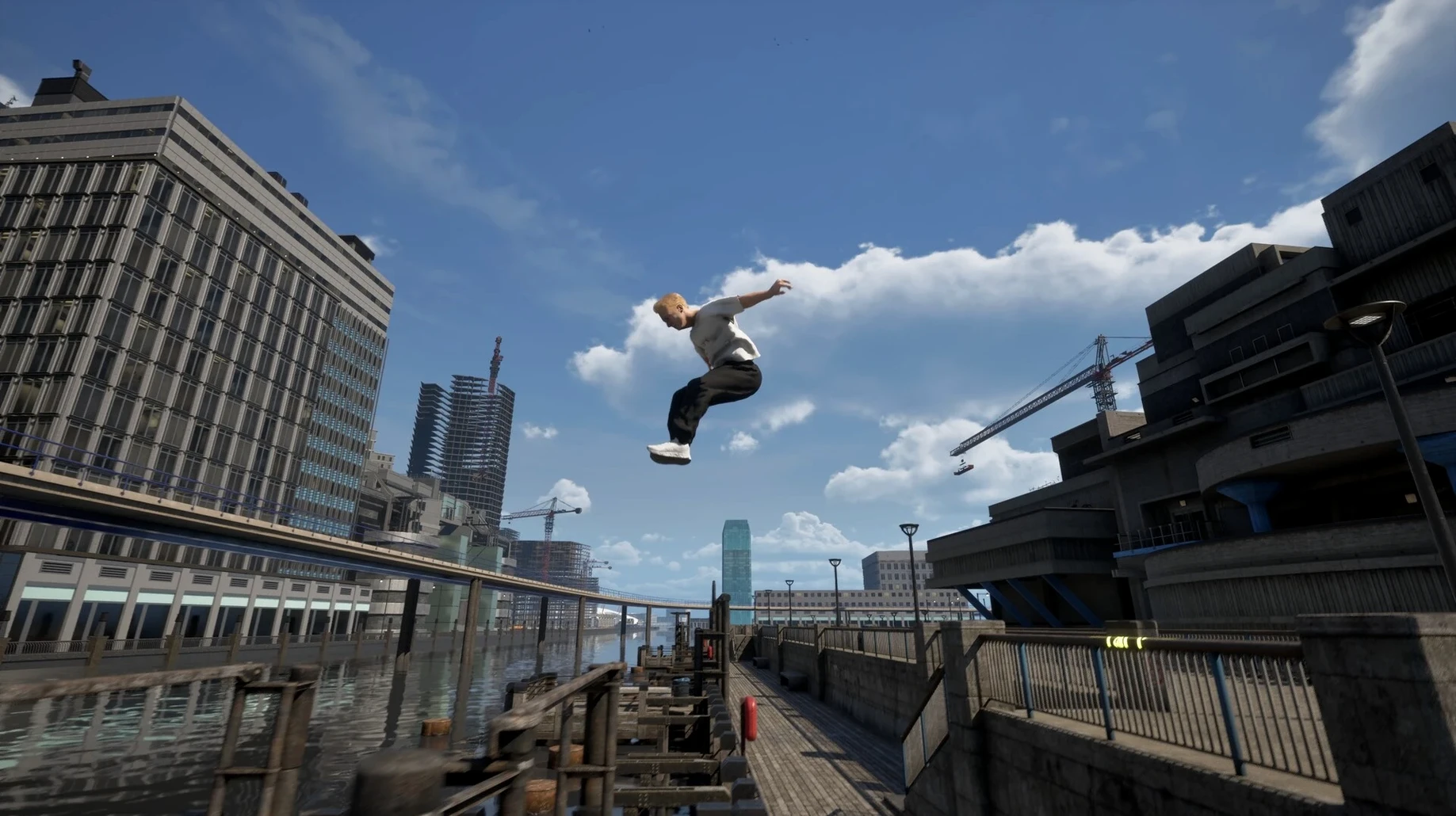
If you’ve ever spent an hour in a Mirror’s Edge time trial, chasing a cleaner line across a rooftop, STORROR Parkour Pro already knows the part of your brain it’s trying to reach. Developed by Hole in the Sleeve Game Studios, this Early Access title transplants that first-person flow into a reimagined Isle of Dogs in London, trading glossy dystopia for the textures of a working dockland. The movement is built on motion capture from parkour athletes, layered over a physics system that asks you to earn every vault and wall-run rather than simply snapping to a ledge. You explore streets and rooftops, climb moving cranes, and learn to read the city as a sequence of linked possibilities.
For movement nerds and chase-mode rivals
- Players who treat movement as a skill to refine, not a button to press.
- Friends looking for a direct, physical competition in the Chase and Escape mode.
- Anyone drawn to the imperfect, textured feel of an Early Access game built around athlete performances.
- Solo runners who zone out to Speed Challenges and incremental route improvements.
Embrace the jank of an early access build
- This is an unfinished Early Access release — expect rough edges and evolving systems.
- The physics-based movement has a learning curve that rewards patience more than twitch reflexes.
- Requires an Apple Silicon Mac running macOS 14.0 or later.
A dusk session through Line Challenges and the first mission
You launch the game in the late afternoon, headphones on, the room dim enough that the screen fills your vision. The menu offers Line Challenges, Speed Challenges, the first Storror Mission, and the Chase and Escape mode — but tonight you want to sharpen your movement, so you load into free roam near Millwall Outer Dock. The camera settles into first-person, and for a moment you just stand on a low rooftop, listening to the distant clank of a crane and the hum of traffic below. The city feels lived-in, not staged.
You spot a shipping container stack across the courtyard. A running jump won’t clear the gap, so you drop to street level, sprint at a concrete barrier, and wall-run along its edge to gain height. The animation blends a dozen motion-captured adjustments — your arms swing, your legs tuck — and for a second the physics catches your weight wrong. You stumble onto the container’s edge, one foot slipping, and the game doesn’t grab you. You pull yourself up manually, heart ticking a little faster. That near-miss is the system working as intended.
From the containers you climb onto a moving crane. Its arm swings slowly over the water, and you crouch to keep your balance as the steel groans beneath you. A helicopter passes low, its searchlight sweeping the rooftops, and you drop into a roll behind a vent. You didn’t plan this — the game just layered three dynamic systems on top of each other and let you react. You stay low until the rotor noise fades, then vault a railing and land on a train carriage rolling east along the dock edge. You ride it for half a mile, jumping between carriages, before dismounting onto a fire escape. Thirty minutes have passed. You haven’t touched a menu.
Chaining a Speed Challenge for a clean time
Speed Challenges are where the motion capture really earns its place. Unlike time trials in more scripted parkour games, the route here is a suggestion — you’re given start and finish markers, but the path between them is yours to improvise. Picking a short rooftop circuit near Canary Wharf, you begin mapping the line in your head.
First run: slow, exploratory. You vault a low wall, slide under a pipe, and mantle onto an air conditioning unit. The animation for the mantle is one of several hundred in the library, and your character plants a hand, swings a leg up, and pushes off in a single motion that feels heavier and more deliberate than the floaty climbs of other games. You miss a jump to a balcony and fall to a lower roof — the clock keeps ticking, so you scramble back up via a drainpipe. The time is bad, but you’ve learned that the balcony approach needs more speed.
Second run: you sprint from the marker, take the wall-run earlier, and use a precision jump to clear the pipe entirely instead of sliding. The landing is clean — you carry your momentum forward, hit the balcony ledge at a better angle, and transfer into a cat leap across to the next building. The game rewards this with a fluid chain of animations: run, jump, grab, swing, release, land, roll, sprint. No clipping, no magnetic snapping. You shave four seconds off your first attempt.
By the sixth run, you’ve found a crane hook you can swing from to bypass a staircase entirely. It’s not an intended shortcut — the hook was swaying there because a crane was moving past, and you happened to look up. The time drops into the top third of the leaderboard. You stop not because you’ve perfected it, but because your hands ache. Tomorrow you’ll try cutting through the train yard instead.
Raw physics instead of Mirror’s Edge snap-to precision
If you’ve played Mirror’s Edge on Mac, you know its clean, stylised rooftops and its forgiving snap-to-ledges. STORROR Parkour Pro replaces that polish with something rawer — the physics aren’t always predictable, and that’s the point. Mirror’s Edge wants you to feel like an elite runner in a curated course; STORROR wants you to feel like you’re figuring it out on the fly, the way the athletes whose motion capture drives the animations would.
Beside Dying Light, which grafts parkour onto a zombie survival framework, STORROR strips away combat and narrative weight almost entirely. There’s no skill tree, no grappling hook upgrade, no day-night cycle to race against. The tension comes from your own mistakes — a mistimed jump, a helicopter you forgot to check for — rather than from enemies clawing at your back. It’s a purer expression of movement, with less to hide behind when the controls demand precision.
Then there’s Stride, a VR parkour game that also leans on procedural generation and speedrunning. Stride’s levels are built for quick, repeatable runs with guns and leaderboard chasing, but it’s tethered to a headset and motion controllers. STORROR Parkour Pro, played on a screen with a gamepad, trades that physical immersion for a denser, more authored city — one where the environment itself, rather than a generated course, becomes the opponent you learn to read. If you’re looking for a storror parkour pro mac experience that feels grounded in a real place rather than an abstract arena, the Isle of Dogs setting makes a quiet but meaningful difference.
- macOS 14.0 or newer
- Apple Silicon Mac
Questions from the booth
Yes, it includes a Chase and Escape mode designed for playing with friends.