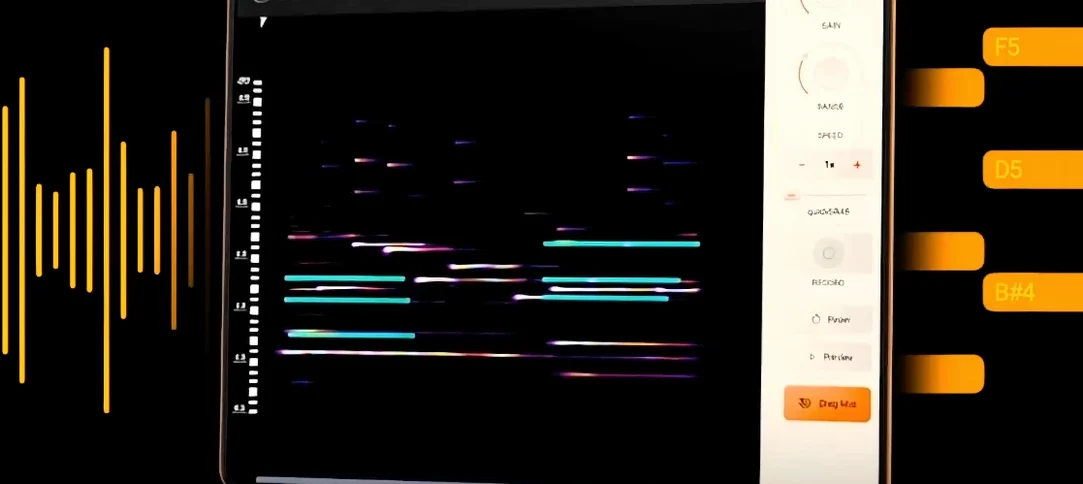
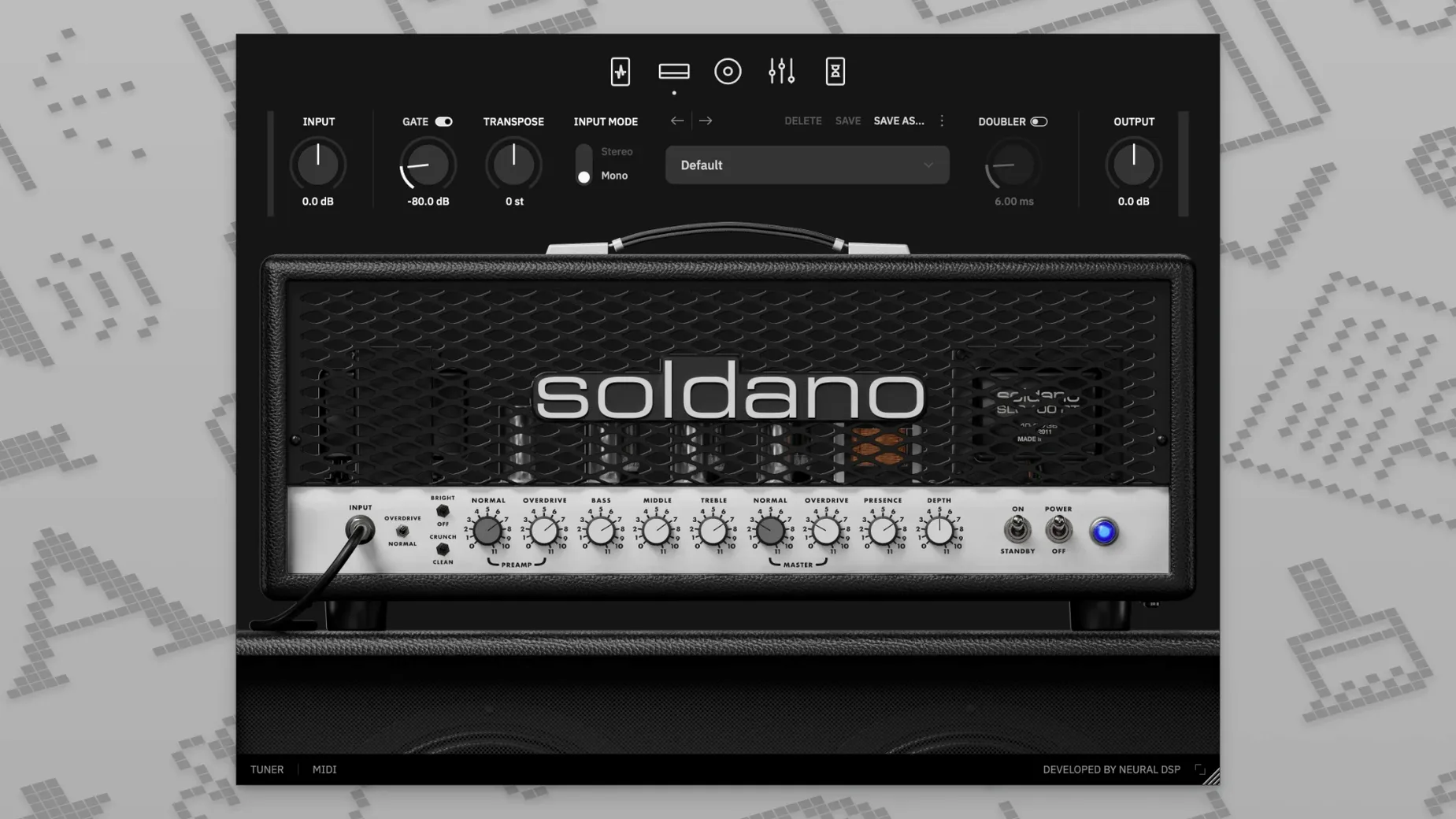
Four amp modes sit inside a single channel strip, which is where the session logic starts with the Soldano SLO-100 X. Clean, Bright, Crunch, and Overdrive are toggled from the amplifier panel, and each resets the gain structure enough that you treat them as four distinct heads sharing one cabinet chain. That means a single instance can cover a verse arpeggio and a chorused lead without loading a second plugin.
Direct tracking with transposition
Record a dry DI through the standalone app or the AU insert in Logic, and use the built-in transposition to drop a part by a few semitones before it hits the input stage. The processed signal stays tight because the pitch shift lives before the preamp, not in a post-FX slot, so the amp’s response reads the shifted note as the original performance.
Re-amping through user cabinets
Send a pre-recorded DI out from your session and back into the plugin with the cabinet section set to a custom IR. The X update lets you load your own cabinet files, which changes the feel more than swapping amp modes—an oversized 4x12 IR turns the Crunch mode into something closer to a pushed clean platform, while a compact 1x12 keeps the Overdrive mode snarling in a busy mix.
Buss processing with the nine-band EQ
Place an instance on a guitar buss with the preamp bypassed and only the EQ and power-amp modelling active. The nine-band graphic plus high-pass and low-pass filters let you carve a stereo double-track without adding another amp layer, which tightens up wide chorused parts that would otherwise cloud the low mids.
An evening session, track by track
It starts with a DI box plugged into the instrument input of an interface that has been running all day, so the converters are warm and the clock is steady. Launch the standalone Soldano SLO-100 X, load a blank preset, and switch the amp to Clean mode. The guitar is a partscaster with a slightly microphonic neck pickup—the kind of thing that hums a little too much through a physical head but settles down once the plugin's noise gate clamps the silent gaps. Gain at three, master at seven, a touch of the built-in compressor to even out fingerpicked arpeggios. Record a two-minute pass into the DAW, then stop to listen. The transient snap is there, but the body feels thin against the reference track, so the cabinet section gets swapped from the default 4x12 to a user IR captured from an open-back 2x10. Suddenly the low-mid bloom arrives and the part sits where the voice will eventually go.
Duplicate the DI to a second track, insert a fresh instance, and flip the mode to Overdrive. Gain pushed to six, the bright switch engaged, and the vintage chorus dialled in at about twenty percent wet—barely a shimmer, just enough width to separate it from the clean take. Pan them hard left and right, then group them to a buss. On the buss, a third instance with the preamp bypassed, only the nine-band EQ and the power-amp section working. Pull 400 Hz down by three decibels, nudge 3 kHz up by two, and set the high-pass to 80 Hz. The stereo image locks into place without fighting the bass guitar that has not even been tracked yet.
Next, a lead part. Transposition drops the tuning by a whole step so the bends land where the vocal melody peaks. Delay sits after the cabinet, set to a dotted eighth at 110 bpm, feedback low enough that it decays before the next phrase. Record it, then add the doubling effect at ten percent mix—not a chorus, more like a second pass played by someone who listens carefully. By the time the session closes, three instances of one plugin have handled clean texture, crunch rhythm, and a modulated lead, all sharing the same core amp DNA but never sounding redundant.
What the X revision changed, practically speaking
The 2024 update did not add new amp modes or a redesigned front panel. What shifted was the underlying modeling, and the difference surfaces most clearly in how the gain structures interact with the built-in boost and overdrive pedals. On the original 2021 plugin, stacking the TS-style overdrive into the Crunch amp could push the upper harmonics into a brittle zone that required surgical EQ afterward. The X version rounds that transition—the same pedal-into-amp combination now yields a saturated midrange that holds together at higher gain settings without shaving off pick attack. It is the kind of change you notice when you stop looking at the interface and just play for twenty minutes.
The user IR loader arrived with this revision, which turned the cabinet section from a curated library into an open-ended sound design tool. Loading an impulse response captured from a bass cabinet, for instance, lets the Clean mode function as a re-amping box for synth pads and sampled keys, well outside the plugin's nominal guitar brief. The transposition algorithm also saw attention: the X version tracks pitch-shifted notes with less warbling on whole-step drops, making it viable as a writing tool rather than just a quick fix for detuned sections.
Alongside other amp sims on the same drive
Stacked against something like Audio Assault's Bulldog, the SLO-100 X occupies a narrower tonal lane but gives you finer control inside it. Bulldog spreads across multiple amp models and leans into a raw, almost unpolished cabinet response that suits stoner and doom textures straight out of the box. The Soldano plugin does one amplifier lineage and refuses to blur its edges—the Clean mode still carries the headroom character of the SLO power section, so pristine jazz tones require more work here than they would in a dedicated clean-platform sim. What you gain is consistency: four modes that feel related, not like four different plugins awkwardly bundled.
IK Multimedia's AmpliTube 5 offers a Soldano model inside a sprawling ecosystem of racks, rooms, and post-effects. That approach rewards builders who want to chain a dozen modules and audition mic placements by the millimetre. The SLO-100 X pares that back to a single screen where everything from the compressor threshold to the reverb tail length is visible without scrolling. It is a difference of philosophy as much as sound—one invites experimentation through accumulation, the other through limitation. For a specific task like tracking a full album's worth of rhythm parts with a focused high-gain voice, the Neural DSP plugin cuts the decision tree down to something manageable at two in the morning.
A post-rock guitarist's weekend project
She has eight DI tracks recorded in a cabin with wood-panelled walls that added a natural slapback to the room mics. The brief is to build a slow-burning instrumental where clean and distorted layers trade phrases across seven minutes. The SLO-100 X sits on every guitar channel, but configured differently each time. Tracks one and two run the Clean mode with the compressor catching peaks and the delay set to a long stereo ping-pong that drifts across the panorama. Tracks three and four flip to Crunch with the doubling effect widening them further, playing simple three-note voicings that crest when the drums push harder. Tracks five and six use Overdrive with the nine-band EQ aggressively scooping low mids, carving out space for a cello part that was recorded separately. Track seven is a single-note melody through the Bright mode, transposed down a minor third, with the vintage chorus adding movement but no obvious warble. By the final mix, the Soldano plugin is running on seven channels and the CPU meter on her M1 Mac has barely crossed thirty percent. She saves the session, exports a rough mix for the band, and notices that she never once opened another amp plugin.
The X revision brings updated modeling technology across the entire amplifier and cabinet section, revisiting the earlier Soldano SLO-100 plugin with a reworked signal path that reacts more closely to input dynamics and gain staging.
- macOS 10.15 or later
- Intel or Apple Silicon Mac
- 64-bit host software for plugin use
Questions from the booth
Yes, it runs as both a standalone application and as an AU, VST, or AAX plugin inside a 64-bit host.