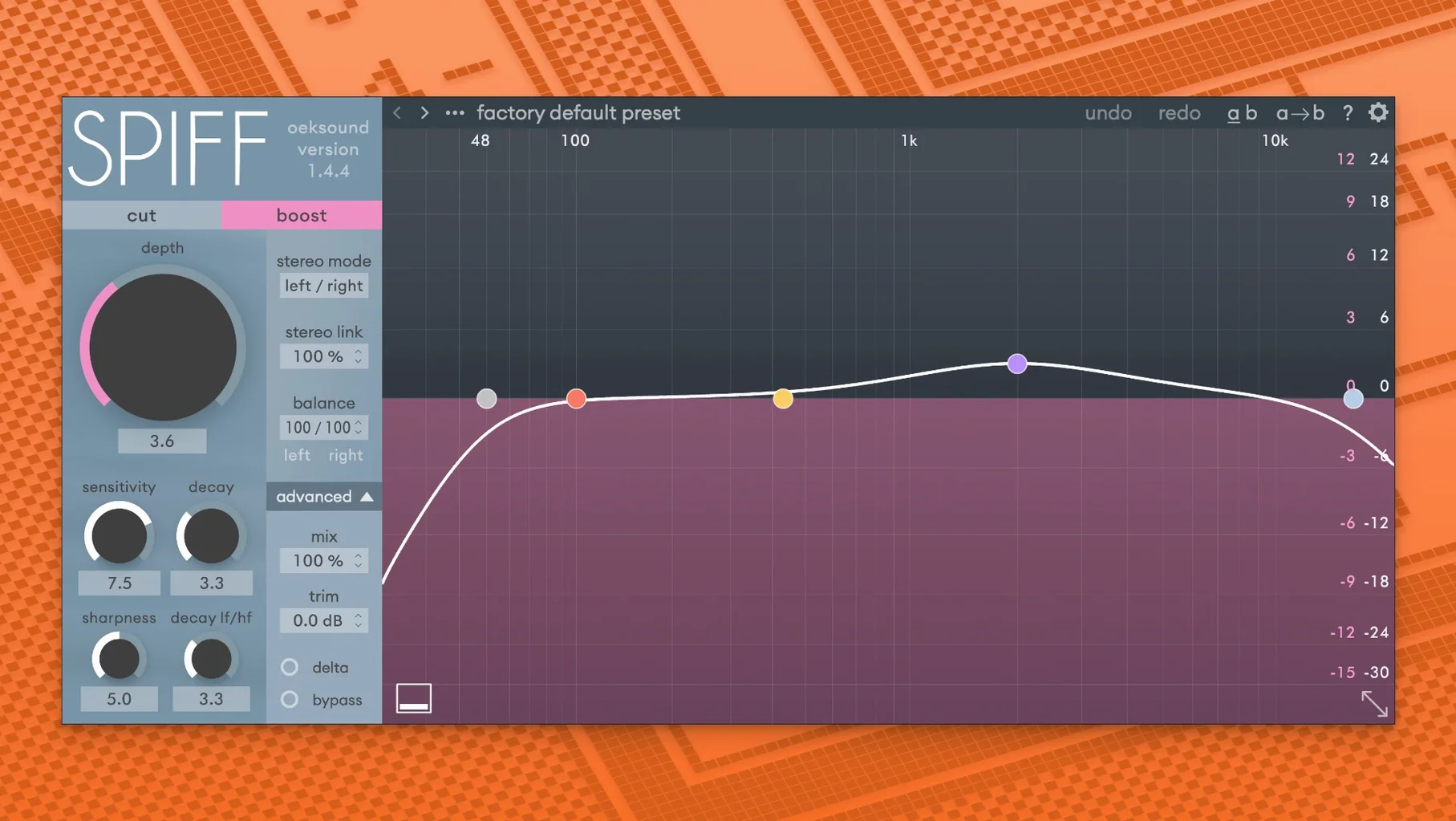
Version 1.4.4 landed with a pair of long-awaited fixes: playback overloads in Logic when the GUI first opens are gone, and automation glitches after mod-key parameter clicks in Pro Tools have been ironed out. It’s a maintenance release, but for anyone who works fast with key commands and dense sessions, it removes friction that had been lingering for a while.
On individual tracks: drawing out or taming the attack
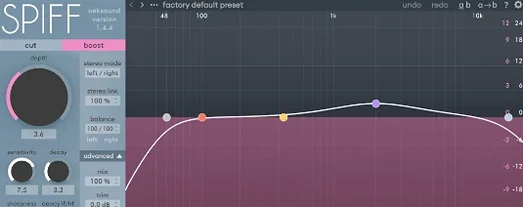
Spiff listens to the incoming signal and identifies transients adaptively, without ever splitting the sound into frequency bands. On a close-miked acoustic guitar where the pick noise jumps too far forward, pulling the delta fader down pushes the transient back into the body of the note — not by dulling the top end, but by actually reshaping the front of the sound. The same control in the opposite direction can give a snare bottom mic more stick definition without adding snap EQ that upsets the shell tone. Because it works on the time-domain contour of the transient rather than a fixed threshold, it follows playing dynamics instead of fighting them, which makes it unusually useful on vocal rides where sibilance and plosives vary take to take.
On buses and the mix: subtle reshaping
On a drum bus, a small cut with a slower attack time can push cymbals back just enough to let the kick and snare speak first, creating a sense of depth that isn’t just volume. On a full mix, boosting transients gently across the midrange can restore articulation lost to heavy compression earlier in the chain, though it rewards a light touch — the adaptive detection is precise enough that overdoing it pulls the mix apart at the seams. Because Spiff runs natively on Apple Silicon and works from High Sierra all the way through to Tahoe, it slots into mobile and studio rigs without compatibility headaches.
Sliding into a session: DAW and OS realities
Spiff runs as VST, VST3, AU and AAX — the formats cover every major DAW without workarounds. Dropping it into an Ableton drum rack or a Pro Tools aux track feels the same: the plug-in scans quickly and the GUI settles without the sluggish window resizing some spectral processors suffer from. On an M1 Max machine, a session with twenty instances of Spiff spread across dialogue stems, foley and a music bed leaves the CPU meter hovering around 25 percent, and the fans stay quiet. Memory pressure barely moves. That kind of headroom means you can commit less, keeping the transient shaping alive through revisions instead of freezing tracks early.
Alongside other tools: where Spiff sits in the chain
The plug-in pairs naturally with dynamic EQs and multiband compressors, but it fills a gap they don’t. A de-esser catches sibilance by frequency; Spiff catches the click of a tongue against teeth by shape, regardless of pitch. Placed before a compressor, it pre-shapes the attacks so the compressor reacts more musically. Placed after, it can restore the sense of front-to-back space that heavy gain reduction flattens. It also plays well with macOS Audio Unit routing and aggregate devices — swapping between the studio interface and the built-in output doesn’t interrupt processing or require buffer-size gymnastics. If you already use Soothe in a chain, Spiff handles the opposite end of the envelope, and the two together give you a kind of time-and-timbre control that feels closer to editing than mixing.
Version 1.4.4 is a targeted maintenance update. It resolves playback overloads in Logic that occurred when opening the GUI for the first time, and corrects automation behaviour in Pro Tools after mod-key parameter clicks. A handful of smaller fixes round out the release.
- macOS 10.14 Mojave or later
- Apple Silicon and Intel support
- VST, VST3, AU, AAX plug-in formats
- AAX requires Pro Tools 11 or later
Questions from the booth
Instead of splitting the signal into bands or relying on a fixed threshold, Spiff analyzes the incoming audio and adapts its transient detection to the material in real time, which preserves the natural tone of the sound while reshaping the attack.
Yes, Spiff 1.4.4 runs natively on Apple Silicon and also supports Intel Macs from macOS 10.14 Mojave onward.