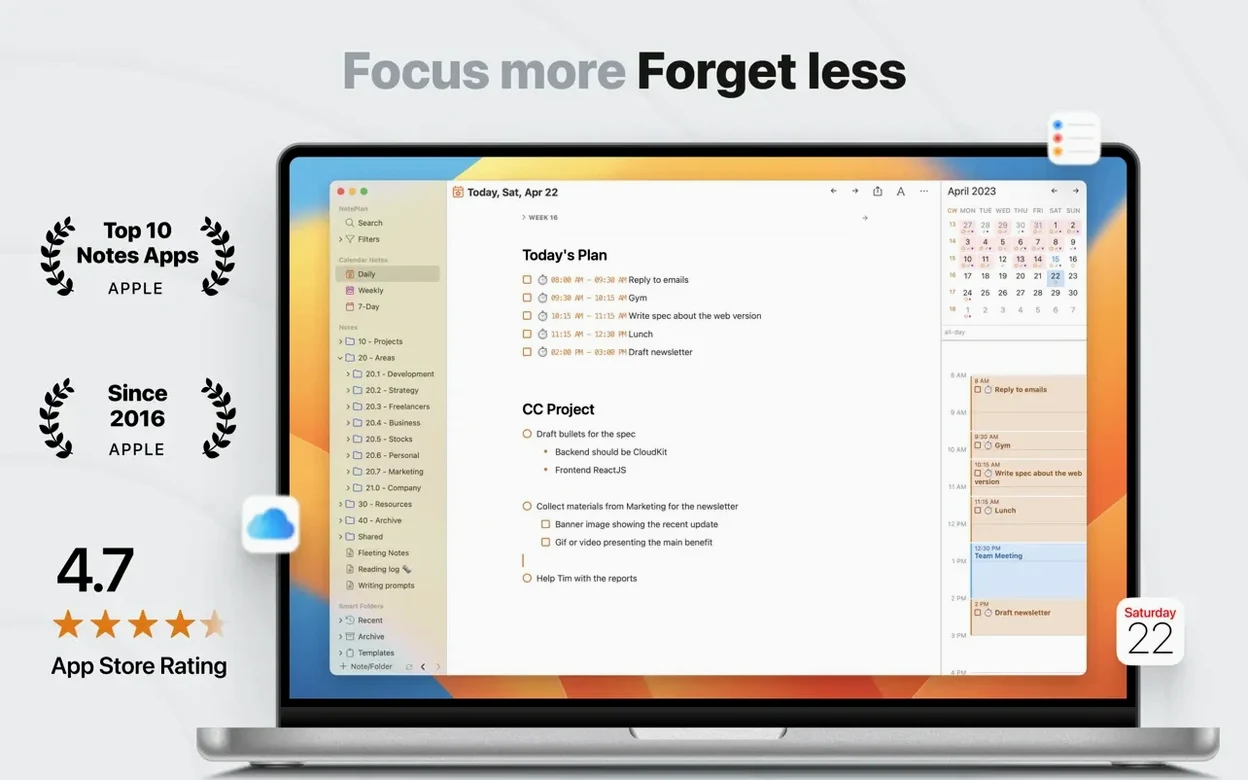
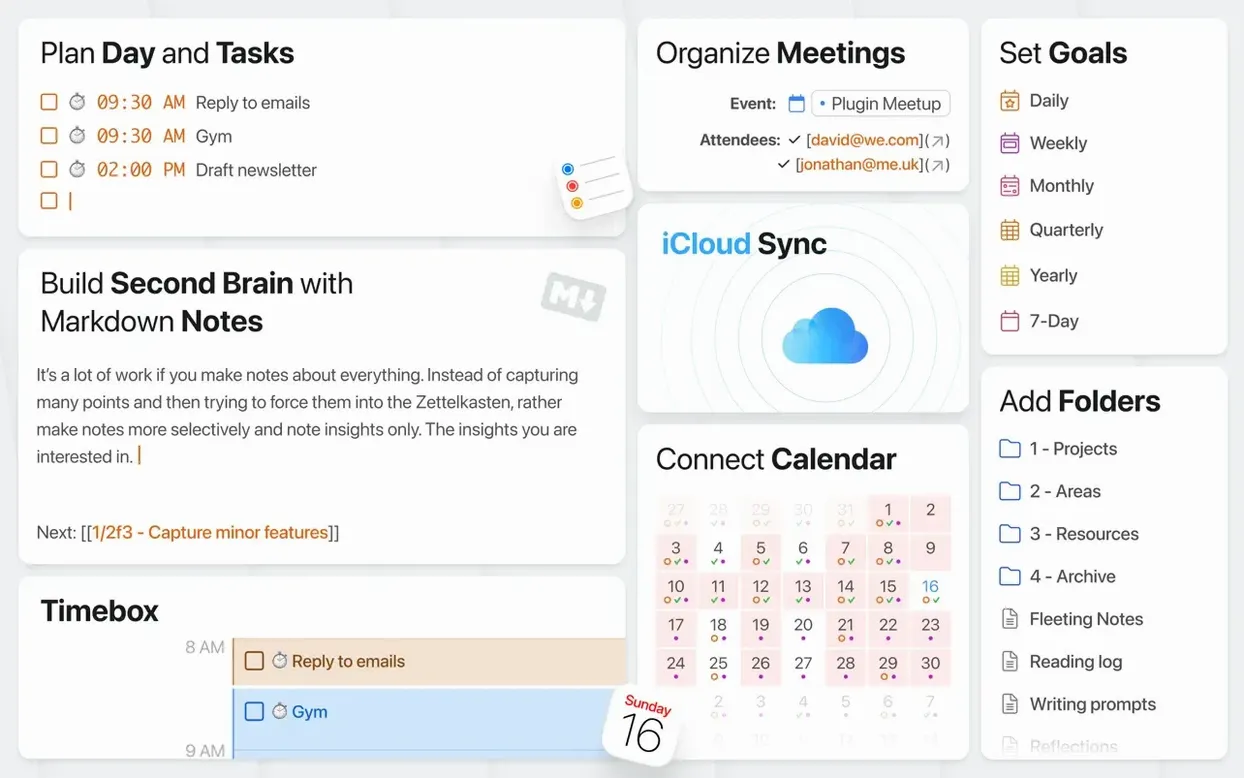
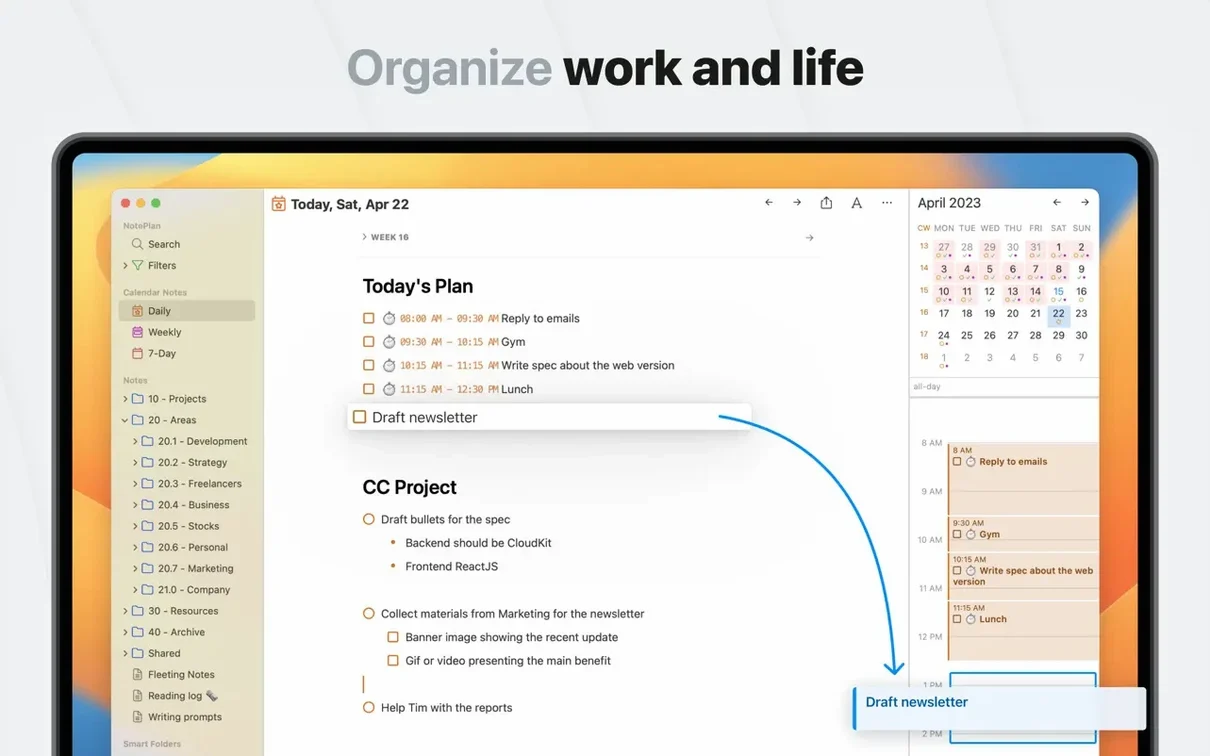
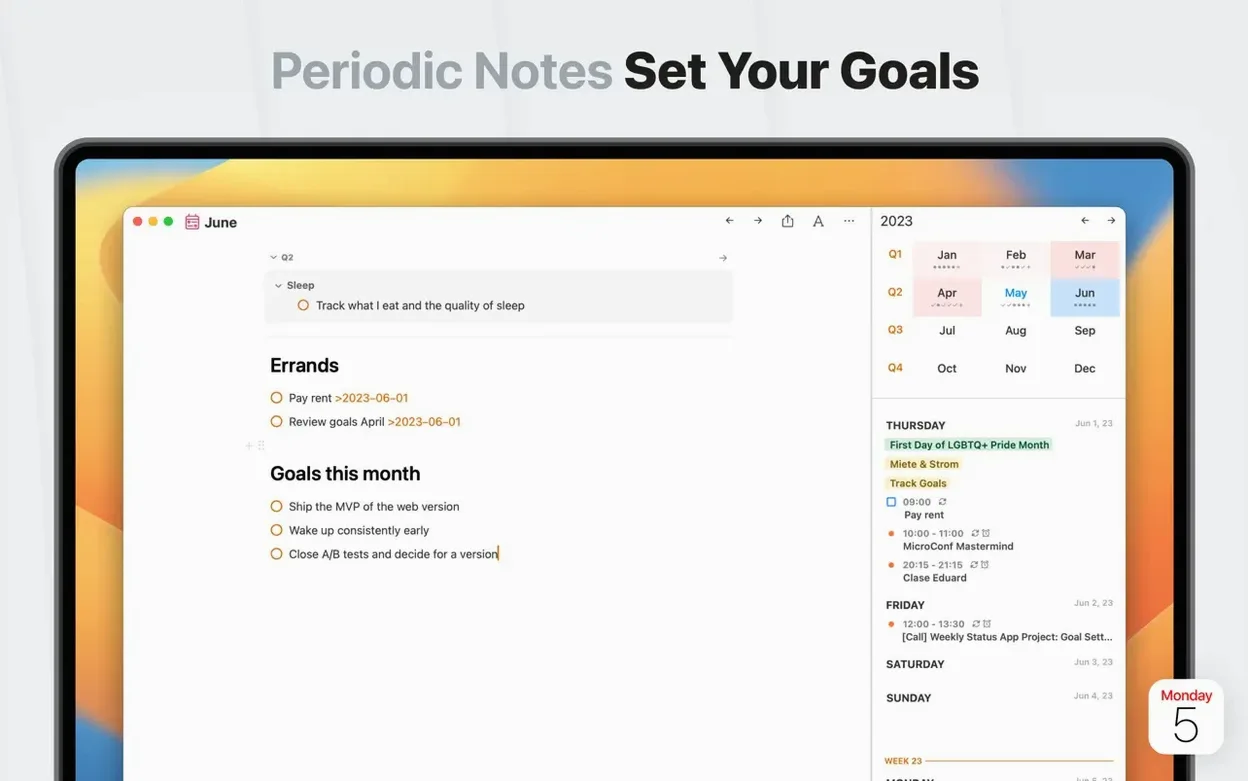
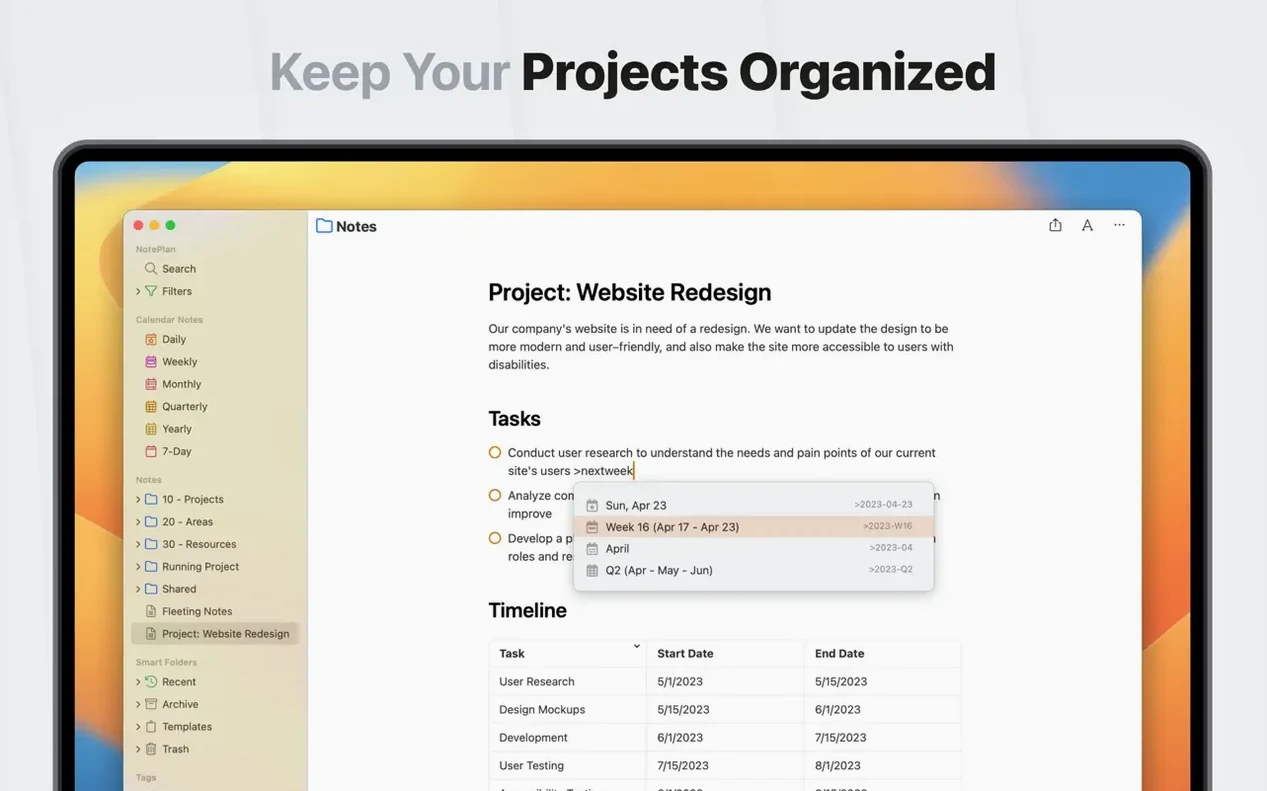
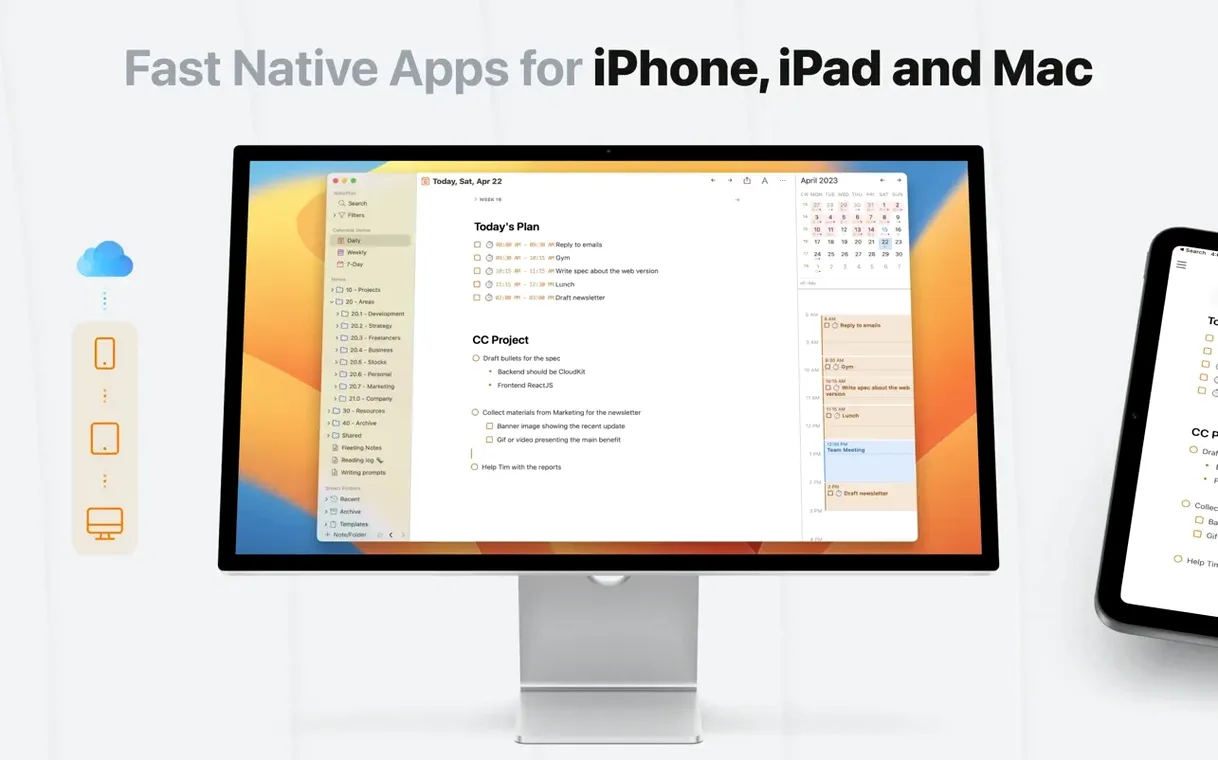
Date-based grouping in regular folder views is one of those quiet additions that reshapes how a morning review feels. NotePlan doesn't wall off your tasks from your notes or your calendar — it threads them together into a single workspace built around a daily note. That note is where the day starts: a running page that holds scheduled events, open tasks, and the stray thoughts that surface while you scan what's ahead.
Tasks live inside your notes as plain-text lines, tagged and filtered by date, project, or custom tag. Nested folders give you structure without forcing a system on you, and Apple Reminders integration means items you capture elsewhere still surface in your plan. Recurring tasks and drag-and-drop rescheduling keep the rhythm from stalling, while task checklists let you break a single line into smaller steps without leaving the note.
The running daily page anchors your thinking
- Anyone who thinks best in a running daily page rather than isolated task lists
- Planning across Apple silicon and Intel Macs running macOS 14
- Working in English, German, or Spanish
Sync sits this version out, activation does not
- Sync is not functional in this version
- No activation is required, but the app expects macOS 14 or later
⌘J opens a command palette that replaces menu diving
The command palette opens with ⌘J and it's worth memorizing early — type a few letters and you jump to any note, run an action, or search by tag without lifting your hands. Less obvious is that you can pin it open as a floating panel from the menu bar, which turns it into a persistent scratchpad for quick capture. Another quiet feature: holding ⌥ while clicking a task marks it complete without moving your cursor, a tiny gesture that keeps the typing flow intact when you're reviewing yesterday's leftovers.
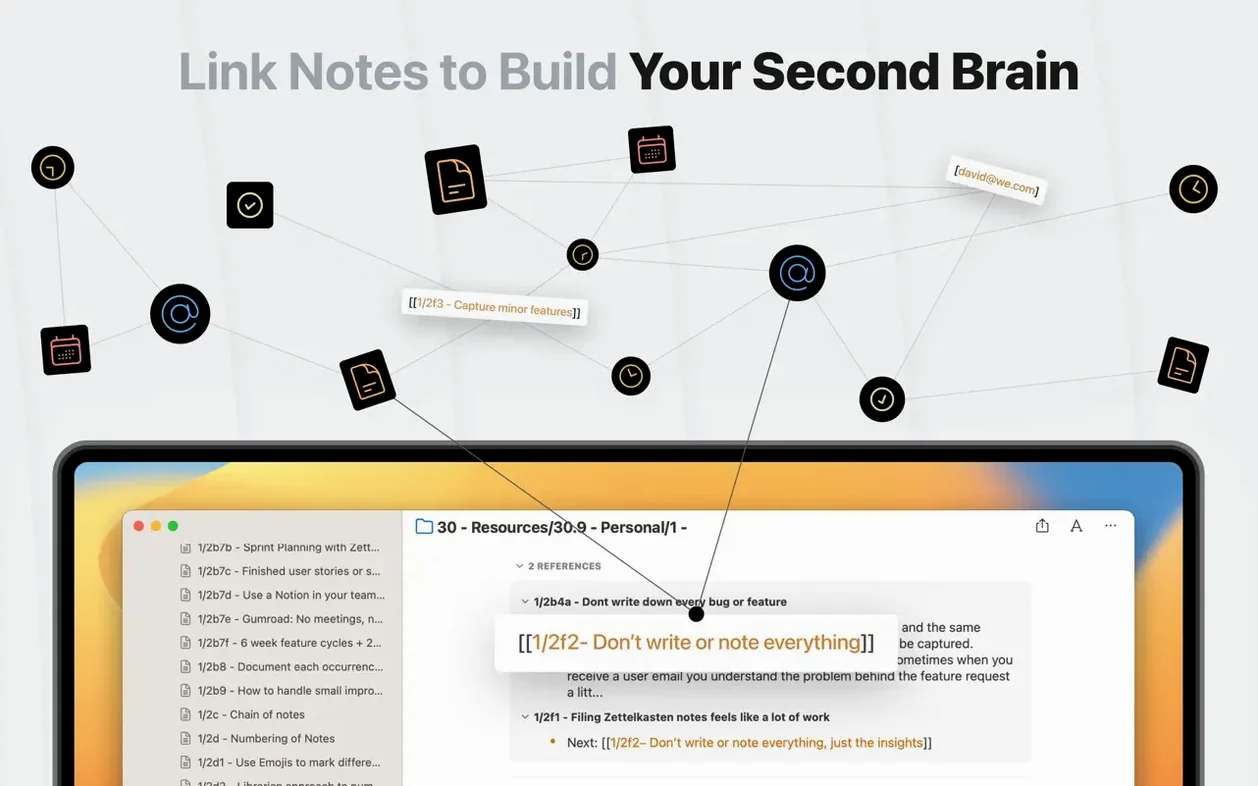
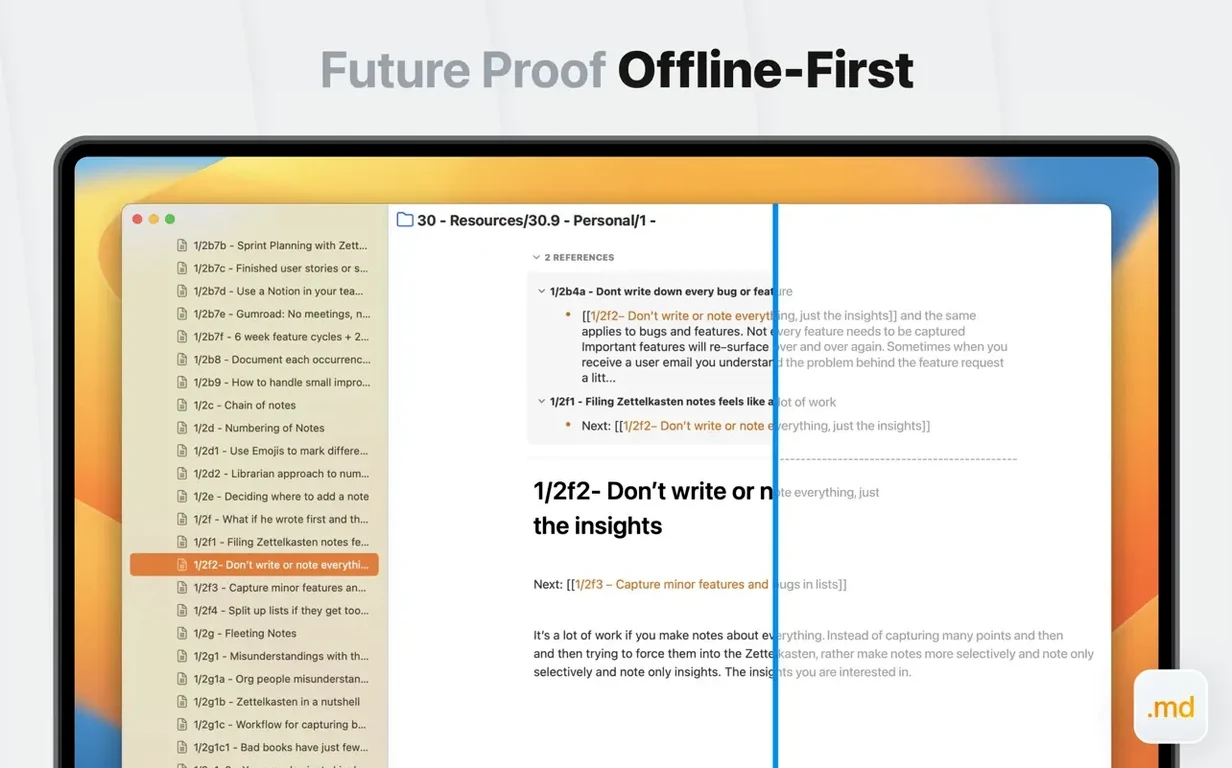
Bidirectional linking works between any two notes by wrapping a title in double brackets, but the app also suggests links as you type a note's name — look for the inline popover that appears after the third character. Those backlinks collect at the bottom of the target note automatically, so you rarely need to hunt for connected pages. In the calendar sidebar, dragging a task from the upcoming list onto a day cell reschedules it, and holding ⌘ while dragging duplicates it instead, useful for planting the same reminder across multiple mornings.
Time blocking is tucked into the daily note's date header: type a time like 14:00 at the start of a line and the app treats it as a scheduled block that appears in Apple Calendar. Combine that with a tag like #meeting and the block inherits the tag's colour for at-a-glance scanning. The editor improvements in 3.21.3 smoothed out some long-standing Markdown rendering quirks — inline code backticks no longer break when followed by punctuation, and nested bullet lists indent more predictably now, especially inside task checklists.
Speak a task into existence without opening the app
Siri AI support arrived in 3.21.3, letting you speak a task or note into existence without opening the app. The phrasing is deliberately simple: "Add a note to NotePlan" or "Create a task for tomorrow morning" routes the text into your inbox or daily note. It's not conversational AI — more of a dictation shortcut that respects the app's plain-text core — but it changes the friction of capture on mornings when opening the lid feels like the hardest step.
Date-based grouping for regular folder views is the other headline change. Previously, folder views sorted notes alphabetically or by modification date. Now you can group them by the date embedded in the note title or its frontmatter, which makes project folders feel more like a timeline. For anyone keeping meeting notes or daily logs inside a project folder, the view finally reflects chronological sense without extra tags or manual sorting. Apple Reminders reliability also got a meaningful bump — items that used to stall for minutes now sync within seconds, and completed reminders clear from NotePlan without ghosting back hours later.
Arranging a week review from scratch
Start in the weekly note — press ⌘⇧W to jump to the current week — and scan what carried over from last Friday. Drag any unfinished tasks onto fresh weekday cells in the calendar sidebar, assigning each one a home day. Open Monday's daily note and, below the scheduled events pulled from Apple Calendar, jot a short priority list as unchecked Markdown tasks. Add a #focus tag to the three that matter most so they surface in the dynamic upcoming list regardless of date.
While you work through the morning, check off items with ⌥-click and use the command palette to hop into project notes for larger context — type the project name, open its note, and link the daily task back to it with [[ ]] brackets. By mid-afternoon, pull up the monthly note (⌘⇧M) and drop a quick reflection line about what's carrying weight this week. The whole rhythm stays in plain text, so nothing locks you into a structure you can't reshape next Monday.
Version 3.21.3 introduces Siri AI support and date-based grouping for regular folder views, making it easier to scan notes by when they were created or last touched. Apple Reminders reliability sees a round of fixes, and several improvements land for sync and the editor.
- macOS 14 or later
- Apple silicon or Intel Mac
Questions from the booth
Yes, you can set tasks to repeat on a schedule and nest sub-task checklists inside any task line for finer-grained progress.