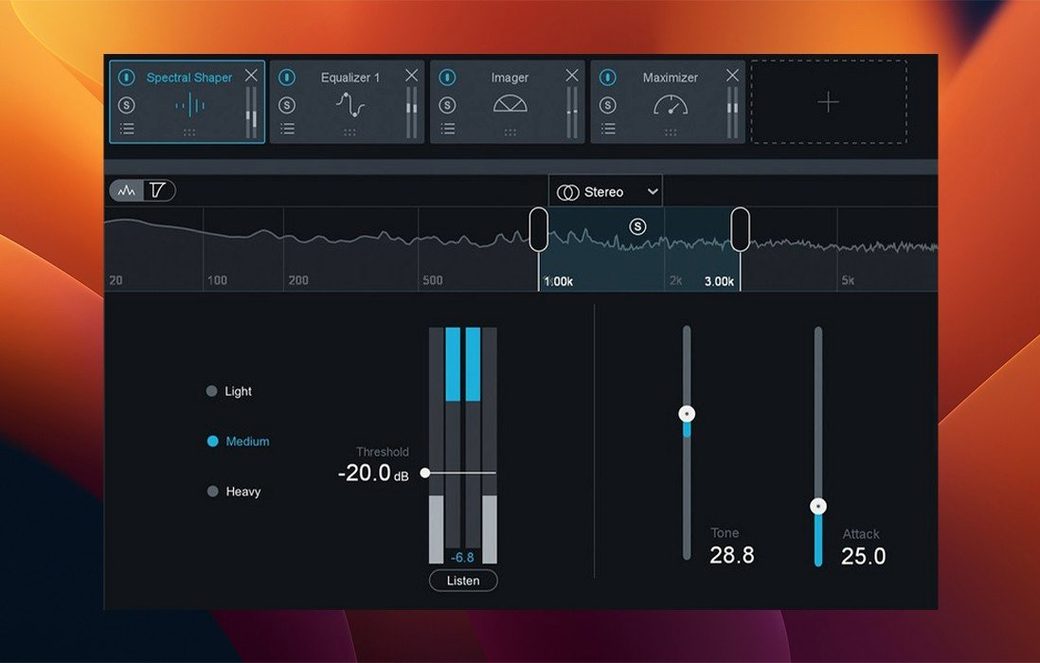
Ozone 12.1.0 lands on Apple Silicon and Intel Macs running macOS Ventura 13.7, Sonoma 14.7, or Sequoia 15.4. The suite speaks AU, AAX, and VST3—all 64-bit, no 32-bit bridges to lean on. Before you commit drive space to an ozone 11 mac torrent or an ozone 12 advanced download, it helps to know what the actual installer carries and where it fits in a finishing chain.
Pushing loudness with IRC 5 keeps transients tactile
- Shaping a final stereo bus with the IRC 5 mode inside the Maximizer, which pushes loudness while keeping transients surprisingly tactile.
- Carving space in a dense mix with Stem EQ—being able to nudge the vocal stem and the drum bus separately inside one window changes how quickly a master gels.
- Controlling runaway low end with the Unlimiter, a module that handles brickwall duties with a gentler knee than the Maximizer when the material asks for it.
- Working across DAWs: Cubase 15 support arrived with this release, sitting alongside the established Logic and Pro Tools workflows.
Mono-to-stereo processing finally works correctly in 12.1.0
- Mono-to-stereo instances now process stereo correctly—a fix in 12.1.0 that matters if you master multi-mic recordings collapsed to a mono source.
- UI loading and instantiation times were addressed in this version, so the plugin feels snappier when you open a session than earlier 12.x builds did.
- An iZotope Ozone 11 crack Mac search often turns up builds that skip the IRC 5 mode entirely, which removes the module that defines Ozone's current sound.
A blank UI window is usually a GPU acceleration clash
A blank UI window after inserting Ozone on a track is almost always a graphics hiccup, not a corrupted install. If the plugin frame draws white or transparent, toggle your DAW's GPU acceleration setting—Logic's "Metal" rendering can occasionally clash with Ozone's waveform previews. Switching to OpenGL in Logic's display preferences usually clears it. Restarting the host after the toggle matters; a simple project reload won't flush the graphics cache.
Latency complaints tend to surface with the Maximizer's IRC 5 mode engaged during tracking or mixing rather than mastering. IRC 5 introduces a lookahead buffer that feels punishing at low buffer sizes. The fix isn't a setting inside Ozone—it's workflow. Insert the suite only on the stereo bus once tracking is done, or run it in your DAW's "low latency monitoring" bypass path. Some engineers keep a second master bus without Ozone for overdub sessions, then re-enable the suite for the final print.
Stem EQ's inter-stem bleed can trip people up when the source material wasn't cleanly separated to begin with. If your "vocals" stem carries faint drum bleed from a live room, boosting 200 Hz on the drum stem and cutting it on the vocal stem creates a strange comb-filtered hollow. The module assumes discrete stems. When working with less-than-perfect separations—ripped from a stereo mix with AI tools, for instance—use gentler curves and solo each band's effect to check for artifacts before committing.
Native Apple Silicon support across AU, AAX, and VST3
Ozone works as an Audio Unit, AAX, and VST3 plug-in, which means it slots into Logic Pro, Pro Tools, Cubase, and Ableton Live without bridging software. On Apple Silicon Macs, AU and VST3 instances run natively—no Rosetta translation needed—provided your DAW also runs as a native binary. AAX on Pro Tools still relies on Avid's own Silicon transition timeline, but the plug-in itself is arm64-ready.
macOS's Audio MIDI Setup utility matters more than it seems. If your interface's sample rate mismatches your DAW session—say, the system runs 48 kHz while Logic expects 44.1 kHz—Ozone's internal oversampling and analysis tools can exhibit slight pitch shifts in the Assistive Audio previews. Locking the project sample rate in your DAW and matching it in Audio MIDI Setup before launching the session prevents this.
The plug-in also responds to macOS's native color profile handling. On wide-gamut displays like the MacBook Pro's XDR screen, Ozone's spectral analyzer gradients can appear oversaturated unless you've calibrated the display or set your DAW's plug-in window rendering to sRGB. It's a subtle visual thing—the metering remains accurate—but a skewed spectrum display can lead to second-guessing your EQ moves.
The Assistant learns from the loudest section it analyzes
Slapping the Master Assistant across a mix and trusting the first suggestion without listening to the delta is the big one. The Assistant learns from the loudest section it analyzes; if you feed it a quiet intro, the suggested EQ curve and limiting threshold will skew conservative. Always play the densest part of your track—typically the final chorus or climax—while the Assistant listens, then step through the genre targets inside the Stabilizer module manually to hear what each curve actually does.
Stacking multiple instances of the Maximizer on a single bus in the hope of "cumulative loudness" is another pattern. IRC 5's adaptive release already handles transient shaping and density in one pass. A second Maximizer downstream fights the first one's envelope, creating a pumping artifact that sounds like bad sidechain compression. If you genuinely need more level, back off the first Maximizer's threshold by 1–2 dB and let IRC 5 do the work across a wider dynamic window.
Beginners also tend to ignore the Bass Control module's crossover point. The default 120 Hz split works for club-oriented electronic music, but acoustic folk or jazz with a warm upright bass often benefits from lowering the crossover to 80 Hz or even 60 Hz. Leaving it at 120 Hz on a sparse track pushes low-mid energy into the sub band where nothing lives, thinning out the body of the bass instrument.
Tweak stem balances while the Maximizer runs on the stereo bus
Self-producing songwriters who track, mix, and master their own material inside a single project file tend to extract the most value. Having Stem EQ and the Maximizer on the stereo bus while still being able to tweak individual stem balances means they can catch low-end collisions between the kick and bass without bouncing stems out to a separate mastering session. The workflow stays iterative—mix a little, check the master, loop back—without the export-import dance.
Post-production editors working on short-form content also find a sweet spot. The Stabilizer's genre targets include presets tuned for dialogue-heavy material, which translates well to podcast and video essay finishing. Running the module at a gentle 15–20% wet mix can even out vocal dynamics without obvious compression artifacts, and the Unlimiter catches peaks that would otherwise clip a platform's loudness normalization stage.
Users who maintain separate headphone and monitor calibration profiles benefit from Ozone's ability to store module chains as user presets. A mastering chain tuned for open-back headphones can sit alongside one voiced for nearfield monitors, each with slightly different tonal emphases in the EQ and Stabilizer modules. Dragging the preset file between Macs is straightforward—the plug-in stores them in a predictable ~/Documents/iZotope/Ozone 12/ folder, making it easy to carry settings onto a travel laptop.
Option-drag an EQ band to hide the spectrum overlay
Double-clicking a module's name collapses it instantly, which beats hunting for the small disclosure triangle when you're A/B testing a chain. Holding Option while dragging a band in the EQ module temporarily disables the spectrum analyzer's real-time overlay—useful when you want to see the static frequency plot underneath without the live energy curve obscuring it.
The Stabilizer keeps a hidden wet/dry blend per band, reachable by right-clicking any of the three processing regions. Dragging the blend slider for the high band down to 30% while leaving the low and mid bands at full intensity creates a subtle top-end softening that resembles a tape machine's gentle roll-off, without needing a separate saturation plug-in in the chain.
If you chase down an ozone 11 free download or an ozone 12 advanced download from a source that strips the bundled presets, you lose the 25 genre targets inside the Stabilizer—those are data files, not compiled code. The factory content folder needs to sit alongside the plug-in components for the Assistant and Stabilizer to reference them. A missing "Reference" folder in the iZotope user library means the module loads with a blank target list, and manually recreating those curves is painstaking work.
Lastly, the Maximizer's IRC 5 mode exposes a "Character" slider that defaults to the middle position. Pushing it toward "Punch" shortens the release envelope on transient-heavy material like hip-hop or drum-forward rock; pulling it toward "Smooth" lengthens the recovery for sustained sources like strings or pads. It's a single control that reshapes the entire limiting behaviour, and it hides in plain sight beside the threshold knob.
Version 12.1.0 tightened the launch experience—plugin windows and instantiation now load without the lag that crept into earlier builds. Mono-to-stereo instances finally pass stereo processing correctly, a fix that saves a workaround routing. Cubase 15 joins the host list, and the supported macOS versions shifted to Ventura 13.7, Sonoma 14.7, and Sequoia 15.4.
- macOS 13.7 or newer (Sonoma 14.7, Sequoia 15.4 supported)
- Apple Silicon or Intel Mac
- AU, AAX, or VST3 host (64-bit only)