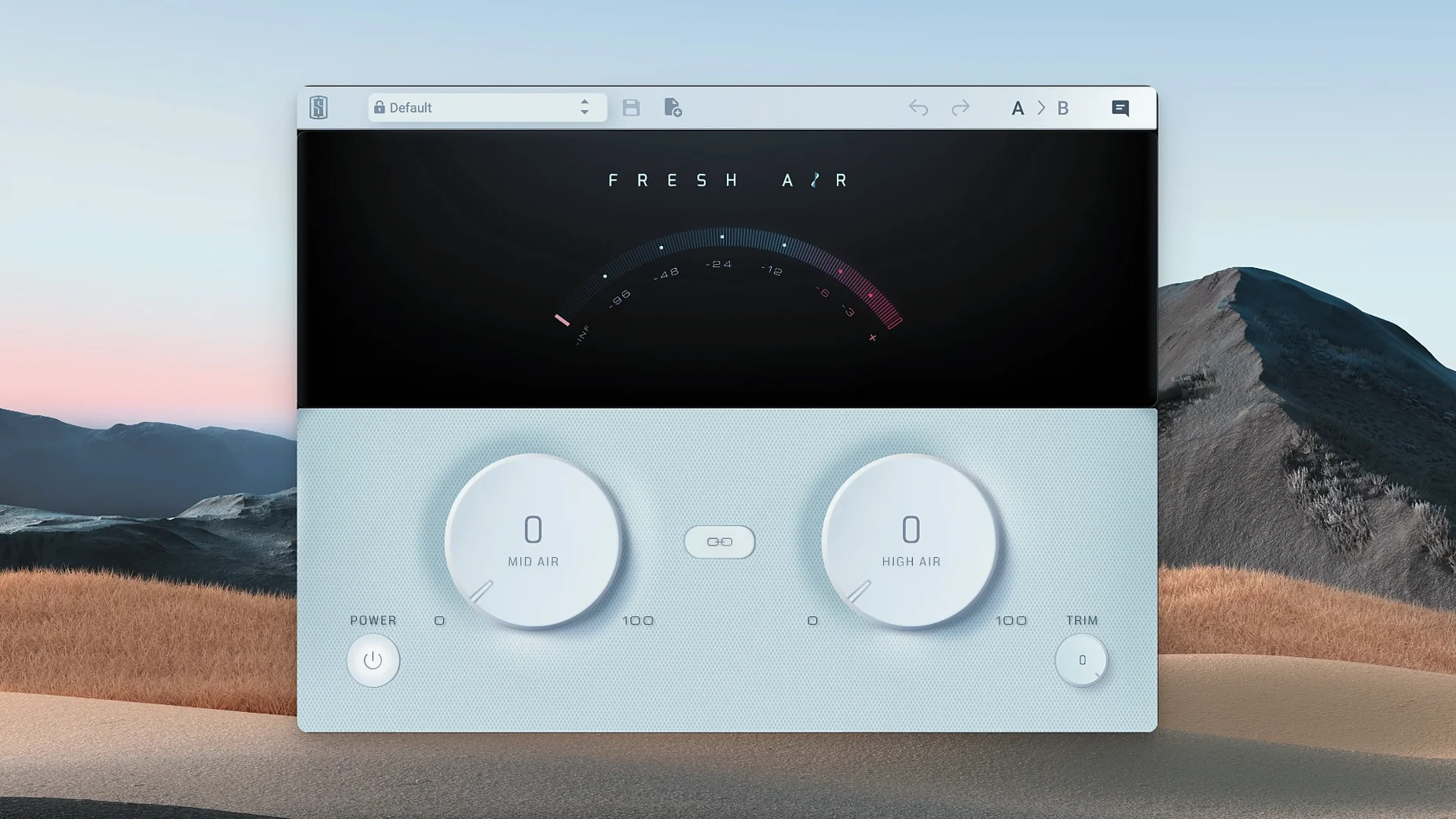
Fresh Air is a dynamic high-frequency processor that uses two deceptively simple knobs to open up the top end of a recording without the brittleness that usually follows.
On individual tracks
A vocal that feels masked in a dense arrangement often needs more than a shelf boost. Mid Air reaches into the upper mids where presence lives, pulling the voice forward without making it nasal. High Air lifts the octave above that, adding the kind of shine that reads as expensive rather than sibilant. The processing is level-dependent, so quiet passages get a gentle lift while louder transients stay controlled. Across guitars, piano and drum overheads, the same restraint holds: brightness arrives without the scratchy artifacts that send you back to the EQ.
Across the mix bus
Engaging the Link button and dialling in a small amount of both controls can nudge a full mix toward openness without tilting the spectral balance. It works as a finishing move after compression, something you add in barely perceptible amounts while monitoring at low volume. The processor responds to programme material rather than applying a static curve, which is why it tends to survive the car test better than a fixed high-shelf boost.
A tracking engineer’s late-night save
Picture a home studio at 11 p.m. A vocalist has just left, and the tracking engineer pulls up the raw takes. The mic placement was solid, the performance is there, but the signal feels like it was recorded through a duvet — warm, close, and missing the top-end openness the song needs. Re-tracking isn’t an option. The engineer drops Fresh Air across the insert, sets Mid Air to about 2.8 and High Air just past 3, then trims the output down half a dB. The vocal lifts out of the murk without sounding processed, and the take stays usable. That same instance stays on the channel through the rough mix, because removing it makes everything feel flat again. It is the kind of fix that happens in thirty seconds and prevents a much longer conversation about booking another session.
Native Apple Silicon support, no Rosetta required
Most people searching for slate digital fresh air mac want to know whether it will run on an Apple Silicon machine without Rosetta. It will. The current build is native for ARM, and the installer places the component where Logic and other hosts expect to find it — no translation layer, no extra CPU overhead. Another common question is whether the plugin works without physical iLok hardware. It does. Machine activation and iLok Cloud are both supported, so the only dongle in the equation is the one you choose not to use. People also ask if Fresh Air is just another exciter that will shred their high end after ten minutes of listening fatigue. The dynamic processing inside it means the effect backs off as the input gets louder, which is the opposite of how a static exciter behaves. That detail matters more than the vintage circuit inspiration.
Instant loads and clean Retina scaling in Logic
Fresh Air integrates like any AU or VST3 plugin — it appears in the effects slot, loads instantly, and draws its modest interface without scaling quirks on Retina displays. It plays well with Logic’s low-latency monitoring mode, which makes it practical to leave active while tracking if the buffer is reasonable. On the automation side, both knobs and the Trim control are exposed as automatable parameters, so riding the Mid Air amount through a chorus section takes two clicks in Touch mode. The plugin also shows up in Audio Units host applications beyond traditional DAWs — video editors who do light audio work in Final Cut Pro can route through an AU host like Blue Cat’s PatchWork and apply Fresh Air to dialogue or room tone without leaving the Mac ecosystem. It does not require any companion software, a separate licensing manager window, or a background service that phones home once it is activated. That keeps the menu bar clean and the session loading times short.
Why cranking both knobs past noon backfires
The first is treating Fresh Air like a static EQ and cranking both knobs past noon while monitoring at loud playback levels. At high volume, the ear perceives brightness as excitement, but on quieter systems — laptops, phones, car speakers at moderate levels — the same settings turn brittle fast. A better habit: set the amount with the monitors quiet, then check at regular listening level.
The second mistake is ignoring the Trim control. Adding high-frequency energy increases perceived loudness, which makes the processed signal sound “better” in an unlevelled comparison. Dial back the output so the bypassed and processed signals match in apparent volume, then judge what the plugin is actually doing. More often than not, a smaller Mid Air setting survives the comparison better.
The third is reaching for Fresh Air before fixing what is wrong lower down. A muddy vocal with a 400 Hz buildup will not become clear by adding 8 kHz. Clean up the low-mids first, then open the top. The plugin works best as the final polish on a sound that already makes sense, not as a mask for problems a shelf EQ should have handled earlier.
- macOS 11 or later
- Apple Silicon native support