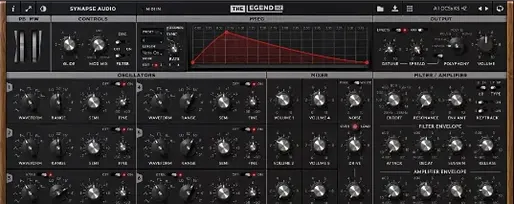
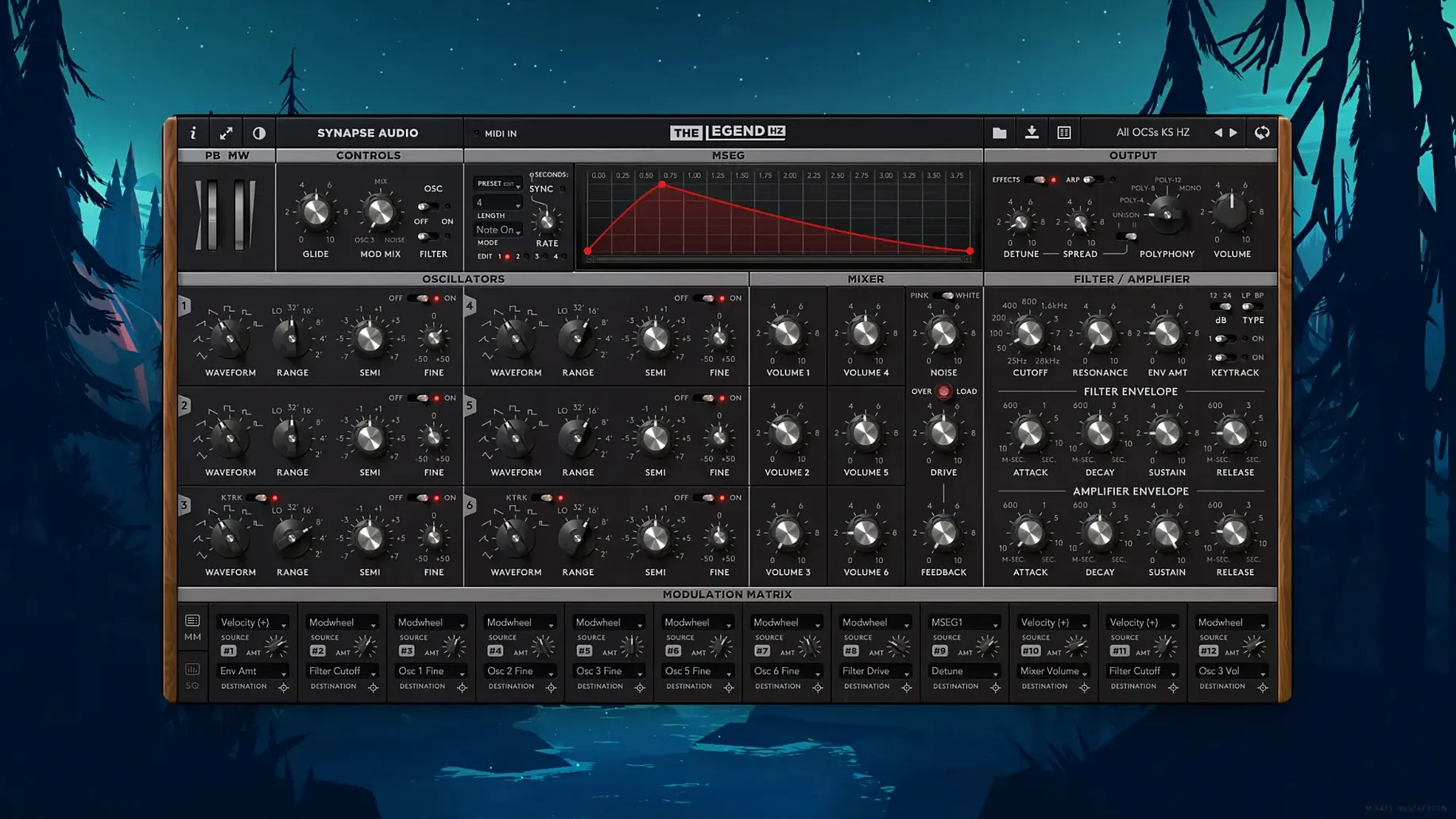
Twelve voices of polyphony, three plug-in formats, and a fixed filter bank derived from vintage console EQs — The Legend HZ arrives as a fully formed instrument before you even load a preset. It runs in VST, Audio Unit, and AAX hosts on Intel or Apple Silicon Macs, with MPE support baked in so every voice can carry its own pitch bend and pressure data. Projects that reference the original The Legend will open this version automatically, letting the two instruments coexist in a session without fuss.
- Factory presets designed by Hans Zimmer and Kevin Schroeder, covering everything from weighted sub basses to brittle, percussive sequences
- A 914 Fixed Filter Bank for carving resonant peaks and notches across the output stage
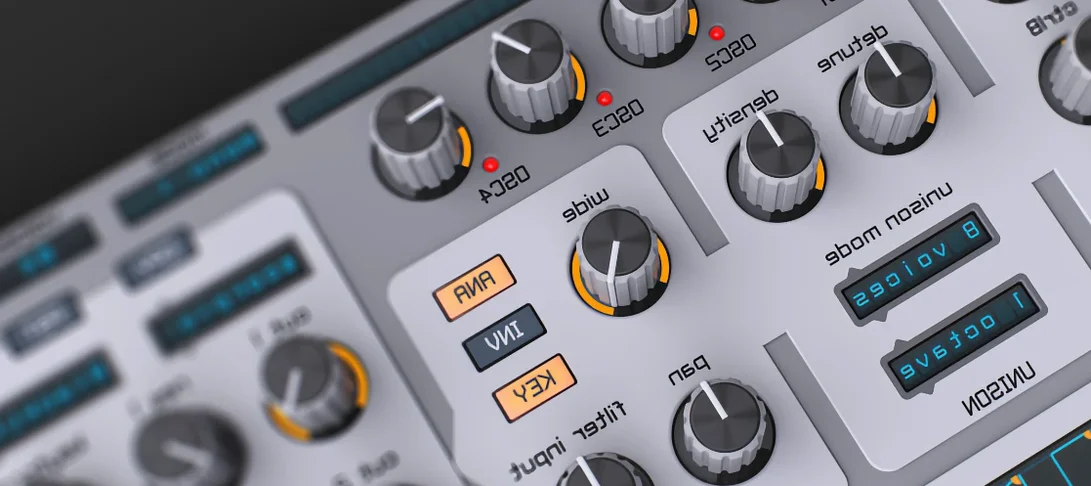
- Unison mode that stacks and detunes voices for thick, drifting analogue textures
- Arpeggiator and sequencer with per-step controls, locked to host tempo or running free
- Native Kontrol Standard integration, so every parameter maps to Maschine and Komplete Kontrol hardware immediately
- MTS-ESP microtuning support for scales that extend well beyond equal temperament
Behind the front panel sits a paragraphic EQ and a compressor saturation stage added in version 2.1 — tools that push the signal from warm and rounded to something closer to tape compression when you drive them hard. The architecture stays faithful to the discrete oscillator and ladder-filter modelling Synapse Audio have refined for years, but the expanded voice count and Hans Zimmer’s own patch library tilt the instrument toward sound design as much as bassline duty.
A rawer oscillator tone than Diva’s chameleon-like impersonations
Put The Legend HZ next to u-he Diva and the difference in character becomes clear within a few notes. Diva spreads its modelling across three oscillator and two filter architectures, which gives it a chameleon-like ability to impersonate a Roland, a Korg, or a Moog depending on the patch. The Legend HZ does one thing — the discrete transistor ladder filter and three-oscillator signal path — and pushes that singular voice into territory Diva only brushes past. The 914 Fixed Filter Bank alone opens resonant band-pass combinations that would require external processing in Diva, and the six-oscillator architecture (three doubled per voice in unison) gives pads a density Diva reaches only by stacking instances.
Arturia Mini V leans harder into the vintage instrument experience, right down to wood-panel graphics and modulation routing that mirrors the original hardware. Its strength lies in that nostalgic workflow and a preset library broad enough to cover decades of recorded Moog sounds. The Legend HZ trades the panel-for-panel nostalgia for modern sound-design reach — the paragraphic EQ, compressor saturation, and MPE implementation belong to a current production environment, not a museum piece. Mini V responds to a ribbon controller; The Legend HZ responds to per-note pressure and microtonal scales, which matters the moment a session calls for something outside equal temperament.
Pull the back-panel compressor saturation to about thirty percent
Head straight to the back panel and pull the compressor saturation up from its default. The difference between zero and roughly thirty percent is subtle — a slight rounding of transients that softens the oscillator attack without obvious compression artefacts — but push it past halfway and the low mids begin to thicken in a way that recalls console overdrive. For bass patches with a fast release, that saturation stage is often the single most effective change you can make before touching the filter.
The voice allocation mode sits in a small dropdown near the polyphony control and ships in a round-robin configuration. Switching it to reassign changes how stolen voices behave during sustained chords, which matters enormously for pad patches with long release tails. In round-robin mode, a nine-voice chord held across a bar will cycle through voices evenly. In reassign mode, new notes steal the oldest voice, which keeps the texture tighter as notes accumulate. Neither is better — but knowing the difference lets you decide whether a pad breathes or stays contained.
On the arpeggiator page, the default latch behaviour is off. Turning it on — and setting the sequencer to retrigger on note input — turns the arpeggiator into a performance tool that keeps running while you audition chords one-handed. Combined with MPE pressure routed to filter cutoff, this one change makes the instrument feel more like a tactile hardware sequencer than a plug-in.
Right-click any knob for per-instance MIDI assignments
Right-clicking any knob reveals an option to assign it to a MIDI controller without opening a separate mapping window. The assignment sticks per instance, not per preset, so a controller mapped to filter cutoff on a bass track won't carry over when you load a lead patch in the same session. That per-instance memory lets you build controller layouts that make sense for the role the synth plays in each track.
Holding Option while dragging a knob switches it to fine-adjust mode, with roughly ten times the resolution of the default mouse movement. This is especially useful on the fixed filter bank, where half a millimetre of travel can shift a resonant peak by several semitones. The same modifier works on the paragraphic EQ bands, letting you dial surgical cuts without reaching for a numeric entry field.
The preset browser responds to plain-text typing — not just arrow keys. Click the preset name display and type the first few letters of a sound you remember; the list filters instantly. Given that the factory library spans over two hundred patches organized by category, this small touch saves more time than it seems on paper.
A film composer's first hour with it
Picture a composer on a deadline for a science-fiction short, sitting down with The Legend HZ for the first time after downloading the legend hz mac torrent. The scene on the timeline is a slow push through a derelict station interior — no dialogue, just ambient hum and the occasional metallic groan from the hull. She loads the "Subterranean Drift" preset, drops the compressor saturation to forty percent, and routes an LFO to the fixed filter bank's lowest band for a slow, cyclical dip in the sub frequencies. The result is a bed of tone that feels alive without drawing attention to itself — exactly what the shot needs underneath the foley.
For the second cue, a chase sequence, she calls up a percussive arpeggio from the Zimmer collection, switches voice allocation to reassign, and maps mod wheel to both filter cutoff and the paragraphic EQ's high shelf. Riding the mod wheel during the take introduces a spectral arc — dull to piercing and back — that follows the action on screen without needing to draw automation by hand. Within an hour, the instrument has covered two opposite ends of the dramatic spectrum, and nothing left the box for external processing. That range — from subterranean drone to brittle, sequenced top end — is where The Legend HZ earns its place in a working composer's template.
Version 2.1 brings a paragraphic equalizer to the back panel, alongside compressor saturation for adding density and drive to the output stage. MTS-ESP microtuning support now lets the instrument follow custom scale files, and fifty new factory presets by Kevin Schroeder join the library.
- macOS 10.14 or later
- Intel or Apple Silicon processor
- VST, Audio Unit, or AAX host
Questions from the booth
No. Projects that contain The Legend will open the original instrument, so both can be used in parallel within the same session.
The Legend HZ is available in VST, Audio Unit, and AAX formats, running natively on both Intel and Apple Silicon Macs.
It supports up to twelve voices of polyphony, with MPE support so each voice can receive independent pitch bend, pressure, and timbre data.