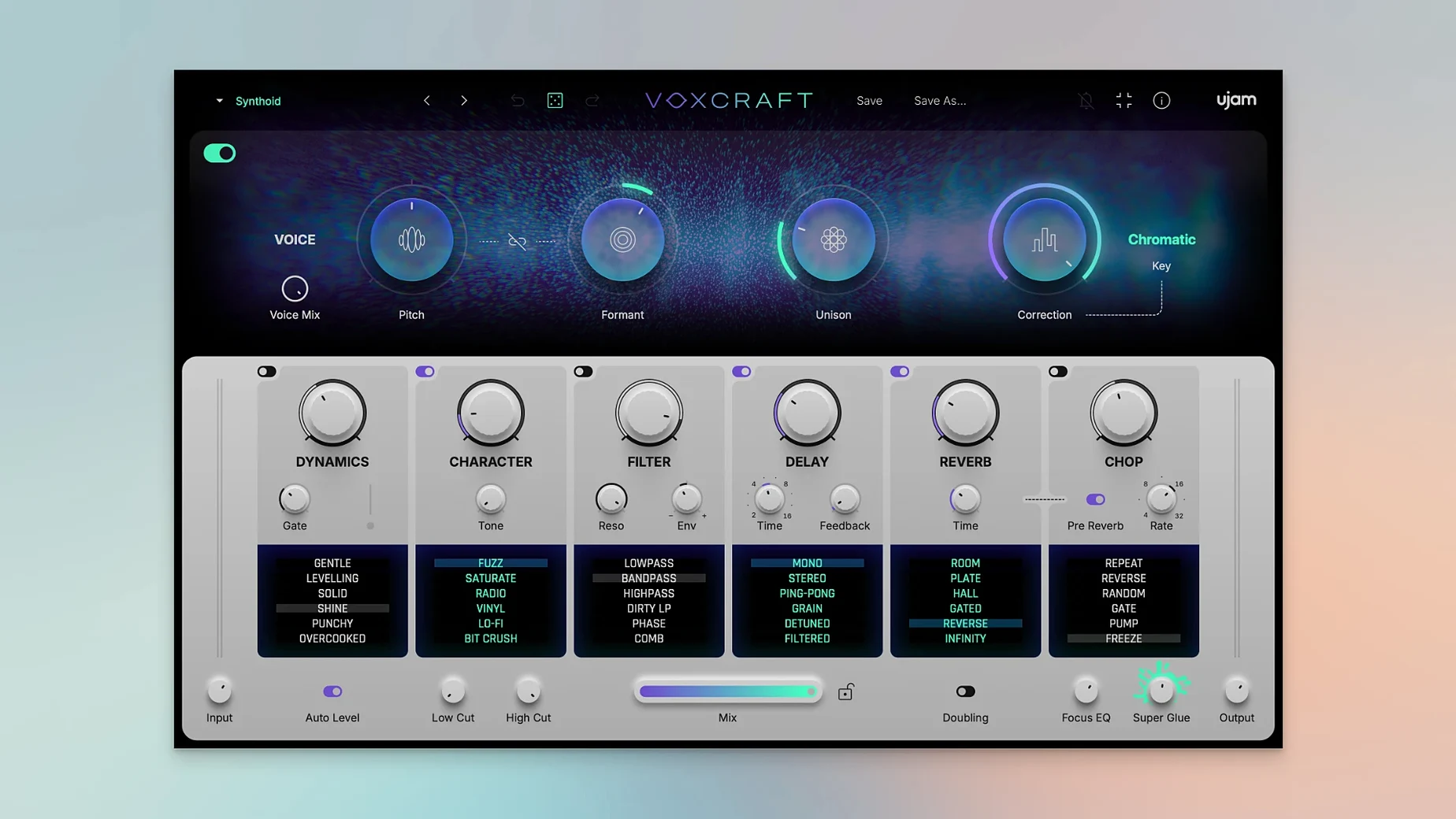
100 presets, six effect modules, and a single focus that UJAM had never tackled before: the human voice. VoxCraft is the developer's first plugin dedicated entirely to vocals, built for producers who work with loops, samples, and chopped phrases rather than full verse-and-chorus arrangements.
Runs natively on Apple Silicon in AU and VST3 hosts
VoxCraft ships as a 64-bit plug-in for macOS 10.13 and later, with native support for both Apple Silicon and Intel processors. It loads into any DAW that hosts AU or VST3 formats — Logic Pro, Ableton Live, Studio One, and the usual suspects all see it without fuss.
What does the signal chain actually do?
The plugin routes incoming audio through six creative modules: dynamics control, a character section for tone and saturation, a filtering block, plus delay, reverb, and a rhythmic chopper for stutter and gate effects. Beneath that runs a core voice engine handling pitch correction, voice multiplication, and formant shifting — the things that turn a dry vocal loop into something that feels composed, even if it started as a single phrase.
How does it approach pitch and tuning?
Rather than chasing transparent, clinical correction, VoxCraft treats pitch as a performance parameter. The tuning engine pulls notes toward a chosen scale with a light touch by default, but pushing it harder yields the hard-tuned sound that's become a texture in its own right. Formant shifting stays independent, so you can alter the perceived size of the vocal tract without touching the pitch.
A vocal atmosphere from scratch
Say you've pulled a short, dry vocal phrase from a sample pack — two words, a little breathy, recorded close. The beat underneath is slow, 75 bpm, with a dark, reverb-washed piano and a sub-bass that only moves every other bar. The vocal as-is sounds too present, too literal. Here's a way through it with VoxCraft.
Start by loading the plugin on the vocal track in your DAW. Open the preset browser and click the randomize button a few times — not to find a finished sound, but to hear combinations you wouldn't have dialled in yourself. One of them lands on a tight, hard-tuned pitch setting with a narrow formant shift upward and a choppy gate on the rhythm module. It's too aggressive, but the formant shift is interesting. Lock that module and randomize again until the dynamics section softens the attack and the reverb pulls the tail outward.
Now tune the details. Pull the pitch correction strength down until the hard-tuning effect barely flickers on sustained notes but still snaps the phrase to the key of the track. Push the voice multiplier to two unison layers, panned slightly apart, and set the character module to something with mild saturation — enough that the breath in the recording catches a little grit. In the filter section, roll off everything below 200 Hz and above 8 kHz so the layered voice sits behind the piano without competing. Dial the delay to a dotted eighth, mix it low, and set the rhythmic chopper to a slow, irregular gate pattern that turns the two-word phrase into something that breathes in and out of the beat. What started as a dry sample now floats behind the track like a texture, not a statement.
Not a channel strip, but a quick transformation engine for vocal one-shots
VoxCraft occupies a narrow but clearly defined lane. It isn't a channel strip for polishing lead vocals, and it doesn't try to be a surgical repair tool. Next to iZotope VocalSynth 2, the difference is structural: VocalSynth layers synthesis engines — vocoder, talkbox, polyvox — under the original signal, treating the voice as an oscillator. VoxCraft never leaves the sample behind. It multiplies, tunes, and shapes the raw vocal itself, which tends to keep the result closer to something still recognizably human. That matters when the goal is a manipulated phrase that still carries the grain and timing of the original performance, not a vocoded wash.
Antares Auto-Tune Pro sits at the other end of the spectrum. It's a precision instrument for pitch, built around graph-based editing and transparent correction. VoxCraft's tuning engine borrows some of that language — scale selection, retune speed — but wraps it in a creative effects chain that Auto-Tune doesn't attempt. Using both in the same project isn't unusual; Auto-Tune for the lead, VoxCraft for the looped backing layers that need character more than accuracy.
For sound designers who already reach for Soundtoys Little AlterBoy when they want pitch and formant shifts with a hard, artifact-prone edge, VoxCraft adds the dimension of layering and rhythm. Little AlterBoy does one voice at a time, brilliantly, with no reverb, no gate, no doubling. VoxCraft bundles those into a single interface, which speeds up the kind of vocal-sweetening chain that would otherwise require three or four separate inserts. It's less of a scalpel and more of a single-knob-per-idea workflow for loop-based production.
Beatmakers drop a single word and turn it into a hook or pad
Beatmakers working from vocal one-shots and short phrases tend to feel at home in VoxCraft almost immediately. The preset library is built for that workflow — quick transformations that turn a single word into a hook, a pad, or a rhythmic element — and the randomize function rewards the kind of fast, audition-heavy process that loop-based production thrives on. If your sessions involve dragging a vocal sample onto a track and wanting something usable within a minute, the plugin fits that rhythm.
Electronic producers building dense, layered arrangements get a slightly different benefit. Because VoxCraft can multiply a single voice into unison stacks and process them independently from the dry signal, it becomes a quick way to build vocal beds without recording multiple takes or stacking plugins manually. The formant and pitch controls stay independent, which means you can create the impression of a small ensemble from one phrase — higher doubles, lower doubles, slightly detuned — all inside one instance.
Sound designers working on game and film projects where the voice needs to feel altered but not synthetic will find the formant-shifting and character modules especially useful. A creature murmur, a distorted radio call, a ghosted phrase that hangs behind dialogue — these sit in the territory VoxCraft was designed to reach quickly, without patching together a dozen separate effects. The rhythmic chopper, in particular, adds a timed, gated motion that suits atmospheric design work far more than it does traditional song arrangement.
- macOS 10.13 or later
- Apple Silicon or Intel 64-bit processor
- AU or VST3 host
Questions from the booth
It runs in real time as a standard AU or VST3 insert, so you hear the processing as you tweak — no offline rendering needed.
While it's built with loops and chops in mind, nothing stops you from running a complete vocal take through it; the rhythmic chopper and delay modules behave musically either way.