A mix is nearly settled. The drum bus still feels polite, the vocal wants more weight without more level. You insert the UnFairchild, pull the threshold down a few dB, and the image thickens before the meters even move. That is the plugin's whole argument in a single gesture.
Formats and hosts before the sound
The UnFairchild runs as a standard VST3, AU and AAX plugin on macOS 10.13 and later, on both Intel and Apple Silicon machines. Windows hosts are covered through VST3 and AAX. Activation details ship with the package. What matters for a working session is that it loads in every major DAW without ceremony, and the side chain input arrives where you expect it in Pro Tools, Logic, Ableton Live or Cubase. The interface stays in English.
What the compression actually does
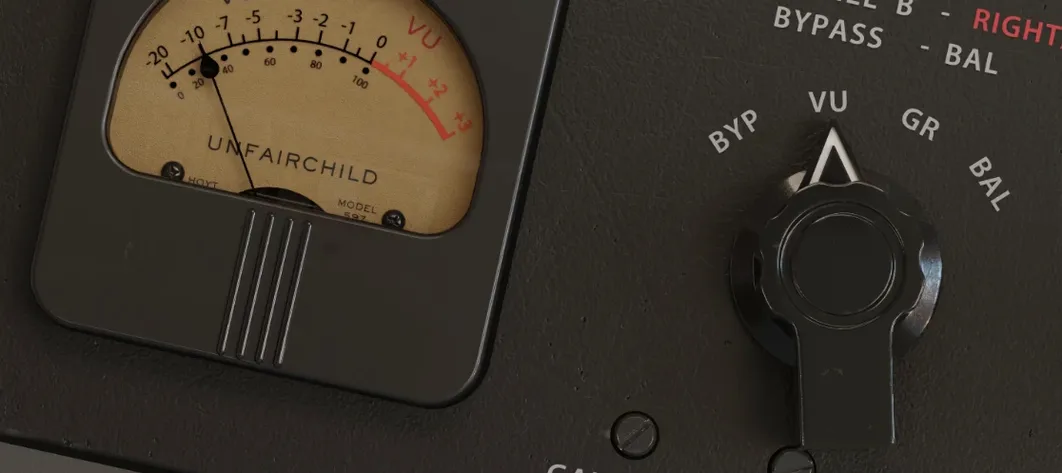
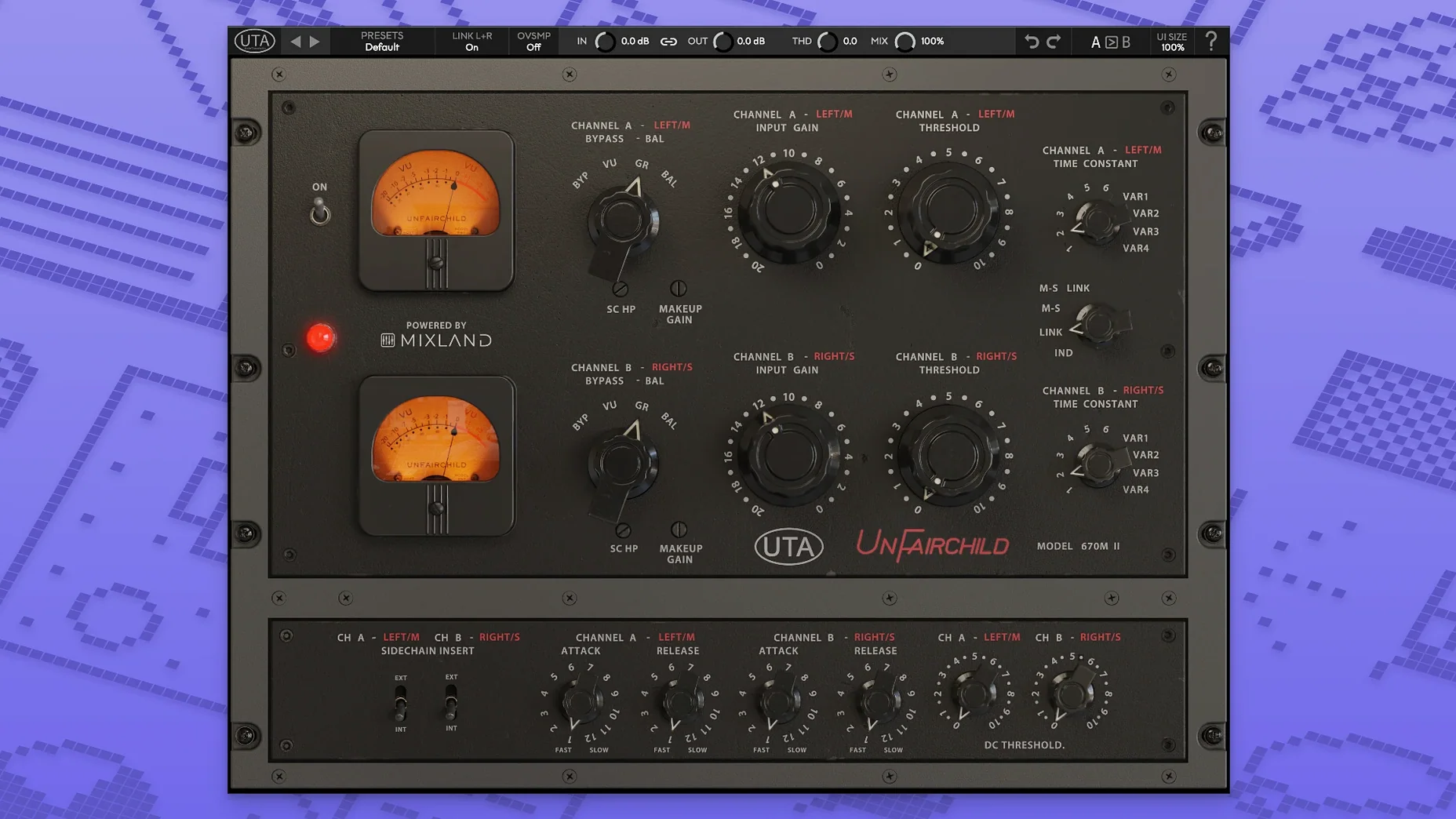
Under the hood, this is the plugin adaptation of the UnFairchild 670M mkII vari-mu circuit, developed with MIXLAND and Eric Valentine. Six original preset time constants sit beside four variable ones, so the release behaviour moves from nearly instant to slow and breathing. A DC Threshold control lets you nudge how the detector reads the signal, while the left/right balance fine adjustment keeps stereo material from tilting. The wet/dry control turns the whole thing into a parallel processor when a full commit feels too blunt. On drums and drum buses it adds density without flattening transients; on vocals it brings a midrange forwardness that sits the performance into the arrangement rather than on top of it.
Creamy midrange versus narrower time constant options
Place the UnFairchild next to a few other Mac vari-mu plugins and its personality sharpens. The IK Multimedia T-RackS Fairchild 670 leans into the familiar creamy midrange push and a rounded top end, but its time constant options are narrower and the stereo linking feels less adjustable. The Arturia Comp TUBE-STA is a different beast entirely — it models a lower-headroom vari-mu with a quick, grabby character that flatters bass-heavy material but lacks the extended control set and the feed-forward option that the UnFairchild carries. Then there is Pulsar Audio Mu, which takes the Manley Vari-Mu path with a cleaner, more modern knee and an excellent mid-side matrix. Pulsar's MS implementation is arguably a touch more intuitive, but the UnFairchild counters with the DC Threshold and the dual feedback/feed-back topology, which opens up sounds the Mu does not easily reach.
The real difference sits in the extremes. Most vari-mu plugins colour the signal and call it done. The UnFairchild can do the familiar thicken-and-smooth routine, but the THD control and the wet/dry path let you pull the circuit apart — keep the transient snap of a drum bus clean while the compressed parallel channel smears just the sustain, or dial the harmonics up until a bass DI track feels like it went through a console channel. That dual-mode architecture, inherited from the mkII hardware, gives it a wider palette than any single-vibe emulation.
Drum bus trick across overheads and room mics
Mix engineers working on dense rock or indie records tend to latch onto the UnFairchild within a session or two. The drum bus trick is obvious — strap it across overheads and room mics, set a medium time constant, and the cymbals glue without losing the stick attack — but the plugin earns its keep on sources where subtle harmonic buildup matters more than gain reduction. A fingerpicked acoustic guitar that sounds thin in a busy arrangement can pass through with barely a dB of compression and emerge with a low-mid weight that needs no EQ boost.
Post-production users get less out of it, not because the plugin underperforms but because its strengths are musical density and tonal shift rather than transparent level control. Mastering engineers who already own a hardware vari-mu often use the UnFairchild as a recallable alternative when the analog chain is offline, and the left/right balance fine adjustment saves them from the stereo drift that some emulations introduce. Producers working from a laptop — especially those hunting for an unfairchild plugin that does not feel like a watered-down Fairchild clone — will find the feed-forward mode an unexpected bonus for snappy, modern compression that still carries tube-era colour.
DC threshold unlocks the detector's transformative side
The default state is a fair starting point, but three controls reshape the plugin enough that a first impression can miss what it does. DC Threshold is the least obvious and the most transformative. Lower it and the detector becomes more sensitive to low-frequency energy; raise it and the compression ignores sub content that would otherwise pump the whole mix. On a bass-heavy drum bus, nudging the DC Threshold upward by 10 to 15 percent keeps the kick from triggering constant gain reduction while the rest of the kit breathes naturally.
Feedback versus feed-forward changes the compression curve itself. Feedback mode produces the softer, rounder knee that vari-mu circuits are known for — the sound of a vocal sitting back. Feed-forward tightens the attack and makes the gain reduction more predictable, which suits percussive material or any source where pump is the enemy. Switching between them mid-mix often reveals that a track you thought wanted feedback actually needed the other.
The THD control adds harmonic saturation independent of gain reduction, so you can run zero compression and still push the signal through the tube-modelled colour stage. This turns the UnFairchild into a tone box: insert it on a sterile soft synth, disable compression entirely, and bring the THD up until the sound gains some analog-style grit. On a clean electric guitar DI, the same trick warms the signal before it hits the amp sim, reducing the work the amp model has to do.
- macOS 10.13 or later
- Intel or Apple Silicon Mac
- Windows support via VST3 and AAX
Questions from the booth
It is a painstaking recreation of the UnderTone Audio UnFairchild 670M mkII vari-mu compressor, developed in collaboration with MIXLAND and Eric Valentine.
Yes, the plugin runs on both Intel and Apple Silicon Macs with macOS 10.13 or later.