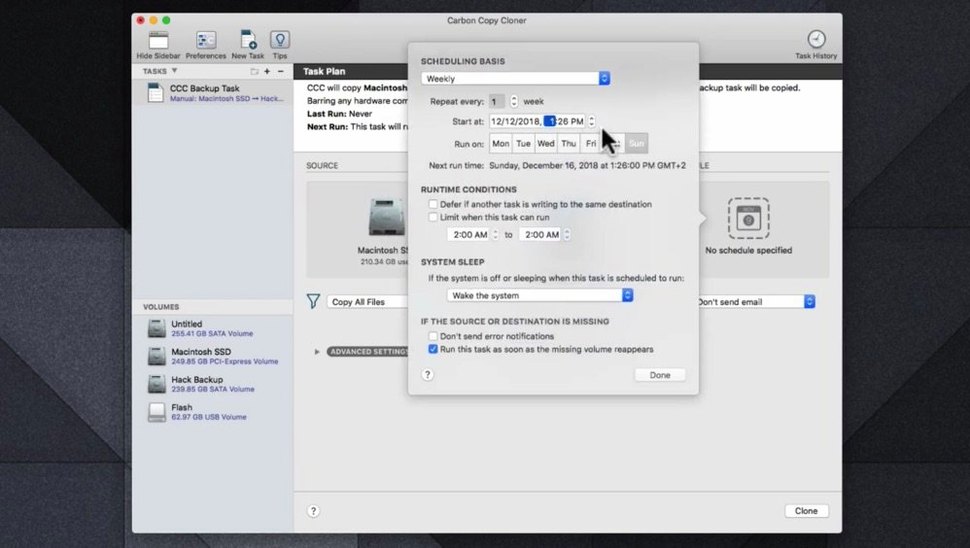
Snapshots on a schedule. That's the feature that keeps a project alive when a drive clicks its last. Carbon Copy Cloner 7, from Bombich Software, lets you pick a day of the week and a time, then steps back. The backup runs while you're in the edit or deep in a game, and you don't have to think about it again until the log confirms everything copied.
Choosing a destination triggers a bootable, file-by-file clone
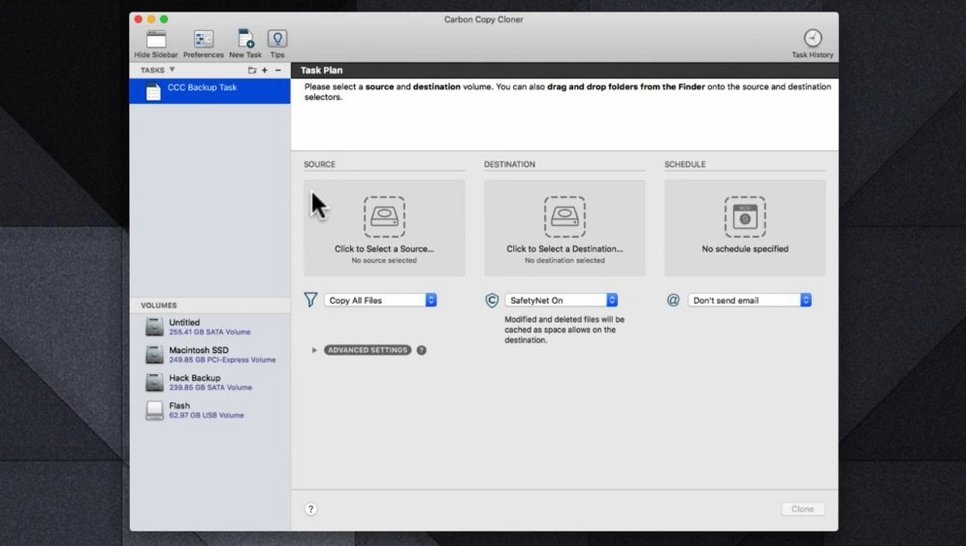
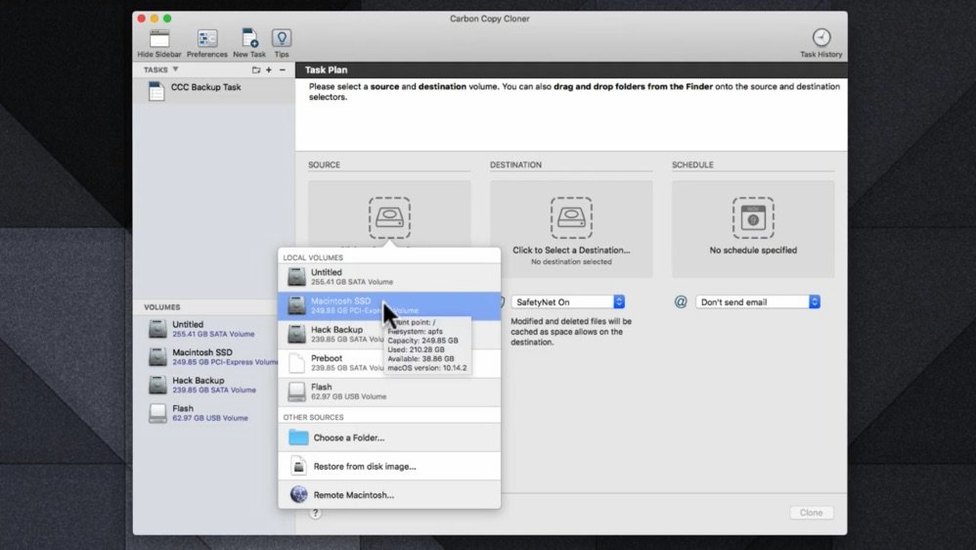
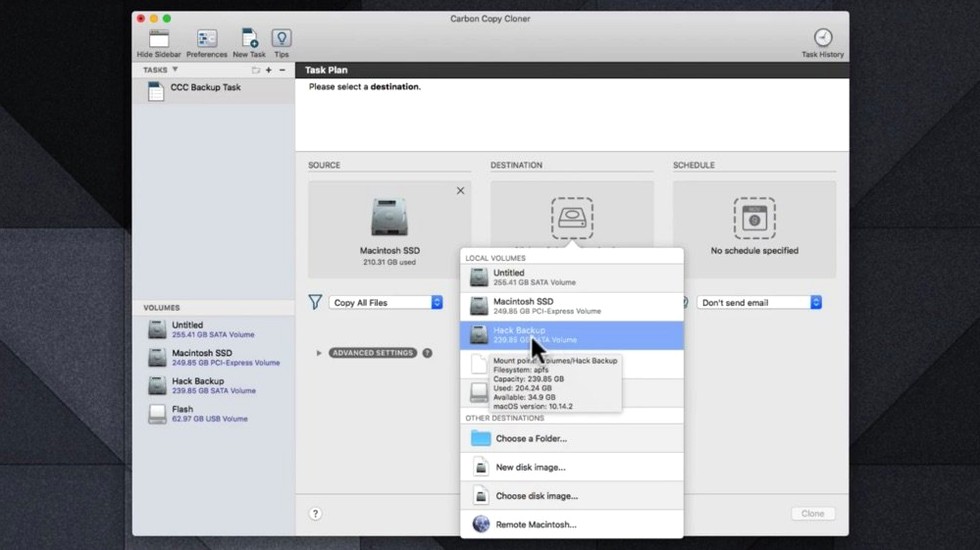
You point CCC at any attached volume and it builds a clone that boots. The utility copies file by file, preserving permissions and structure, so the destination feels like the source the moment you switch to it.
How does automatic scheduling change the rhythm of a backup?
It removes the mental checkpoint. Set a weekly window, say Sunday at 2 a.m., and the app wakes the Mac, runs the task, then lets the machine sleep. The backup exists as a fact, not a to-do.
What is CCC 7 qualified to run on?
The current version is fully qualified on macOS Golden Gate. It requires Catalina or later, leaving behind the older architecture of Big Sur and Monterey support that was present in earlier releases.
A true clone copies the OS and invisible system folders Time Machine ignores
A bootable clone is not the same as a folder of copied files. People wonder about that distinction early on. A true clone carries over the operating system, the user accounts, the invisible system folders that Time Machine skips. Plug it into another Mac, hold Option at startup, and the machine treats it like the internal drive. That matters when you are facing a deadline and cannot afford to reinstall an OS before getting back to work.
Another question that shows up repeatedly is whether CCC plays well with large media drives. Short answer: yes. Film projects often sit on external NVMe enclosures with six or eight terabytes of footage. CCC handles those volumes without choking, provided the destination has enough free blocks. The utility checks available space before it starts copying and warns you if the math does not add up. That warning has saved a few overnight renders from evaporating.
People also ask about incremental backups. CCC uses a snapshot-based approach on APFS volumes, which means it only copies what changed since the last run. The time saved on a two-terabyte project drive with a few hundred megabytes of new footage is significant. The verification pass afterwards reads through the destination and confirms every checksum, so you are not gambling on a silent corruption.
And then there is the question of version compatibility. The current build, 7.1.6, runs on Intel and Apple Silicon Macs through a Universal application build. It requires Catalina or later, so older machines stuck on Mojave or High Sierra need an earlier release. A quick system check clears that up before the download finishes.
Right-click the menu bar icon to jump to a failed task’s log
The menu bar icon is more than a status indicator. Right-click it and you see the last few tasks with their completion times. Click any entry to open its log. When a backup fails at 3 a.m. you can diagnose it with two clicks before the coffee finishes brewing.
Task groupings are another thing people overlook. You can chain tasks so that a clone of the internal drive triggers a second backup to a network volume only after the first one succeeds. That chain prevents the NAS from filling up with partial copies if the local drive disconnects mid-task. The grouping panel sits behind a small button in the main window and rarely gets the attention it deserves.
Drag-and-drop scheduling adjustments are faster than opening the scheduler panel. With a task selected, you can drop an .ics file from Calendar onto the CCC window and it pulls out the recurrence rule. The opposite direction works too: export a task schedule as a calendar event and let it sit alongside your shoot reminders.
Disk Centre, tucked into the sidebar, gives a live read on S.M.A.R.T. status for attached drives. A drive with a rising reallocated sector count shows a caution before you trust it as a clone destination. That early warning is easy to miss because most people open CCC, launch a task, and close it again without exploring the sidebar at all.
A full 512 GB clone finishes in under twenty minutes on M1 Max
A full clone of a 512-gigabyte internal SSD to an external Thunderbolt enclosure clocks in under twenty minutes on an M1 Max MacBook Pro, assuming the destination can sustain writes. The delta copies that follow take seconds. CCC 7 leans on the Apple File System's fast directory enumeration, so the scanning phase before a backup barely registers in Activity Monitor.
Memory usage during a task hovers around 120 to 180 megabytes, even with a million files passing through. The app does not balloon the way some backup utilities do when they cache file lists in RAM. On an Apple Silicon Mac the process stays on the efficiency cores most of the time, leaving the performance cores free for an After Effects render or a Logic session.
Stability is where CCC earns its reputation. The task engine runs as a background daemon that survives user logouts, so a scheduled backup that starts during a late-night session finishes even if the Mac drops to the login window. Logs show clean exits and detailed error codes when something goes wrong, which makes support threads easier to parse. In six months of weekly clones across four machines, the only failures I have seen came from a loose USB-C cable and a NAS that went offline during a firmware update. Neither was the software's fault.
A destination that won’t boot usually needs a GUID Partition Map with APFS
The most frequent stumble is a destination that refuses to boot after cloning. That usually means the destination is formatted as a GUID Partition Map with an Apple File System container. An MBR or APM partition scheme will copy files just fine but will not show up in the Startup Disk pane. Disk Utility can repartition the drive without erasing the clone if there is enough free space, but it is faster to check the scheme before the first backup runs.
Another snag involves system files that cannot be copied while macOS is running. CCC handles these with a snapshot strategy: it creates a temporary APFS snapshot of the source at the start of the task and copies from that frozen moment. If the snapshot creation fails because the source volume is critically low on space, the task halts with a clear error. The fix is freeing up a few gigabytes and running the task again.
Network destinations over SMB sometimes stall when the Mac sleeps. The workaround is a small CCC setting that wakes the network interface before the task begins. It lives under the advanced options for the destination and adds about ten seconds to the startup of a scheduled task. Worth enabling for any backup that targets a NAS.
Occasionally people running a carbon copy cloner mac full clone for the first time hit a permissions prompt that asks for Full Disk Access. Without that, CCC cannot read certain protected folders like Mail or Messages. Granting it through System Preferences and restarting the task clears the block. The prompt itself is clear, but it appears behind the main window sometimes and gets overlooked.
When the edit suite goes quiet, I point Project_A at its twin drive
The edit suite goes quiet around eleven. Footage from the day sits on a 4-terabyte G-Drive labelled Project_A. The backup destination is an identical drive named Project_A_Clone connected over Thunderbolt and formatted as APFS.
I open CCC. The main window shows last week's task still green in the sidebar. I select it, check that the source and destination paths match the drives I just plugged in, and hit the clone button. A progress bar fills in steady increments, file count ticking upwards. The estimated time starts at eighteen minutes and settles around fourteen.
While the clone runs I switch to a different desktop and pull up the script for tomorrow's shoot. CCC stays out of the way. The menu bar icon shows a tiny pie chart that inches clockwise. No fans spin up. The Mac stays cool.
Fourteen minutes later a notification slides in: task completed with zero errors. I open the log, skim the summary line that confirms the byte count matches, and close the window. The clone drive goes onto a shelf. If the main drive dies tomorrow morning, I can boot from the clone and keep working without losing anything past yesterday's ingest. That certainty is the point of the whole exercise.
- macOS 10.15 Catalina or later
- Runs on Intel and Apple Silicon Macs