If you already keep a scanned family archive in Photos or sort film frames in Finder, PhotosRevive slots in as the quiet specialist that gives those greyscale images a considered colour pass without leaving the desktop.
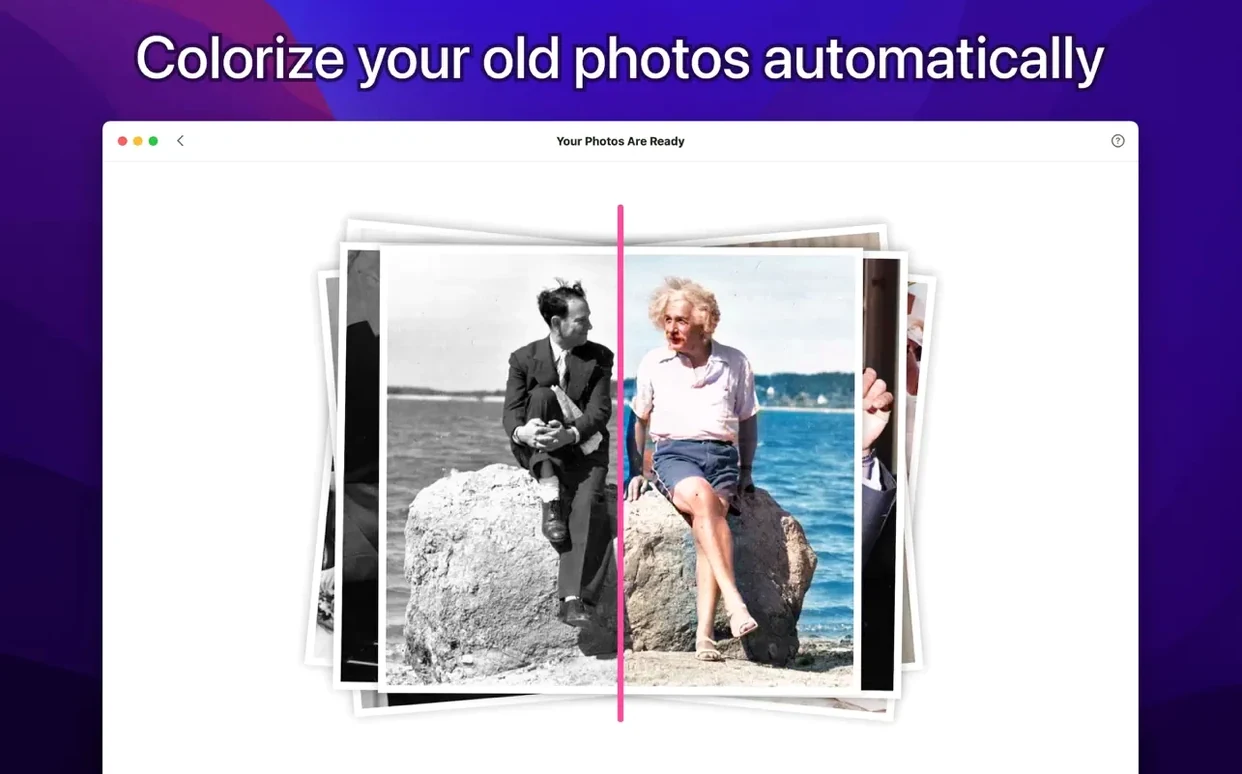
Automatic colorization — the app reads a black-and-white image and applies a full colour treatment in one step, no manual masking required.
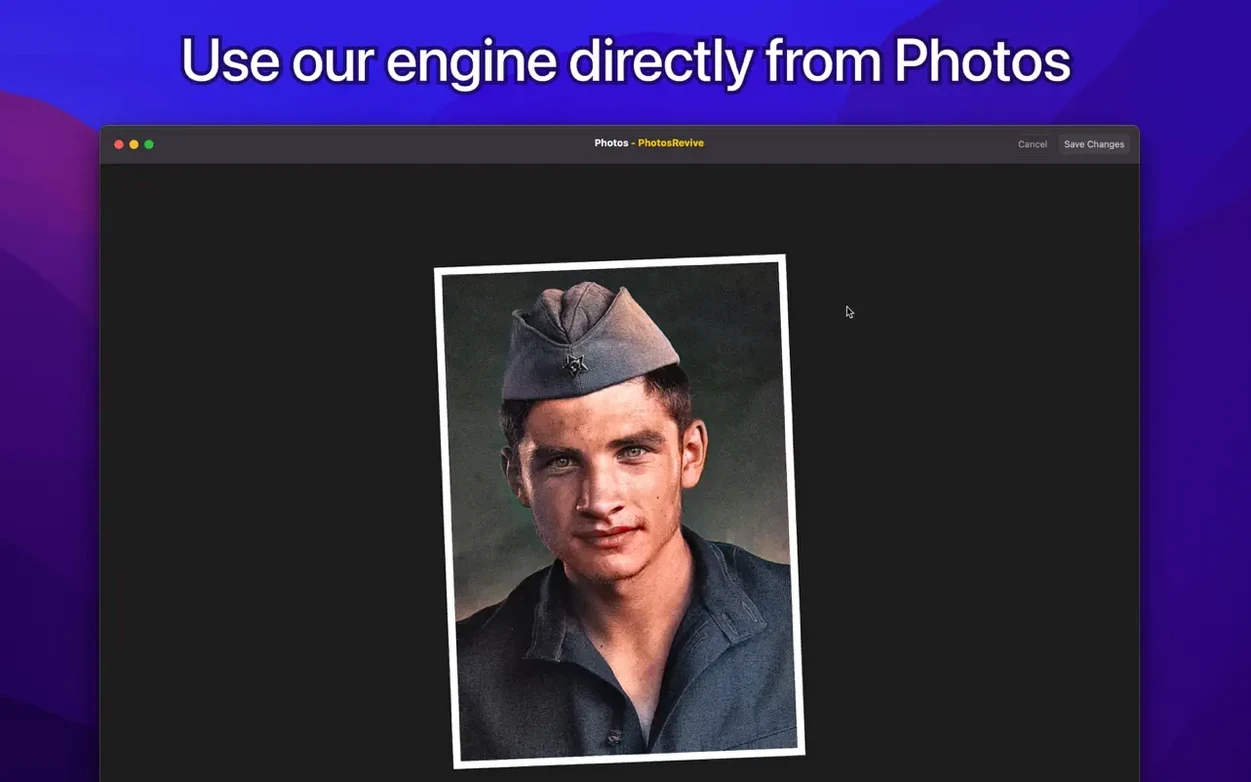
Photos extension — you can launch it from inside Apple’s Photos app, so a freshly scanned portrait never has to leave the library before it gains skin tones and sky blues.
Apple Silicon and Intel — it runs on both architectures, which means the same quiet performance on an M-series MacBook Air or an older Intel iMac still holding a family photo collection.
Interface languages — English, German, Spanish, Italian, Simplified Chinese, French, and Japanese are built in, making the tool legible across a multilingual household or studio.
The colour decisions land somewhere between plausible and poetic; a 1940s street scene gets ochre brick and muted teal signage that feel period-appropriate without claiming forensic accuracy. That restraint is what lets it sit alongside a raw developer or a scanning utility without overpromising. The latest build keeps everything working smoothly on macOS 26.
A few snags you might run into and how to work through them
When PhotosRevive misreads a scene, the culprit is almost always contrast. A faded sepia print where the sky bleeds into a pale building facade confuses the model, and you get a single beige wash across what should be two distinct surfaces. Scanning the original at a higher DPI and nudging the black point in Preview or Photos before colorization gives the neural network enough edge information to separate elements cleanly.
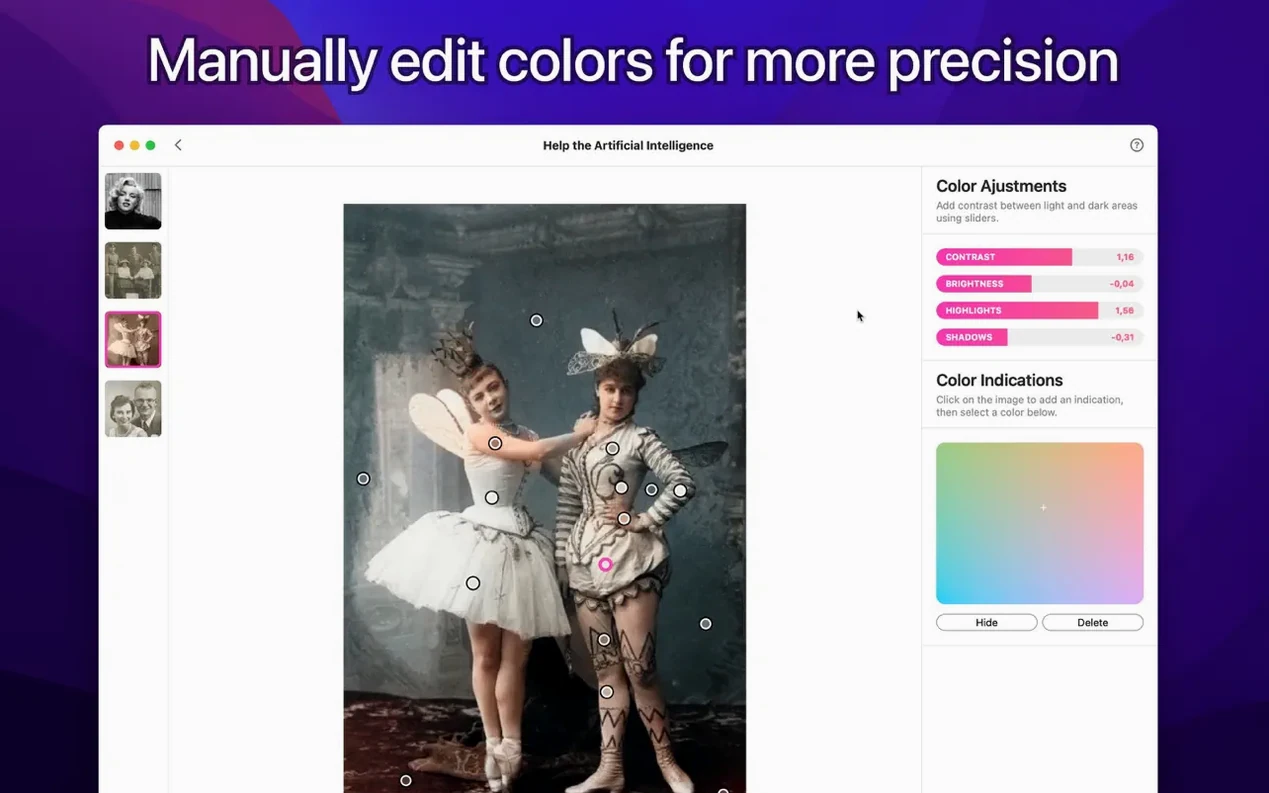
Skin tones occasionally drift toward magenta on underexposed portraits. Rather than running the whole image again, drop a small hint dot on a cheek or forehead with the manual colour tool — the app recalculates the entire face from that one cue, and the correction usually holds across other faces in the frame. People who hunt down a PhotosRevive for Mac cracked version often discover the manual hint feature becomes their favourite tool, resolving most colour-cast complaints in seconds once they know where to tap.
The Photos extension occasionally appears greyed out after updating macOS. A quick relaunch of Photos, or toggling the extension off and on in System Settings under Extensions, restores it. The standalone app never has this issue, so keeping both installed gives you a fallback editing path.
A 3000-pixel scan finishes in under four seconds on Apple Silicon
On an M2 MacBook Air, a 3000-pixel scan finishes in under four seconds. The same file on a 2019 Intel iMac takes closer to nine, which still feels brisk for a process that would take an hour by hand. Memory use hovers around 400 MB during a colorization pass and drops back to idle almost immediately afterward — no creeping background load, no sudden fan spins on Intel machines.
Batch work reveals the only real bottleneck: the app processes one image at a time, and queuing twenty scans means twenty individual clicks. It never crashes mid-queue, though, and I have left it chewing through forty high-resolution TIFFs without a single hang. The undo stack is deep enough to step back through a dozen hint adjustments, which invites experimentation without fear of losing a take you liked.
Energy impact stays low enough that a full afternoon of restoration work barely dents battery on Apple Silicon. If your library lives on an external drive, the read-write pattern is light — it pulls the file once, processes in memory, and writes the result when you save, rather than hammering the disk throughout.
Work through five photos from the same roll to learn its color biases
Start with five or six photos that share a similar setting — same era, same film stock, same lighting conditions — and work through them in one sitting. The neural model’s biases become predictable quickly: it leans toward olive greens for military uniforms, warm amber for indoor tungsten scenes, and a particular slate blue for overcast skies. Knowing those tendencies lets you preempt corrections before you even click.
Keep a small reference image open in Preview alongside PhotosRevive — a colour photo from the same period or location. A quick glance at real brick tones or period-appropriate car paint stops you from accepting a result that feels right but is actually a decade off. The manual hint tool becomes exponentially more useful once you have that visual anchor.
When you find a combination of hint colours that nails a particular film stock, jot the hex values in a sticky note. Reusing the same three or four swatches across a whole roll gives a cohesive look that automatic mode alone cannot guarantee, and it cuts your per-image time in half by the third day.
- macOS 11 or later, up to macOS 26
- Apple Silicon or Intel 64-bit processor
Questions from the booth
It works both ways — you can open it as a standalone Mac application or call it up as an extension from within Apple's Photos app.
PhotosRevive 2.2.0 requires macOS 11 or later and runs natively on both Apple Silicon and Intel 64-bit Macs, with full optimisation for macOS 26.
The app supports English, German, Spanish, Italian, Simplified Chinese, French, and Japanese.