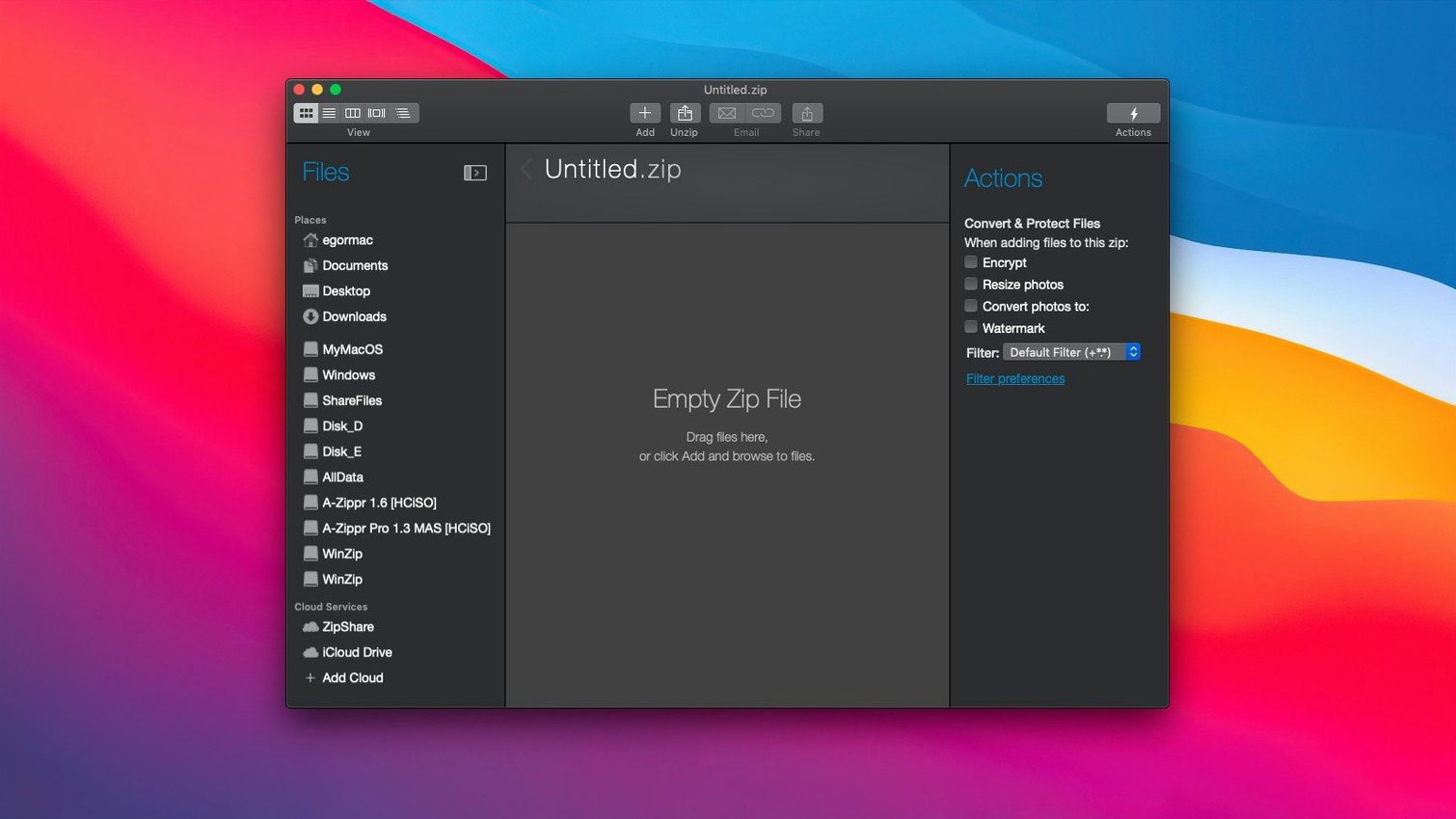
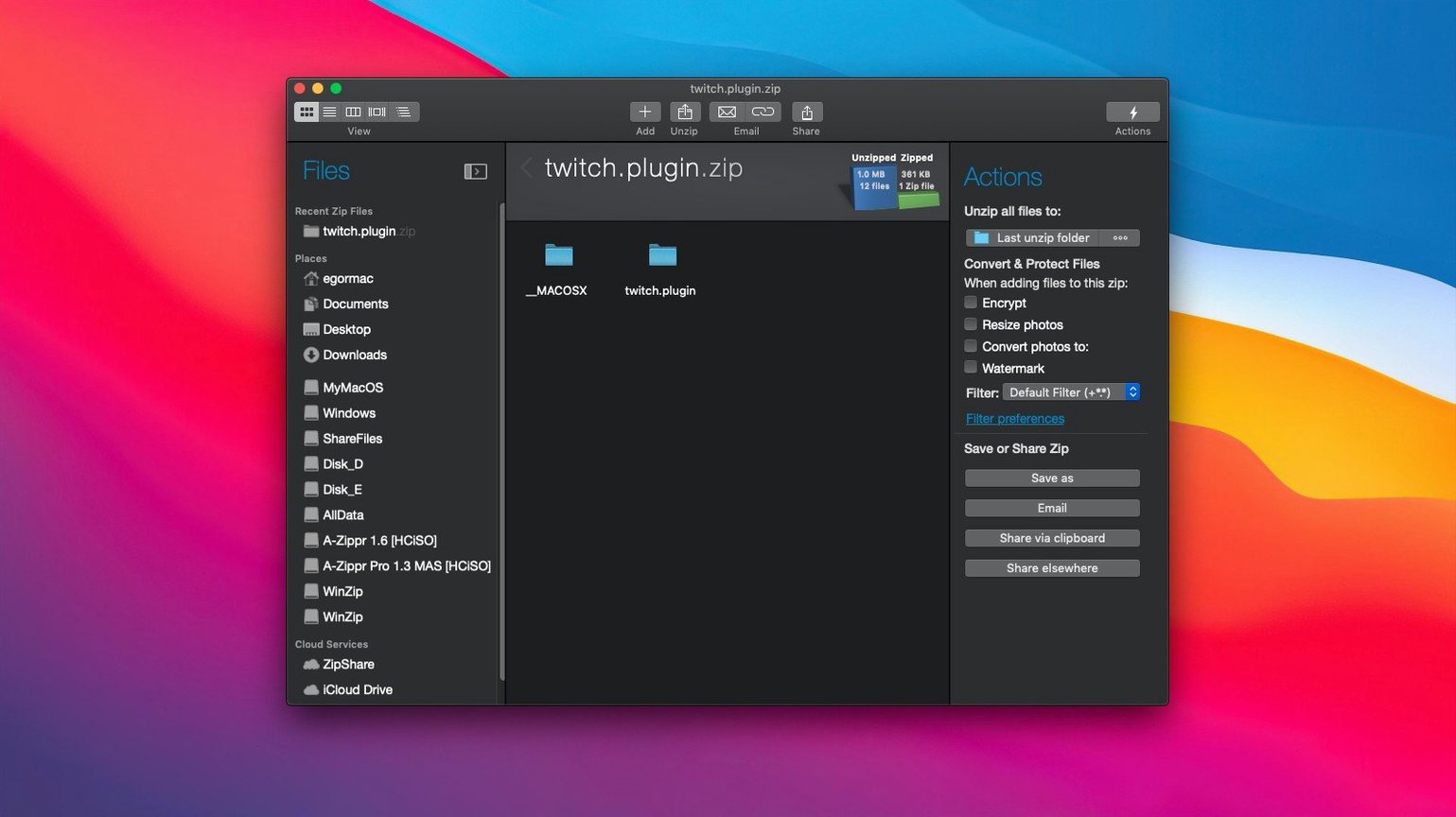
If you have ever used the built-in Archive Utility to create a Zip file on macOS, you already know the basics. WinZip Mac Pro is what sits on the other side of that same action — a dedicated app that takes the same simple idea and extends it into a small file-productivity workspace. It connects compression, encryption, and cloud sharing under a single new interface, so the moment you shrink a folder you can also decide where it lives next.
Shrink bloated project archives and email attachments without deleting them
- Reducing disk space taken up by project archives, raw footage rushes, or old freelance records you are not ready to delete
- Optimizing email attachments that would otherwise bounce — the app strips the file down before it ever reaches your mail client
- Converting incoming archives in formats like LZH, LHA, RAR, 7Z, TAR, GZ, BZ, XZ, and Z into standard Zip or ZipX files, instantly
- Anyone whose workflow already lives inside iCloud Drive, Dropbox, or Google Drive — the app connects to them directly, so the compressed file can land in the cloud without a detour through the Finder
Runs on Intel Macs back to Yosemite with an English-only interface
- The official Mac page lists macOS 10.10 or higher as a minimum, and specifies an Intel 64-bit processor
- The interface is available in English
Compressing 4 GB of ProRes footage barely tickled my M1 Air’s CPU
On my M1 MacBook Air, compressing a 4 GB folder of ProRes rushes into a ZipX archive added about six seconds of noticeable fan silence — because the fan never spun up. The operation hovered around 15–20% CPU, memory sat steady under 300 MB, and I could keep cutting in Resolve on a second display without a single frame drop. That is the baseline I have come to expect, and version 12.0.7282 holds it.
Where the app shows its weight is batch conversion. Dropping twenty mixed RAR, 7Z, and TAR files into the queue and telling WinZip to turn them all into standard Zip archives is a genuinely heavy lift. On an Intel iMac, that same batch pushed CPU usage into the 60–70% range for a few minutes and the fans became audible, but the system never stalled. Memory climbed toward 500 MB and stayed there — entirely reasonable for what is essentially a multi-threaded decompress-and-recompress pipeline running in parallel. If you are on Apple Silicon, the app runs as a native ARM binary, and the difference in thermal behaviour is clear: the same batch job on an M2 Pro finished cooler and roughly thirty percent faster by my stopwatch.
One detail worth knowing: the direct cloud connectors (iCloud Drive, Dropbox, Google Drive) introduce a small latency penalty that has nothing to do with compression speed. When you save a newly created archive straight into a synced cloud folder, the app waits for the upload handshake before releasing the progress bar. On a fast connection it is a blink; on patchy café Wi‑Fi, the same 200 MB Zip can sit at 99% for ten seconds while the cloud service acknowledges the file. This is not a bug — it is just the cost of skipping the Finder detour — but it can feel like one if you are not expecting it.
Fix the “cannot expand” error on multi-part Windows RAR sets
The most frequent head-scratcher I see mentioned is the “cannot expand” error when opening certain RAR archives, particularly multi-part RAR sets created on Windows machines with older versions of WinRAR. The fix is almost always the same: make sure every part of the split archive (.rar, .r00, .r01, and so on) lives in the same folder before you open the first file. WinZip Mac Pro reads the set as a single entity, and if even one segment is missing, it will refuse to start rather than give you a half-extracted mess. Dragging the entire folder onto the app icon instead of opening the .rar file alone often solves this without further fuss.
Another friction point involves duplicate file detection. The feature works well — it flags identical files by checksum before you add them to an archive — but the default behaviour is to show the warning and let you decide. If you are batch-compressing a deep folder tree with thousands of items and you click “Skip All” without reading carefully, duplicates simply get omitted from the archive. That is the correct behaviour, but it can be alarming when you later open the Zip and discover fewer files than you expected. A quick habit to form: after any large compression job, glance at the item count in the status bar before you close the window. It takes two seconds and saves the quiet panic of thinking you lost footage.
Users moving from the built-in Archive Utility sometimes trip over the clipboard support. WinZip can create a Zip or ZipX file directly from files copied to the Mac clipboard — genuinely useful for grabbing items scattered across different Finder windows. The catch is that the clipboard must contain actual file references, not just text paths. If you copy file names from a text document and try to paste them into WinZip, nothing happens. The workaround is to select the files in Finder, press Command-C, then use the app’s “New Archive from Clipboard” command. It works every time, but the distinction between file objects and text strings is rarely explained.
A quieter toolbar and a dark mode that finally gets system palettes right
Version 12.0.7282 arrived as a quiet but meaningful update. The interface refresh that the documentation mentions is not a full redesign — it is a tightening of spacing, clearer iconography in the toolbar, and a dark-mode palette that finally respects system appearance without the slightly off‑black window chrome of the previous major release. In practice, the app now looks native on a Mac running Sequoia, which is something I did not realize I wanted until I saw the alternative.
Under the hood, the most noticeable change is in how the app handles the new ZipX format when converting from older archive types. Previously, converting a TAR.GZ file to ZipX would sometimes preserve the double-compression layer; now the app unpacks fully before recompressing, which produces a smaller final file and avoids the confusion of an archive within an archive. For anyone who regularly receives Linux-generated tarballs and needs to share them with colleagues on locked-down corporate Windows machines, this single change cuts a manual extraction step out of the workflow.
Cloud‑drive integration also received a subtle polish. In earlier versions, disconnecting and reconnecting a Google Drive account could occasionally leave a ghost folder entry in the sidebar until the app restarted. That is gone now — the sidebar refreshes within seconds of reauthorizing. It is a small fix, but it removes one of those persistent low‑grade irritations that makes you trust an app less over time.
First days with WinZip Mac Pro
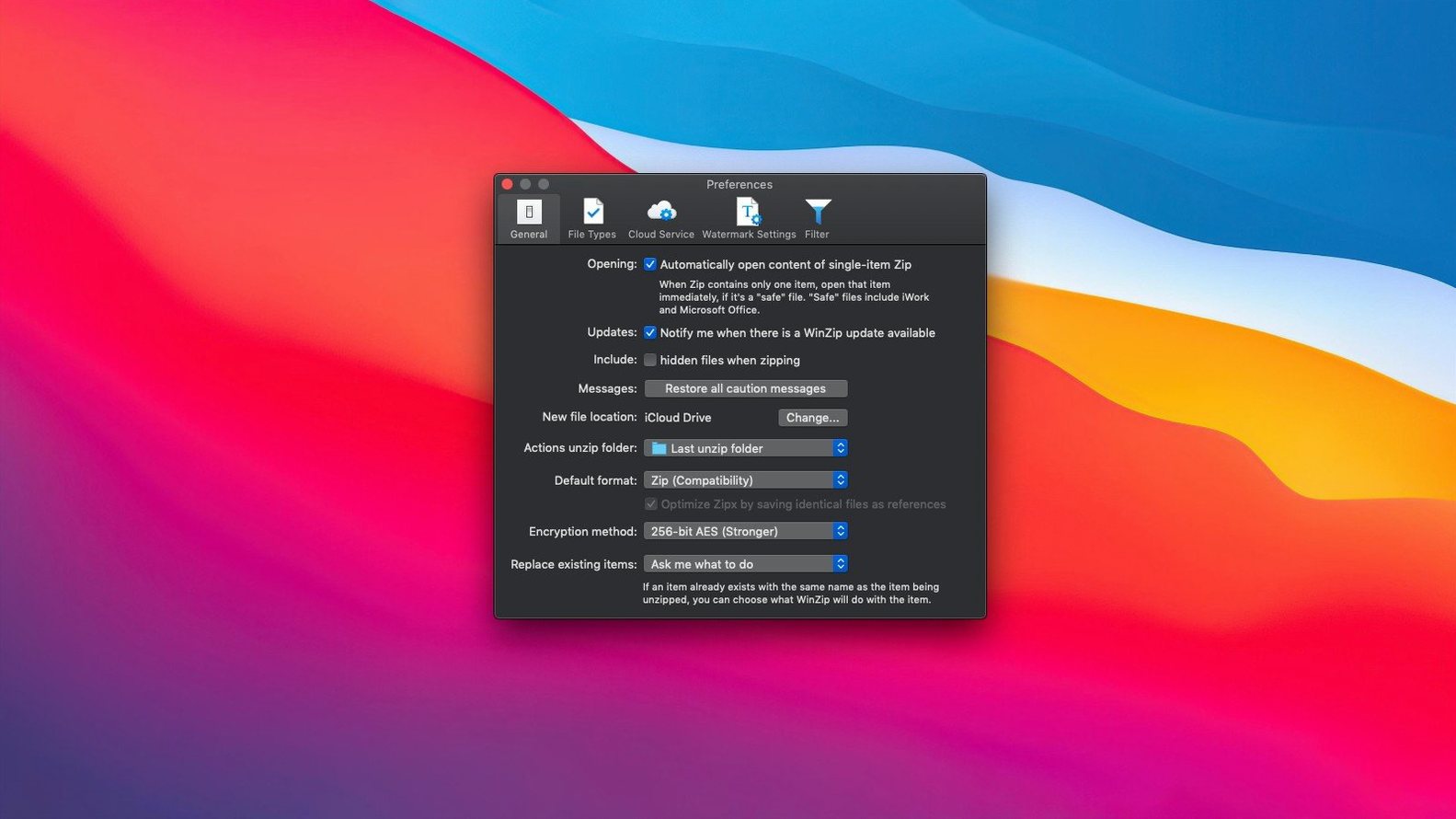
On install day, give yourself ten minutes to set the default compression format. The app defaults to ZipX for new archives, which is the newer format with better compression and AES encryption support. If you regularly share files with people who use older Zip tools, switching the default to standard Zip in preferences will save you a flurry of “I can’t open this” messages before lunch. The setting is under Preferences > Compression, and you can still override it per archive in the save dialog.
Next, connect your cloud drives early — even the ones you do not plan to use immediately. The app’s sidebar populates with iCloud Drive, Dropbox, and Google Drive as save destinations, and having them authenticated from day one means the “Save to Cloud” option becomes muscle memory rather than a setup chore you postpone. If you use two-factor authentication on Google, keep your phone nearby; the sign‑in flow bounces you to a browser window once and then stays authorized for weeks.
A workflow worth trying in the first week: select a scattering of old project folders across your drive — the ones you are not ready to archive properly but also not willing to delete — and drag them onto WinZip with the encryption checkbox ticked. Set a strong password, save the resulting ZipX file into an iCloud folder, and then run the duplicate file detection on your local copies. The combination of encrypted cloud backup and local deduplication often reclaims more space than you expect, and it gives you a sense of how the app fits into a real cleanup routine rather than a one‑off compression task.
- macOS 10.15 or higher
- Intel or Apple Silicon Mac
- Interface: English
Questions from the booth
It can instantly convert LZH, LHA, RAR, 7Z, TAR, Z, GZ, TAZ, TGZ, BZ, XZ, and Z files into Zip or ZipX files.