
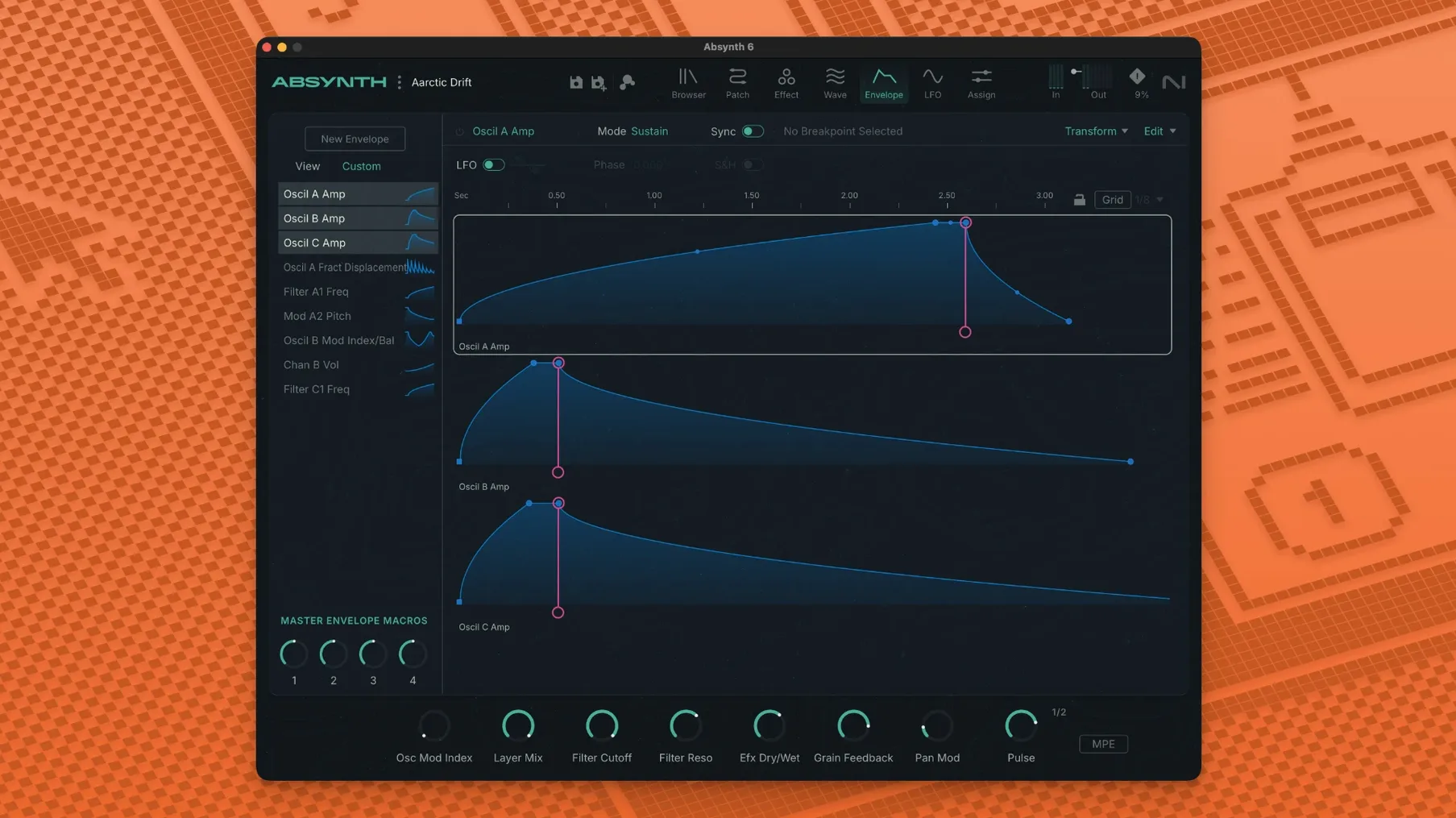
Absynth 6 runs natively on Apple Silicon and Intel Macs, asking for macOS 14 or later and a host that speaks 64-bit VST3, AU, or AAX. Four gigabytes of RAM will get you there, though six makes the more elaborate patches breathe easier.
The real pull for anyone who has spent years with a signal path in their head is how its semi-modular architecture puts subtractive, FM, wavetable, and granular synthesis on the same canvas. You are not locked into one voice. A patch can start as a wavetable sweep, fracture into FM grit in the second oscillator, and dissolve into a granular cloud in the third, all routed through filters you can drive into unstable resonance when the scene calls for it.
The Sound Mutator shifts that further. Instead of building a patch from init, you feed it two sounds and let it crossbreed characteristics: the transient snap of one, the spectral tail of another. The result rarely sounds like either source, which makes it useful when a cue needs something that does not immediately read as a synthesizer.
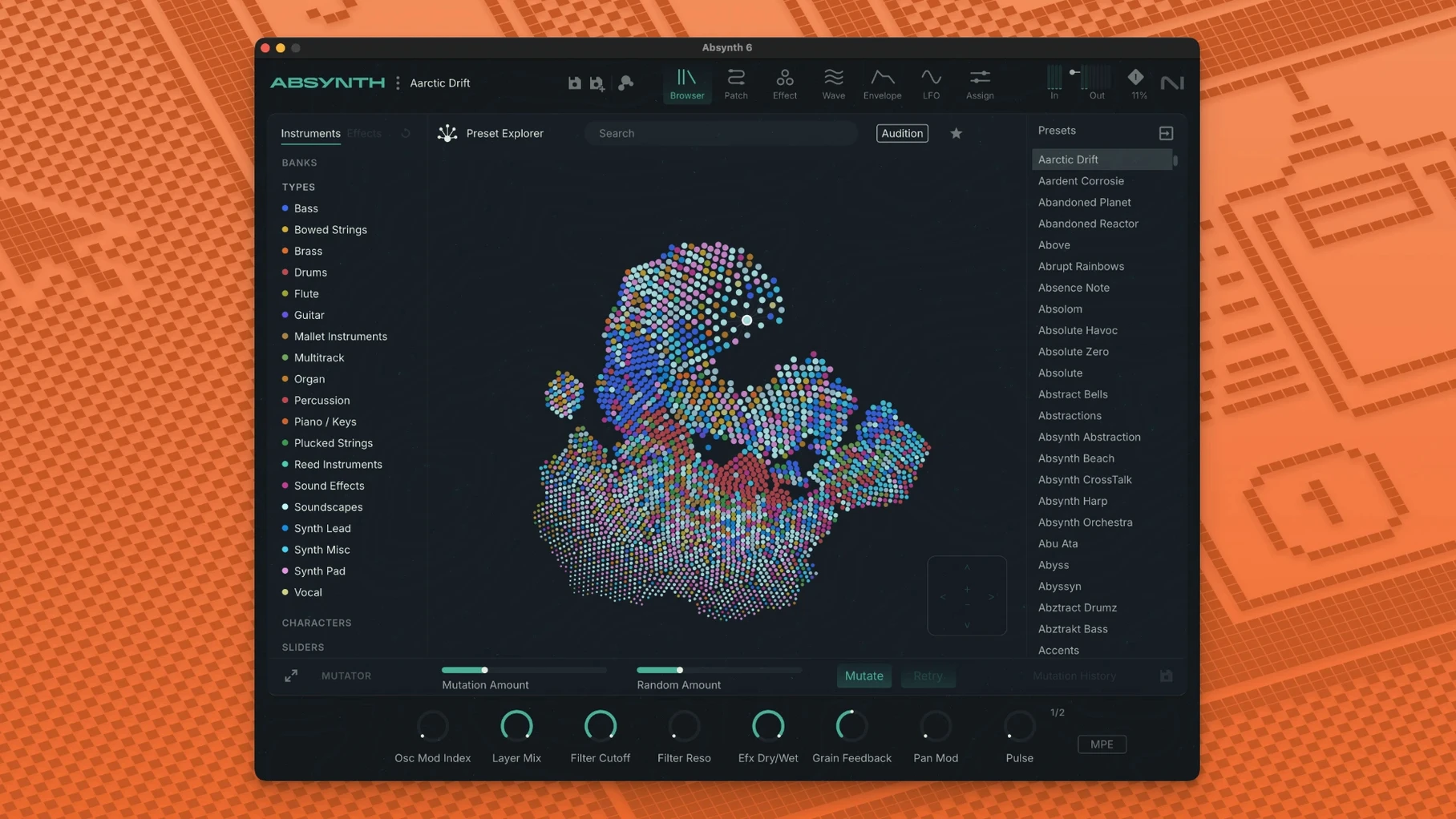
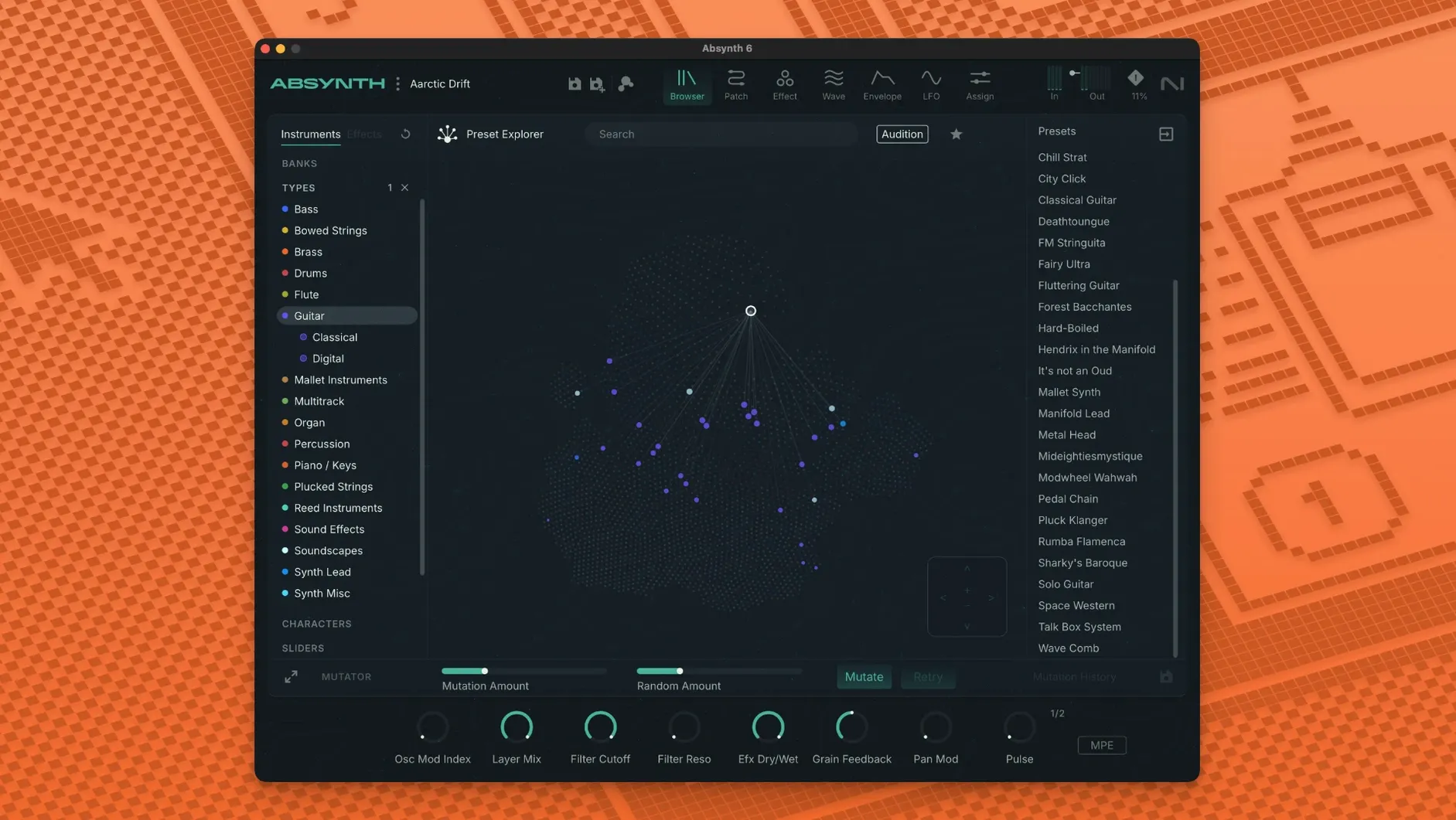
Version six also wraps the engine in full MPE and polyphonic aftertouch, so a LinnStrument or a Roli Seaboard can bend and push individual notes independently. The preset browser helps navigate the sheer density of what the oscillators can do, and the new surround support extends the spatial reach to eight-channel formats, which matters the moment a project moves beyond stereo beds.
The texture engine inside a larger scoring template
Absynth rarely lives alone. The most fluid setups I see treat it as the texture engine inside a larger scoring template: Logic Pro handling picture and stem routing, Absynth occupying three or four instrument tracks fed by different MIDI channels from a single MPE controller. Kontakt handles the orchestral weight, Reaktor runs the rhythmic oddities, and Absynth covers the spaces in between — pads that drift out of phase, impacts that feel like they came from a Foley stage rather than an oscillator, low drones that sit under dialogue without fighting the centre channel.
On the macOS side, it slots into AU host behaviour cleanly. The plug-in exposes its parameters to Logic's automation lanes and Smart Controls, so you can map filter cutoff and the Aetherizer mix to hardware faders without opening the Absynth window. If you use an MPE controller, macOS's Audio MIDI Setup sees it as a multi-channel device and passes per-note expression straight through — no wrapper, no translation layer. That matters when you are riding polyphonic aftertouch on a long chord and need the Supercomb feedback to track each finger independently.
It also plays well with the Finder-level habits sound designers develop over years. Preset files live in the standard Native Instruments user library, which means you can tag batches of your own .absynth patches with Finder tags, back them up with Time Machine, or sync them between machines via iCloud Drive without corrupting the database. I keep a working folder of unfinished patches tagged grey for the ones I want to revisit on a rainy afternoon; the preset browser inside Absynth sees them the moment they land in the user content path.
Sculpting a bowed gong and groaning ice from scratch
Last Thursday I sat down to score a short that needed a single sound to carry the opening ninety seconds: something between a bowed gong and the groan of ice shifting underfoot. The picture was locked, the tempo map was in Logic, and I had about two hours before the director wanted a first pass.
I instantiated Absynth on an instrument track, set the channel to stereo for now — the final mix would go to 5.1, but building in stereo keeps CPU predictable while you explore — and opened the preset browser. The factory library is dense, so I typed metal into the search field and auditioned a handful of patches by tapping middle C on a Seaboard Rise. Nothing quite fit, but a patch called something like "Gong Residue" had the right spectral tail. I saved it as a starting point and began pulling it apart.
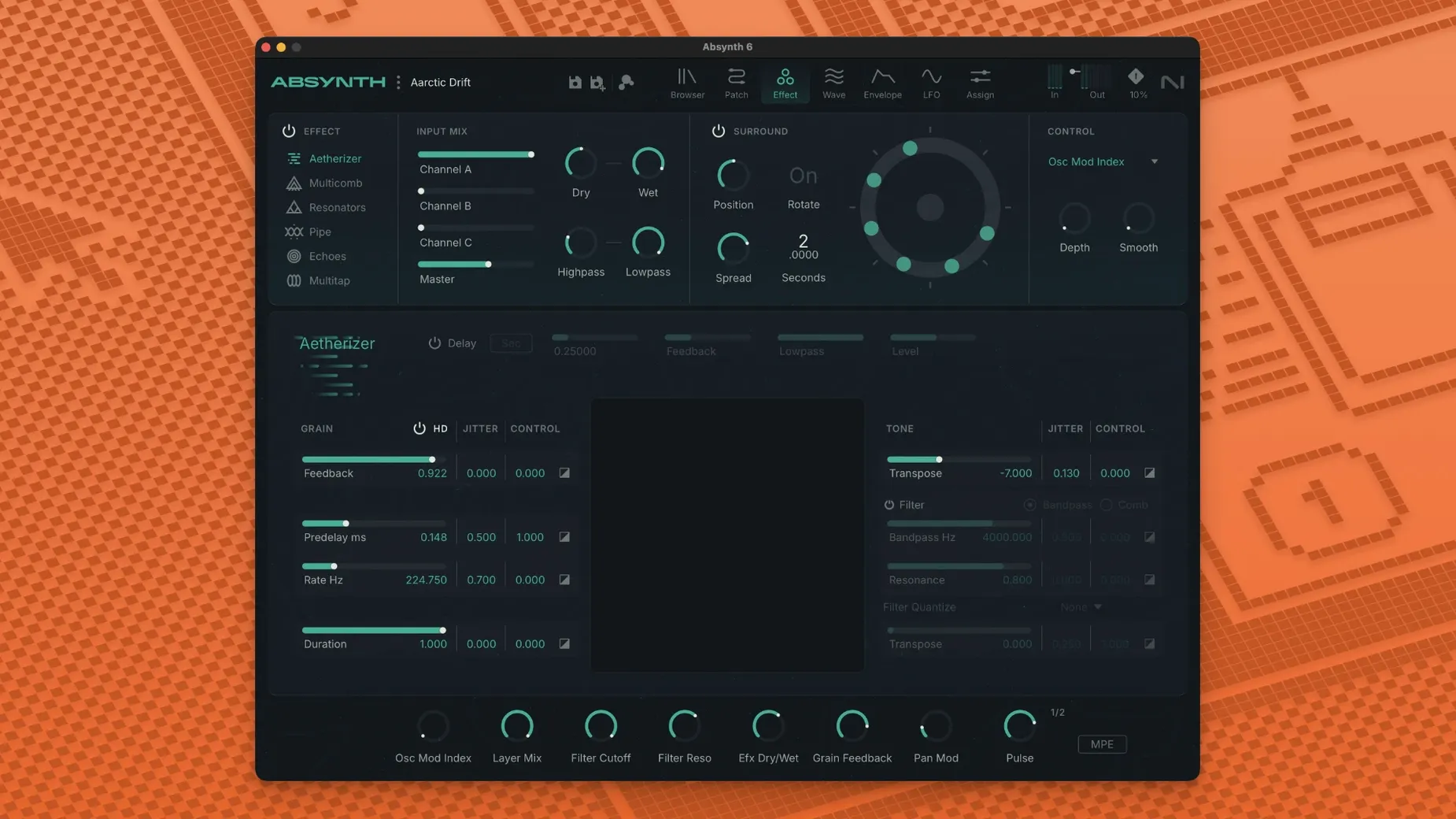
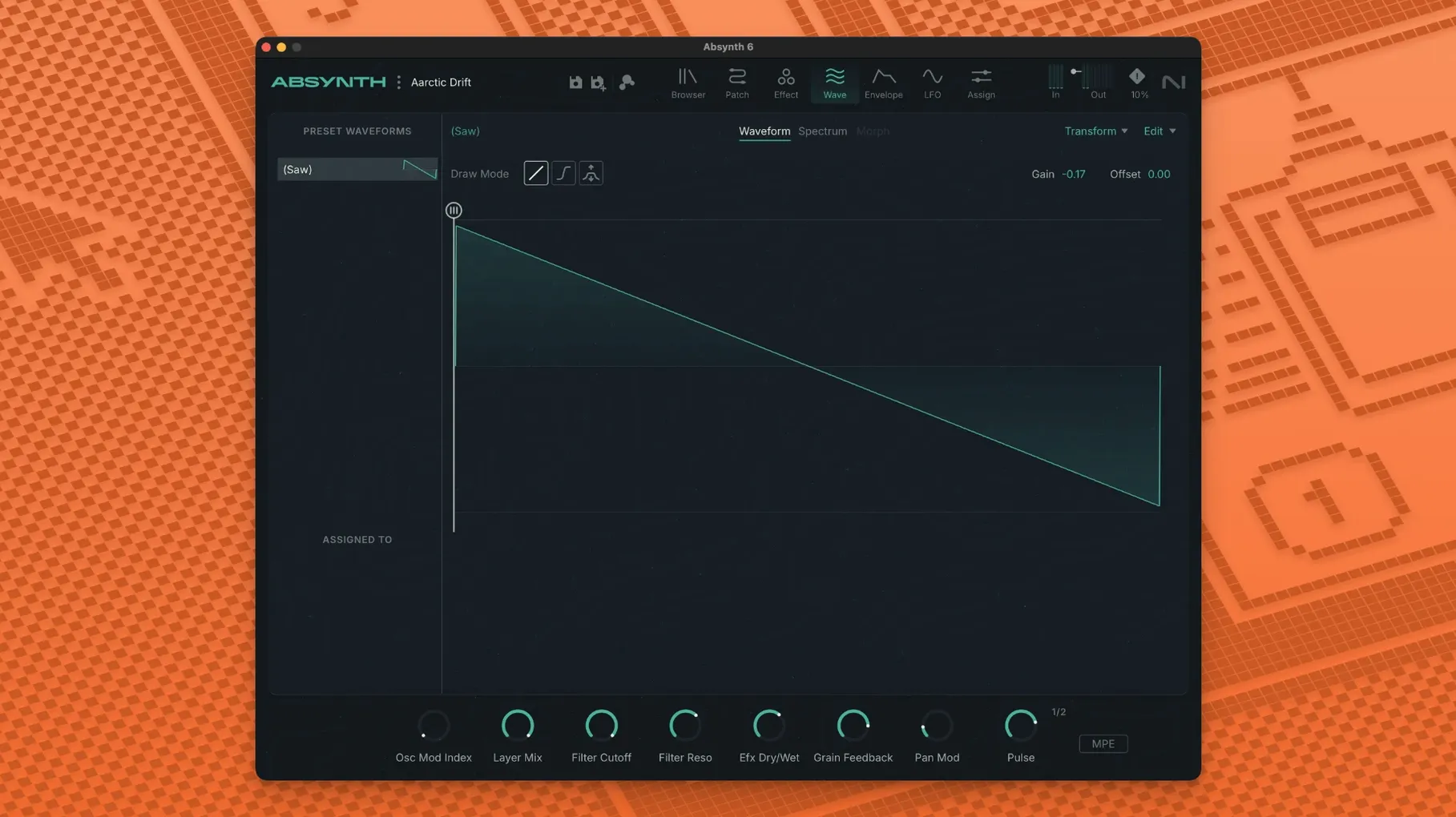
The first oscillator was running a wavetable with a slow scan, the second was doing FM with a ratio that produced inharmonic sidebands, and the third was a granular engine chewing on a sample of a struck bronze bowl. I swapped the wavetable for something glassier, pushed the FM ratio up by a few cents to introduce slow beating against the fundamental, and routed the granular oscillator through the Cloud Filter to smear the transients. The Aetherizer sat at the end of the chain, set to about thirty percent wet, turning the whole thing into a wash that still had a discernible attack when you leaned into the keys.
With the MPE mode enabled, I recorded a pass riding pressure and vertical position on each note. The patch responded to polyphonic aftertouch by opening the filter slightly and increasing the Supercomb feedback, so individual notes in a three-note cluster brightened and darkened independently. I printed the audio, then duplicated the track and shifted the second instance's tuning by minus seven cents with a slightly different Aetherizer rate. Panned hard left and right, the two takes created a slow chorusing that felt physically wide without any obvious modulation.
The director asked for the sound to move backward during a slow zoom. I automated the surround panner to push the wet signal into the rear channels over about twelve bars while the dry attack stayed anchored in the centre. Absynth's eight-channel support meant I did not need a separate spatializer plug-in; the panning was native, and Logic saw the extra channels as soon as I changed the track format.
A four-voice chord with Aetherizer taxes a single core
On an M1 Max MacBook Pro with 32 GB of RAM, a single instance of Absynth playing a four-voice chord with the Aetherizer and both filters active hovers around four to six percent on one performance core. That number climbs when you stack instances, of course — a session with eight Absynth tracks, each running complex granular patches and surround output, will nudge the buffer toward 128 samples before you hear crackles. For most stereo work, though, you can run it at 64 samples and forget the transport is moving.
Patch loading has improved noticeably from earlier versions. Where Absynth 5 sometimes paused for a beat and a half when switching between large presets, version six loads most patches within a fraction of a second. The preset browser does its indexing in the background and does not beachball the interface while it scans, which means you can keep playing while the library populates. I have noticed occasional redraw stutter on the oscillator display when dragging a wavetable position quickly, but it does not affect audio and seems tied to macOS's window compositing rather than the DSP thread.
Memory use is modest. A single instance with a loaded sample-based patch sits around 180 to 220 MB of RAM; multiply that across a template and six gigabytes of headroom on the system starts to make sense, especially if Kontakt or a sample-heavy string library is running alongside. The plug-in does not leak memory over long sessions. I have left a Logic project looping overnight with Absynth active and come back to the same memory pressure reading in Activity Monitor the next morning.
What version six shifted in daily work
The jump from version five to 6.1.0 is less a redesign and more a reclamation. The synth had been absent from active development for a stretch, and its return brought three things that alter everyday use more than the feature list suggests.
MPE and polyphonic aftertouch change how you perform rather than how you program. In the old workflow, expression came from automation lanes drawn after the fact. Now you play a chord and lean into the note that needs to cry out — a much faster path to a performance that breathes. Sound designers who build patches for keyboard players will notice that Absynth responds to channel pressure, pitch bend per note, and timbre control without any routing setup. It is on by default, and the modulation depth is sensible out of the box.
The surround format support repositions Absynth from a stereo pad machine into something that can anchor a multichannel mix. Quadraphonic and 5.1 patches feel less like a concession and more like a native mode. Practically, this means you can design a sound in the context it will be heard — building a drone that circles the room while you monitor on a 5.1 array, rather than guessing in stereo and hoping the upmixer does the right thing.
The Sound Mutator, while not new to version six, has gained a quiet reputation among users on forums and trackers as a shortcut for sound design that would otherwise take an afternoon of resampling. I have seen discussions where people mention searching for absynth 6 torrent or absynth torrent specifically to explore the Mutator on older sample libraries — feeding it a cello pizzicato and a glass hit and seeing what hybrid emerges. Some of those conversations drift toward absynth 6 rutracker threads where users trade Mutator recipes and preset collections built around crossbred sources. The absynth 6 mac torrent crowd tends to focus on whether the Apple Silicon build holds up under heavy Mutator processing — it does, and without Rosetta translation, which matters when you are chaining three Mutator passes in real time. Searching absynth 6 crack often leads to the same patch-sharing circles, and the instrument's real longevity comes from the architecture itself: a semi-modular core that still sounds like nothing else Native Instruments makes, six versions in.
Absynth 6 marks a full return of the synthesizer, rebuilt with full MPE and polyphonic aftertouch so every finger on a compatible controller can shape pitch, timbre, and level per note. Surround work also jumps forward with support for up to eight-channel formats.
- macOS 14 or later
- Apple Silicon or Intel processor
- 4 GB RAM (6 GB recommended)
- 64-bit VST3, AU, or AAX host