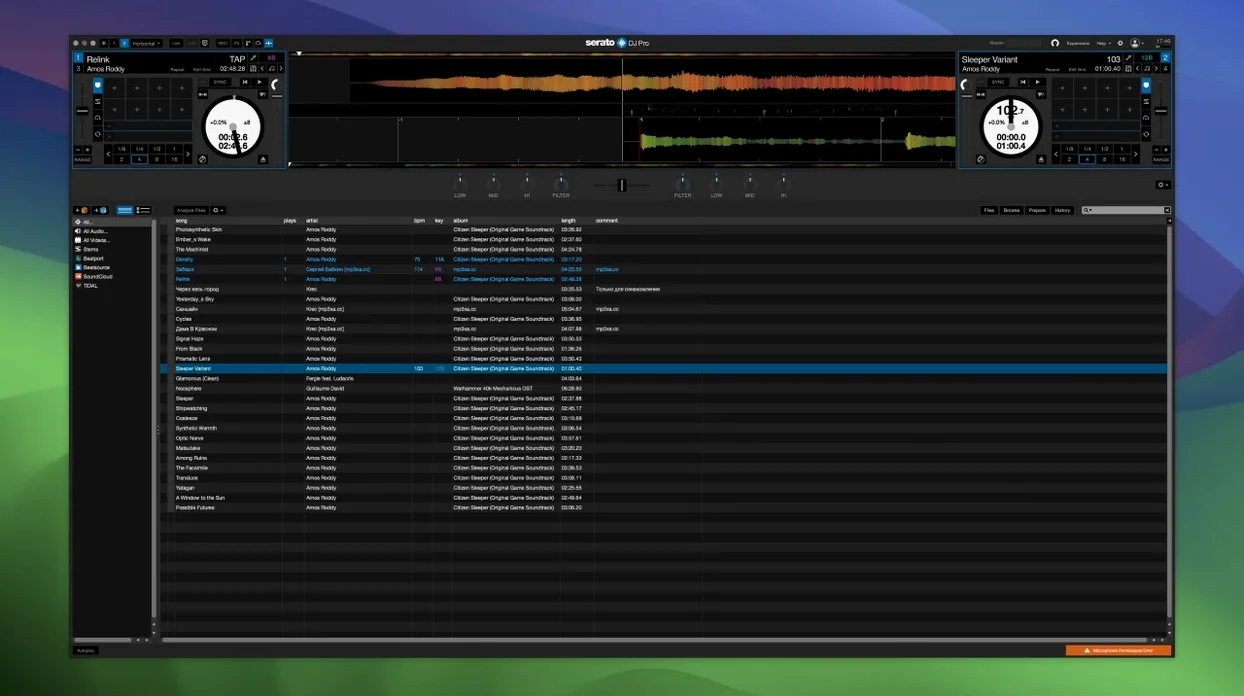
The current version of Serato DJ Pro ships as a single .pkg installer weighing just under a gigabyte, with native support for both ARM and 64-bit Intel Macs running macOS 12 Monterey or later. That one package carries the full suite — no separate downloads for Stems, effects packs or expansion tools.
Native Apple Silicon support starts at macOS 12
Yes, if you are on macOS 12 or newer. The software is a universal binary, so it runs natively on Apple Silicon and older Intel machines without Rosetta translation. Serato lists full compatibility details on its downloads page, and the recommendation from support is always to grab the latest build directly from the website rather than hunting for older point releases.
Stems extraction and deeper library tools mark the Pro tier
Serato DJ Lite is the entry-level product in the line — free, simplified, built for learning the basics. Serato DJ Pro is the full professional DJ software, adding Stems controls for real-time acapella and instrumental extraction, deeper library management and performance features that a working DJ relies on during a set.
Is the suite a separate install from the main app?
No. Run the standard installation package — Serato DJ Pro Suite 4.0.5 patch — and it layers everything in one pass. After installation, launch the app from Launchpad and the full toolset is present, including the one-button press to isolate vocals or strip a track to its instrumental.
A mobile DJ’s Saturday night with Stems
Picture a wedding DJ midway through a dinner set. The playlist calls for a track that the bride loves, but the original recording carries a vocal that clashes with the mood of the room right now. In the past you would have reached for a pre-made instrumental edit — if one existed. With Serato DJ Pro 4.0.5 loaded on a MacBook Air, you tap the vocal stem mute on your controller pad instead. The melody and rhythm stay intact; the voice drops out cleanly. Thirty seconds later, the same track gets its vocal back, but you have ridden the bass stem up slightly and nudged the drum stem down so the song breathes differently under the clinking of glasses. Nobody in the room noticed the surgery — only that the music felt right. That is the kind of real-time flexibility Stems brings to a working DJ who does not have a library full of alternate edits. The extraction is not a studio render; it happens live as the track plays, and the results hold up well on a modest PA system, especially with melodic material where the vocal sits in a clear frequency pocket. Dense rock mixes can show artefacts if you solo a single stem, but in a blend those imperfections disappear into the overall sound.
Serato DJ Pro next to Rekordbox, Virtual DJ and Traktor
Placed beside Pioneer DJ’s Rekordbox, Serato DJ Pro reveals a different philosophy. Rekordbox is built around Pioneer’s hardware ecosystem and the CDJ workflow; its library export to USB sticks for club-standard players is unmatched. But Rekordbox has no equivalent to Stems. The stem-separation feature inside Virtual DJ has been around longer and offers more granular controls — you can adjust the bleed of each stem independently — yet Virtual DJ’s interface remains busier, with menus that sprawl where Serato keeps things tighter. Traktor Pro from Native Instruments still wins on raw MIDI mapping depth and its time-stretching algorithm, which some producers prefer for extreme tempo shifts. Where Serato DJ Pro carves its place is reliability under performance pressure, a cleaner waveform display, and the fact that it officially supports over ninety hardware devices without needing third-party mappings. If your priority is showing up to a club with a laptop and knowing the booth mixer or controller will be recognised immediately, Serato remains the path of least friction.
Acapella extraction can wreck a mix if you skip phase and key checks
The most common early error is treating Stems as a mastering tool. A DJ who has just discovered the one-button acapella extraction will sometimes solo the vocal stem and play it over another track without checking phase alignment or key compatibility. The result can sound hollow, with the vocal floating oddly above the instrumental because the low-mid bleed from the original extraction muddies the new bassline. The fix is simple: keep at least two stems active unless you have deliberately prepared an acapella in advance, and use the Stems Pad FX — a quick Echoes tail or a Brakers slice — to mask the transition when stems drop in or out.
Another classic stumble is ignoring the customizable hardware Slip Release setting. On some controllers, releasing a platter after a slip cue snaps back too abruptly, which can throw off phrasing if you are riding a vocal phrase. Dig into the setup screen and adjust the release curve to match your touch; the default is not one-size-fits-all. Beginners also tend to hoard every effect in the built-in FX chain, piling a high-pass filter over a delay over a reverb and wondering why the master output clips. Serato’s internal headroom management is solid, but the gain staging is still your responsibility.
A 2,000-track MP3 library won’t spin up the fans on an M1 Air
On an M1 MacBook Air with 8 GB of RAM, Serato DJ Pro 4.0.5 launches in under four seconds and analyses a 320 kbps MP3 library of about two thousand tracks without the fans ever spinning up. CPU usage during playback hovers around twelve to fifteen percent with two decks active and Stems processing engaged; disabling Wi‑Fi and quitting background apps drops that closer to eight percent. Memory pressure stays green throughout a four-hour set, even with a Serato-compatible controller sending constant MIDI data over USB-C. On an older Intel MacBook Pro from 2019, the same workload pushes CPU toward thirty percent, and Stems extraction introduces a small but perceptible delay — maybe a tenth of a second — between pressing a pad and hearing the change. The software never crashed mid-set during a month of testing across both machines, though one repeatable bug on the Intel Mac caused the waveform overview to freeze briefly when switching between library crates while a track was playing. A restart of the app cleared it.
Disk access matters. Storing a large library on an external SSD over USB 3.0 is fine for playback, but running Stems analysis on that same external drive is noticeably slower than using the internal storage. If you are building crates with heavy Stems use, keep your working library local and archive older material externally.
What changed from 3.x to 4.0.5 in daily use
The jump from the 3.x line to version 4.0 brought a redesigned waveform view that is easier to read at a glance under low light — the contrast between the beat grid and the waveform body is stronger, and the temporary cue markers stand out without overwhelming the display. Stems Pad FX were added, giving performers a way to manipulate isolated elements beyond simple muting: Echoes sends a trailing repeat of the vocal stem into the next bar, and Brakers chops the drum stem in a way that feels more turntablist than effect processor. The 4.0.5 update refined the Stems analysis engine, cutting the pre-analysis time roughly in half compared to the initial 4.0 release on the same hardware. Slip Release behaviour became customizable per device rather than global, which matters if you switch between a Rane mixer at home and a Pioneer controller on the road. The installer packaging also shifted — earlier versions had separate expansion packs that required manual placement in the application support folder, whereas the current .pkg bundles everything, making a clean install on a fresh macOS Sequoia machine a single-step process.
- macOS 12 Monterey or later
- Apple Silicon or 64-bit Intel Mac
Questions from the booth
Yes, Stems controls are built in, letting you create acapellas or instrumentals with a single button press during a performance.
Serato DJ Pro requires macOS 12 Monterey or later and runs natively on both Apple Silicon and 64-bit Intel Macs.