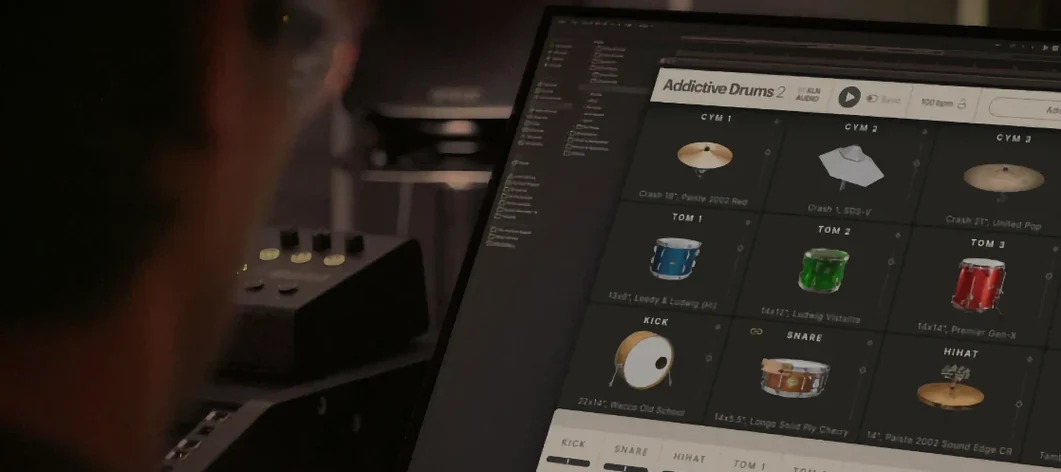
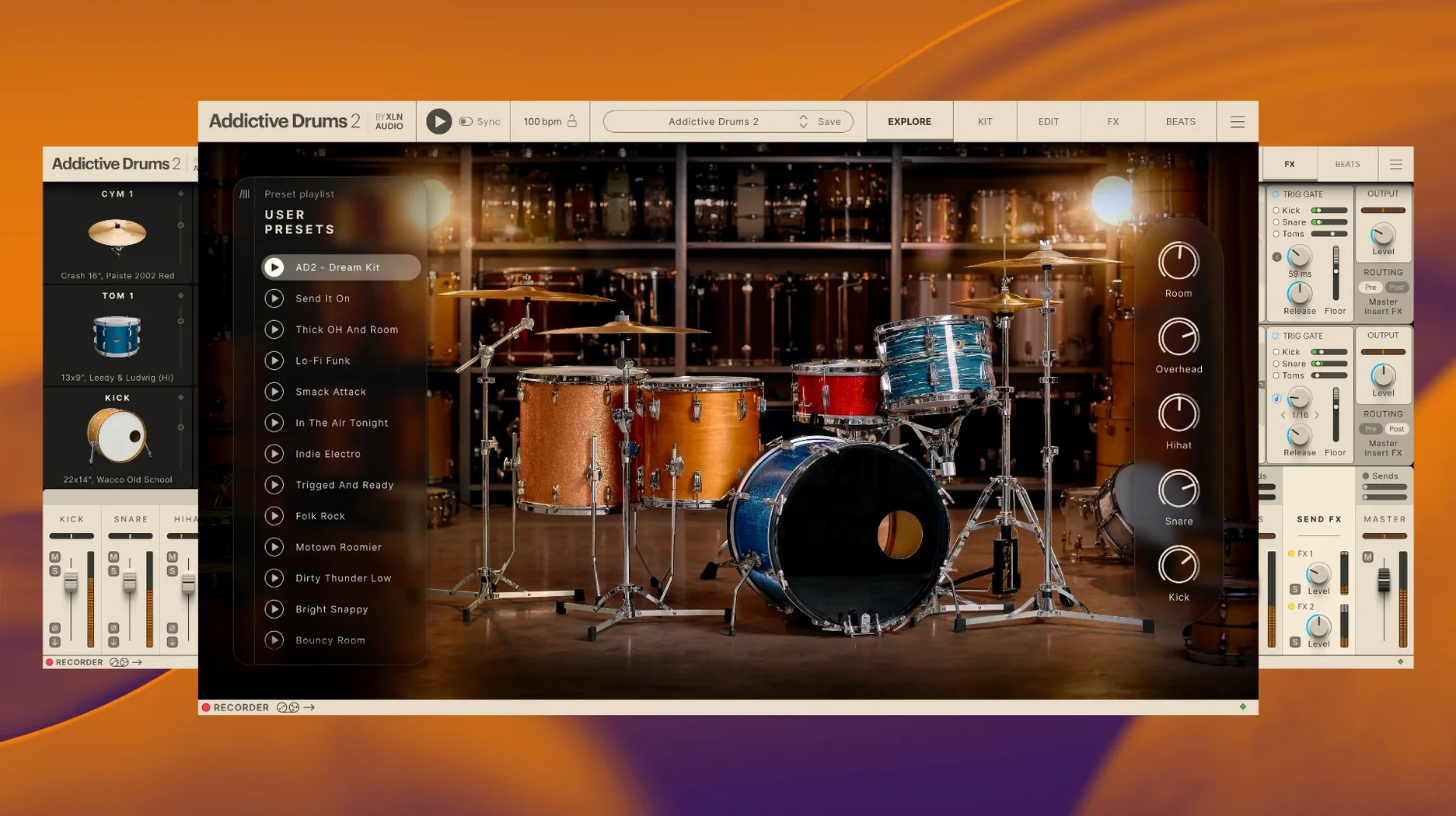
Addictive Drums 2 is a virtual drum instrument that puts a fully produced drum studio inside your DAW. It arrives as the Complete Collection, bundling every official ADpak, MIDIpak and Kitpiece Pak into a single, cohesive engine. The idea is simple: you browse kits that were recorded in world-class rooms by experienced engineers, pick a groove, and start shaping a performance that sits in a mix without hours of tweaking.
What the Complete Collection includes
- Every ADpak — from vintage soul kits to modern metal shells, each sampled in its own acoustic space with a distinct sonic character
- The full MIDIpak library of beats and grooves, playable as-is or dragged into your timeline for editing
- Kitpiece Paks that let you swap individual snare drums, kicks and cymbals across kits, creating hybrid setups that never existed in one room
Who it suits
This is a tool for songwriters who need a drum sound that feels finished the moment they load a preset, and for producers who want to dial in their own processing on every channel. The internal mixer gives you separate kick, snare, hat and room mics with flexible routing, so you can treat the kit like a raw multitrack recording. And because it runs as a 64‑bit instrument on both Intel and Apple Silicon Macs, it fits into a project alongside your other instruments without pushing the session to its limits.
Mistakes that flatten a kit before it ever hits the mix
A surprising number of producers load a kit, play a few bars, and decide the sound is too processed or not processed enough. The first mistake is ignoring the kit piece stack. Every drum in a loaded kit is a slot you can click — kick, snare, hi-hat, each tom — and behind that slot sits a list of alternatives from across the entire ADpak library. Someone will audition the default Black Oyster snare in the Fairfax Vol. 1 kit, find it too ringy, and reach for an EQ when the real fix is swapping in a maple snare from the United Pop ADpak in two clicks. The sample pool across the Complete Collection is enormous, yet many users treat each kit as a locked set of sounds.
Another early misstep is running the internal mixer channels too hot into a DAW. Addictive Drums 2 outputs each mic channel at a level that expects headroom. When every fader sits at zero and the master channel clips, the instinct is to pull down the plugin's master volume. That masks what is actually happening: the room mics and overheads are crowding the close mics. Lowering the room fader by a few decibels and pushing the kick and snare direct channels slightly opens up the stereo field without a single external plugin. The mixer is a console, not a volume knob.
Beginners also sleep on the Envelope tab. The decay time of a kick drum can move a track from tight and punchy to boomy and washed-out, and it is adjustable per kit piece. A common pattern is loading a metal kit for a pop track, finding the kick too clicky, and abandoning the whole ADpak when trimming the sustain by milliseconds would have pulled it into place. The transient shaper built into each channel is subtle but surgical, and bypassing it entirely is like leaving a fader at unity out of habit.
Finally, MIDI grooves are dragged into a DAW timeline unedited. The supplied beats are performances, not static patterns, and they arrive with velocity curves and ghost notes that reflect how a drummer actually plays. Quantizing them to the grid or stripping the velocity data kills the thing that makes them work. Let a groove breathe before you decide it needs fixing.
Settings to change before you write a single note
Open the Mapping tab early. The default MIDI map follows the General MIDI standard, but most electronic kits and pad controllers do not send GM by default. Spending thirty seconds loading a preset for a Roland or Yamaha kit — or saving your own — prevents the classic moment where a snare pad triggers a ride cymbal and derails a session. The mapping editor is visual and colour-coded, with each articulation mapped to a note on a piano roll, so correcting a single assignment takes seconds.
Set the output routing before you start writing parts. By default, all kit pieces sum to a stereo output pair. Switching to multi-output mode in your DAW — and then assigning kick, snare, overheads and room to separate aux tracks inside Addictive Drums 2 — gives you independent control in the mixer later. Doing this after you have already built a full arrangement means recalling presets and rebalancing. Do it once on an empty instance and save it as a template.
The bleed control hidden in each channel strip shapes how much of one drum spills into another drum's microphone. A snare mic picking up too much hi-hat can make a groove sound washy; dialling the bleed back on the snare channel cleans up the transient without closing down the room sound. The default settings are realistic, but realism is not always what a dense mix needs.
Under the Beats tab, change the sync mode from "Host" to "Host (Song)" if you want the browser to follow your DAW's transport position. The default mode plays the selected groove in a loop regardless of where your project is, which is useful for auditioning but confusing when you expect the beat to chase the arrangement.
How it sits alongside other virtual drum instruments on Mac
People often weigh Addictive Drums 2 against Superior Drummer 3, BFD3 and EZdrummer 3. The philosophical split is this: Superior Drummer and BFD3 are raw-mic environments where you build a drum sound from bare recordings, while Addictive Drums 2 and EZdrummer both lean toward a produced, mix-ready presentation. The difference inside that second group is depth. EZdrummer 3 strips away complexity — fewer mics, fewer tweakable parameters, a streamlined interface that gets a groove playing fast. Addictive Drums 2 gives you the same immediacy but leaves the full console, the envelope controls and the kit-piece swapping within arm's reach. It sits in a middle ground: faster to a finished tone than Superior Drummer, more configurable than EZdrummer.
BFD3 offers enormous sample detail — multiple velocity layers, round-robins, bleed routing that models the physics of a room — but the trade-off is a steeper system load and a longer path to a polished drum track. On an Apple Silicon Mac, Addictive Drums 2 loads kits in under two seconds and plays back glitch-free at buffer sizes that would choke BFD3's heavier kits. The engine is lean, and the samples are stored compressed without audible degradation, which keeps library sizes manageable on a laptop.
Where Addictive Drums 2 pulls ahead is the ADpak concept. Each expansion is a self-contained production — a specific room, a specific engineer, a cohesive set of kit pieces recorded together in one session — rather than a collection of individual instruments that you assemble yourself. The Fairfax kits sound like they belong together because they were tracked together, and that coherence is harder to achieve when you mix and match pieces from different BFD or Superior Drummer libraries. It is a curated approach versus a modular one, and it suits people who want a signature sound with room to adjust rather than an open sandbox.
Small conveniences that stay hidden until you stumble across them
The drag-and-drop MIDI from the Beats browser is the headline feature, but holding Option while dragging exports the groove as a standard MIDI file with all its original velocity and timing data intact, ready to drop into a sampler or send to a collaborator. No export dialog, no file naming prompt — just a clean MIDI region on your desktop or timeline.
Right-clicking any kit piece reveals a "Copy settings" option that transfers EQ, envelope, pitch and level adjustments from one drum to another. When you have dialled in a snare compressor setting that works across the whole track, copying it to the snare in a different kit preset saves redoing the same work from memory.
The search field inside the kit browser scans across all installed ADpaks simultaneously. Typing "maple" returns every maple-shell drum in the collection — snares from multiple kits, toms from different eras — presented in a single list. It turns the Complete Collection from a set of isolated libraries into one large, filterable drum closet.
There is also a solo button per channel that works independently of your DAW's solo system. Clicking it isolates a single mic — say, the snare bottom — without disrupting your project's solo state, which makes checking phase relationships or fine-tuning compression on a single close mic much faster than routing workarounds.
For those who have explored versions floating around on forums, phrases like addictive drums mac crack or addictive drums vst crack appear alongside queries about addictive drummer 2 and addictive drums 2 full version free download, and some even dig into addictive drums rutracker links. The Complete Collection available here bundles the full official library in a single package, which means the days of hunting down individual ADpaks across multiple sources are behind you.
Speed, stability and how it breathes in a working session
On an M1 MacBook Air with 16 GB of memory, loading the Fairfax Vol. 2 kit — a full multi-mic setup with bleed paths, envelope states and internal effects — takes roughly two seconds from click to playable. On an older Intel iMac from 2019, the same kit loads in about four and a half seconds. Once loaded, playback at a 128-sample buffer is clean, with CPU meters inside Logic Pro hovering in the single-digit range for a single instance running a moderately dense groove. Running four instances with different kits — a verse kit, a chorus kit, a percussion layer and a separate electronic kit — pushes the meter to around eighteen percent on the M1, leaving enough room for synths and processing chains.
The plugin handles transport jumps well. Scrubbing across a timeline or jumping between markers does not trigger the burst of stuck notes that some sample-based instruments produce, and the streaming engine recovers sync within a beat. Automatic delay compensation reports correctly in Pro Tools and Logic, which matters when you route individual channels out to aux tracks and apply external processing — the phase relationship between the close mics and the room mics stays locked.
Memory usage is modest for a library of this size. The engine streams samples from disk rather than loading every velocity layer into RAM, so a full kit occupies somewhere between 300 and 600 MB of active memory depending on the ADpak. On a machine with 8 GB of RAM, that leaves breathing room for other instruments, and the disk streaming is fast enough that even a mechanical hard drive rarely audibly chokes — though an SSD removes the last hint of latency when cycling through kit pieces quickly.
Stability over long sessions has been uneventful. Instances survive sleep-wake cycles on a MacBook without requiring a reload, and the plugin has not yet caused a Logic Pro crash in daily use across several weeks of tracking and mixing. The HCiSO release here includes all content in a single install, and once extracted it runs without online checks or background processes, which keeps the plugin's footprint strictly to disk and memory.
- macOS 10.13 or later
- 64‑bit host application
- Intel or Apple Silicon processor
Questions from the booth
Yes, it supports both ARM and x86 64‑bit architectures, so it runs natively on M‑series and Intel Macs.