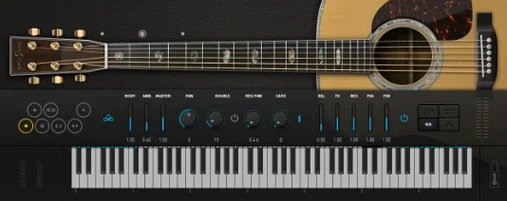
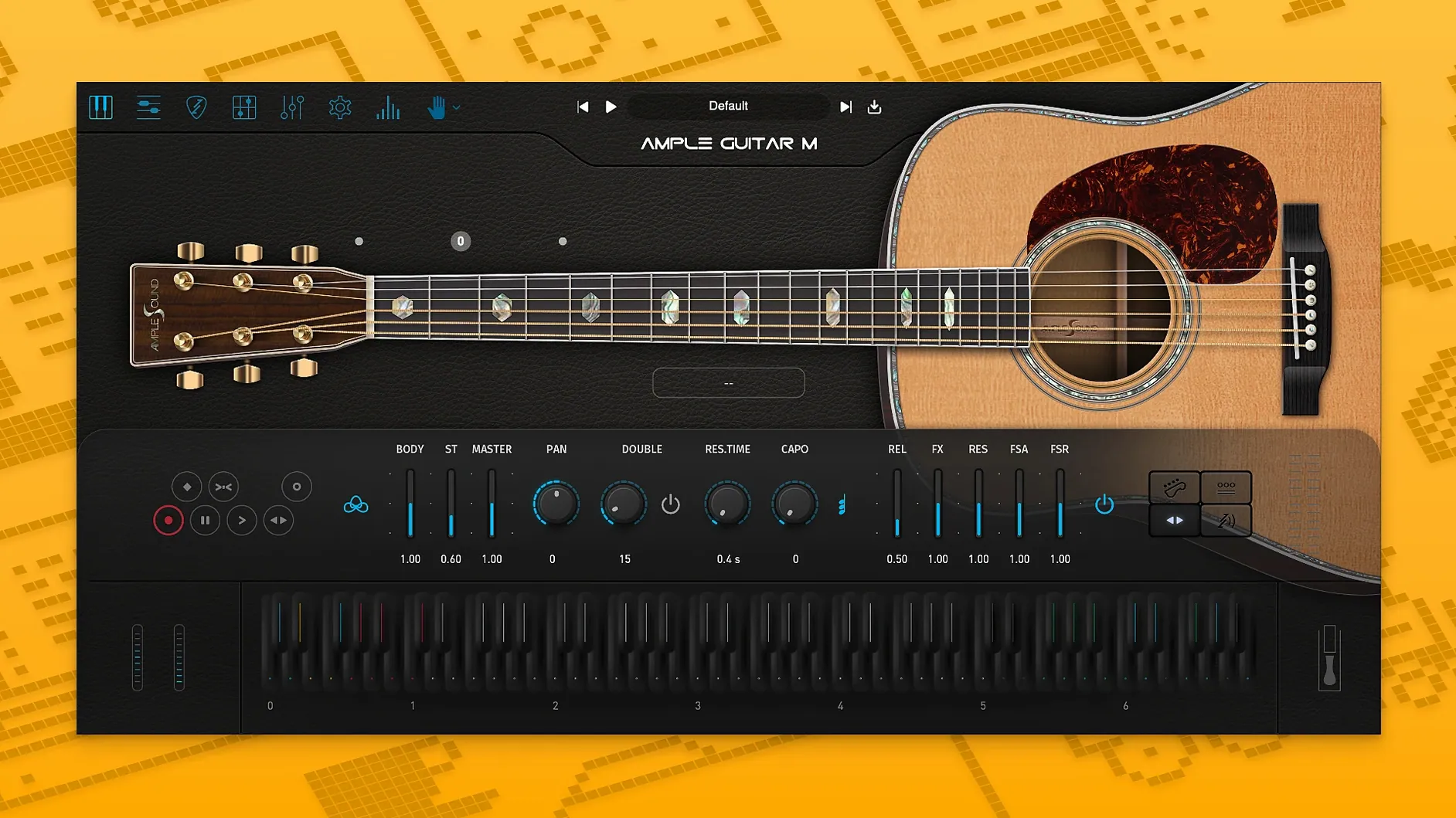
6 strings, 8.5 GB of samples, and a single instrument that stays closer to a wooden dreadnought than most libraries dare. Ample Guitar M models a Martin D-41 steel-string acoustic with the kind of detail that reveals itself when you stop playing chords and start listening to the space between notes.
String resonance and fret noise follow your dynamics in real time
String resonance, fret noise, and release samples all respond to playing dynamics in real time. The strum engine lets you map velocity and keyswitches to rhythm patterns, so a held chord can pulse like a picked figure without sounding like a loop.
How does the tab player change the way I write?
The built-in tablature player reads Guitar Pro files and displays them as a scrolling fretboard, which means you can import a full arrangement and hear it performed through the sampled instrument. It turns a sketch into a performance check without leaving the plugin.
The doubled mics spread naturally behind a vocal without heavy EQ
The doubled-mic setup and stereo width control give you a natural spread that doesn't need much EQ to sit behind a vocal. Rolling off the low-mids and nudging the close-mic fader forward pushes the guitar into a rhythm role without making it brittle.
Auto Vibrato Curve makes sequenced lines breathe on load
The sampler engine loads faster and the Riffer now includes an Auto Vibrato Curve alongside Swing Quantization, so sequenced lines feel less mechanical the moment you apply them.
the moment 4.1 lifted a weight off the session
Before 4.1, loading the full 8.5 GB library on a spinning drive meant a coffee break. After the update, the same instrument materializes on an Apple Silicon Mac in under eight seconds — the sampler engine now streams samples without the long silence that used to make you doubt whether the plugin had frozen. Playback doesn't hitch when you jump from a strummed chord to a fast legato line mid-phrase, and the voice-stealing logic feels invisible where earlier builds would drop a release tail right when you needed it.
Memory pressure stays surprisingly low for a deeply sampled acoustic. On a 16 GB M1 machine, a project with three instances of Ample Guitar M — one fingerpicked, one strummed, one doing harmonics for texture — hovers around 4.2 GB total Logic Pro memory use. CPU spikes are rare; the processing stays in the single digits per instance once the samples are buffered, which leaves room for the reverb, EQ, and tape sim plugins that an acoustic this detailed deserves.
Stability in 4.1 has been uneventful in the best way. No timeline jumps during Riffer playback, no sudden loss of iLok recognition mid-session, and the plugin wakes from sleep reliably even when a MacBook lid has been closed for three days. The one quirk worth knowing: if you route Ample Guitar M through a bus with heavy look-ahead limiting, the strum engine can drift a few milliseconds — nudging the track delay compensation by 4 ms solves it cleanly.
Switch the Velocity Curve to Soft for a held-guitar feel
The defaults are fine for a quick audition, but a couple of tweaks make the instrument feel more like a guitar you're holding rather than one you're triggering. First, open the Settings panel and switch the Velocity Curve to Soft. The default linear curve makes note velocities 80–110 sound almost identical; the Soft curve spreads that range so a gentle finger lands under the bridge and a harder strike pushes the top end forward — essential when you're programming dynamics with a mouse instead of a weighted keyboard.
Second, raise the Fret Noise and Release Sample levels by about 6 dB each. Out of the box, these are conservative enough that they disappear in a dense arrangement, but for solo work or an exposed intro, the squeak of a finger sliding and the faint thump of a lifted string sell the performance more honestly than any reverb tail. Those sounds are part of what makes an ample guitar torrent worth pulling down in the first place; burying them loses half the character.
For strum work, the Riffer's new Swing Quantization deserves a session of its own. A value around 18–22% on sixteenth-note strums introduces the slight push-pull of a wrist moving across steel strings, and combined with the Auto Vibrato Curve — which ramps vibrato depth with note age rather than applying it instantly — a programmed rhythm part stops sounding like a grid and starts breathing.
The 4.1.0 update brought a faster sampler engine with snappier loading and smoother playback, plus two new Riffer features: an Auto Vibrato Curve and Swing Quantization that give sequenced lines a more human feel without extra editing.
- macOS 10.13 or later
- Apple Silicon and Intel 64-bit support
- Separate sample library download required
Questions from the booth
Yes, the built-in tab player can open Guitar Pro files directly and display the notation on a scrolling fretboard while using the sampled instrument for playback.
Version 4.1.0 supports both Apple Silicon and Intel 64-bit architectures, so it runs without Rosetta on M-series machines.
It is a sample-based virtual instrument modelled on a Martin D-41 acoustic guitar with steel strings.