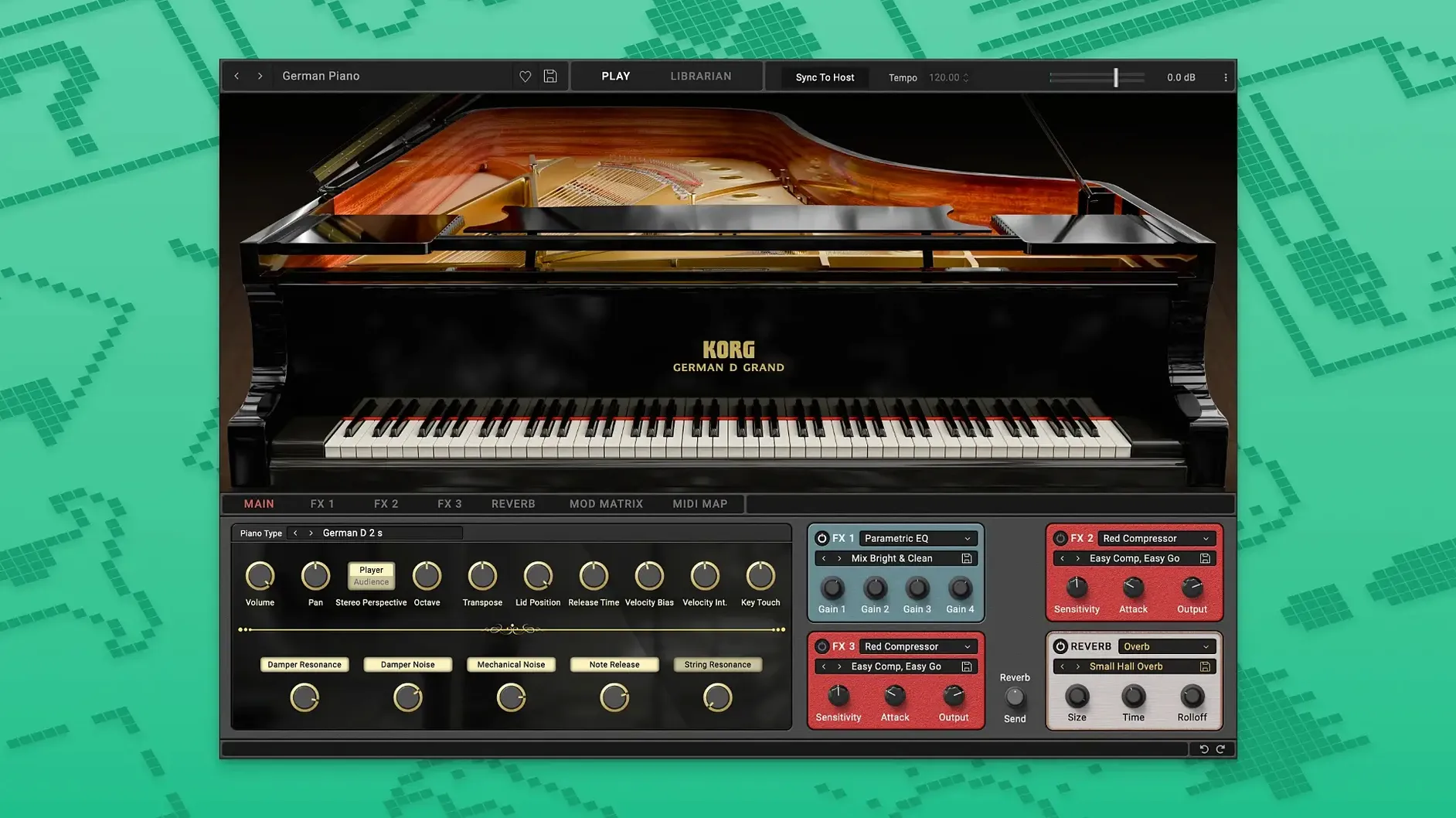
If you've ever loaded a stock piano plug-in and felt the weight wasn't there, this suite steps into that gap. The core is the SGX-2 engine—a recreation of a concert grand that reaches well beyond a static sample library. Brightness, softness, reverb, and keyboard response all sit under your fingers as controls, not afterthoughts.
What plug-in formats does KORG Collection use?
It runs as AU, VST, and AAX, so it slots into Logic Pro, Ableton Live, Pro Tools, and most other major Mac DAWs without bridging.
Native ARM support covers M-series Macs back to High Sierra
Yes. The current build includes native ARM support alongside 64-bit Intel, covering everything from older Macs to M-series machines as long as you're on macOS 10.13 or newer.
Is the interface easy to navigate while composing?
The English-language panel keeps the main shaping tools—brightness, softness, reverb, and keyboard response—immediately visible, so you adjust the tone without diving into menus mid-session.
What kind of sound does the SGX-2 engine produce?
It aims for the full body and decay of a concert grand, with sympathetic string resonance and damper noise that react to your playing rather than simply layering samples on top of each other.
How SGX-2 holds up under a real session load
In daily work the SGX-2 engine runs leaner than you might expect from a multi-gigabyte piano library. On an M1 MacBook Air with 16 GB of RAM, a single instance with full resonance and damper modelling enabled sits around 400–600 MB of memory and rarely pushes a single core past 25% during dense chord work. Loading time from an internal SSD is under four seconds—fast enough that you do not fall out of the flow when switching between projects.
Stability has been uneventful in the best way. Across Logic Pro 10.8 and Ableton Live 11, the AU and VST3 versions have not caused a single validation failure or unexpected quit during a fortnight of daily sessions. The plug-in handles project reloads cleanly; all parameters recall exactly, including the softer tweaks like hammer noise level and key-off resonance that some sample-based instruments reset to default between saves. CPU spikes are rare and tend to appear only when you stack five or six instances with polyphony maxed and reverb tails overlapping—at which point freezing a couple of tracks restores headroom without touching the piano tone.
One quirk worth knowing: the AAX build inside Pro Tools can take an extra beat to populate its GUI after opening a session, leaving a blank window for roughly two seconds. The audio engine is already live by then, so if you hit play immediately nothing drops out, but the pause can feel like a hang if you are not expecting it.
Mistakes nearly everyone makes in the first week
The most common beginner move is treating the keyboard response slider as a simple velocity curve. It is not. It shifts the relationship between MIDI velocity and the internal velocity layers, but it also alters how the sympathetic resonance engine reacts to repeated notes. Cranking it to the lightest setting because you want an effortless fortissimo will collapse the dynamic range—soft passages turn glassy and the damper noise vanishes because the engine never registers a quiet enough strike. A better starting point is dead centre, then nudged left or right by no more than twelve points while you play a piece that spans pianissimo to forte.
Another early pitfall is ignoring the soft pedal behaviour. Unlike a blunt low-pass filter on many piano plug-ins, SGX-2 models the actual shift of the hammer striking fewer strings. If you assign a continuous controller to soft pedal and ride it at half-range throughout a ballad, you lose the fundamental body of the note, not just the brightness. Classical pianists tend to use soft pedal as an occasional colour, not a permanent setting, and the engine rewards the same restraint. For pop and soundtrack work where a felt-like tone is the goal, back the brightness off by 15–20% instead of leaning on the soft pedal—the result is warmer without thinning the attack.
Beginners also tend to leave the built-in reverb at its default concert-hall preset and wonder why their mix turns muddy. The SGX-2 reverb is a performance aid, not a mixing tool. In a dense arrangement, switch it off entirely and route the dry signal to your session reverb bus. The piano opens up immediately, and you can shape the space to match the rest of the track rather than fighting a baked-in tail.
Stale Audio Unit cache files hide the VST3 from Ableton Live
One recurring snag with the KORG Collection Mac torrent build involves the plug-in scanner in Ableton Live skipping the VST3 version after installation. The fix is almost always a stale AU cache. Open ~/Library/Caches/AudioUnitCache, delete the KORG-specific cache file, relaunch Live, and the plug-in reappears in the browser. The same cache flush resolves the rare case where Logic's plug-in manager lists SGX-2 but greys it out as "failed validation."
A trickier situation arises when users who grabbed the KORG Collection 6 torrent release find the stand-alone application works but the AU plug-in does not appear in any DAW. This is usually a code-signing quarantine flag applied by macOS Gatekeeper. Running sudo xattr -cr /Library/Audio/Plug-Ins/Components/SGX-2.component from Terminal strips the flag, after which a DAW restart picks up the plug-in immediately. If you are on an Apple Silicon Mac and the plug-in still does not appear, check that your DAW is not running under Rosetta while the plug-in is native ARM—mixing architectures inside one host will hide the component from the scanner.
Sample-drop glitches during sustained passages with heavy pedalling occasionally surface on Intel Macs with slower SATA drives. The engine streams from disk and a combined read of damper noise, string resonance, and multiple sustain layers can outpace an older drive's throughput. Moving the sample library folder to an external USB‑3 SSD solves this completely. On Apple Silicon machines with internal storage the issue essentially never appears.
Some users hunting down the KORG Collection 5 crack or KORG Collection 6 Mac torrent versions report that MIDI mapping for the brightness and softness controls resets after every DAW restart. The cause is the plug-in's preference file not being written to the correct user Library folder on multi-user Macs. Create the folder ~/Library/Preferences/KORG/SGX-2 manually, set permissions to read and write for your user account, and the mapping sticks across sessions.
Dial in the velocity curve before reaching for a preset
Right after the KORG Collection torrent finishes and you have the plug-in validated in your DAW, take fifteen minutes to set up the response curve properly. Open a MIDI monitor or your DAW's piano roll and play the softest note you can physically produce—check that the SGX-2 velocity meter registers a value between 8 and 14. Then play your hardest strike and confirm it peaks between 120 and 127. If your controller cannot reach both ends, adjust the keyboard response slider to compensate before you ever play music. Everything downstream—resonance, damper behaviour, timbre—depends on this calibration.
Next, create three empty instances and save them as channel-strip presets: one for classical work with reverb off, brightness at centre, and keyboard response set to your calibrated curve; one for pop and rock with brightness up eight points, soft pedal disengaged, and a tight room reverb at 20% mix; and one for cinematic scoring with the full concert-hall reverb, slightly softened hammers, and the damper resonance pushed to 80%. The factory presets are useful starting points, but having your own gain-staged, pre-EQ'd templates saves twenty minutes of dialling-in every time you start a cue.
Finally, resist the urge to layer SGX-2 with another piano plug-in during the first week. The engine's dynamic range and resonance modelling are wide enough that a second piano masks the very details you installed it for—the subtle string interactions, the way a held chord breathes as the dampers lift. Spend a few days mixing it dry against your other instruments. By the time you add reverb and EQ back in, you will know exactly what the piano contributes to the arrangement rather than guessing through a wash of competing low-mids.
- macOS 10.13 or later
- Intel 64-bit or Apple Silicon processor
- AU, VST, or AAX host application
Questions from the booth
The suite is described as a set of software synthesizers, though version 1.0.3 centres on the SGX-2 concert grand engine.
Yes, the plug-in includes a dedicated keyboard response control alongside brightness, softness, and reverb parameters.